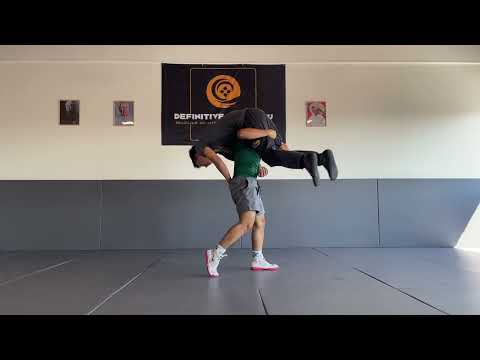
Standard Double Leg Wrestle-Up

Genus

スタンダードダブルレッグレスルアップ(Sutandādo Daburu Reggu Resuru Appu)

Transliteration

Translation: standard double leg wrestle-up

Overview

The Standard Double Leg Wrestle-Up drives from the bottom position into a double-leg entry, wrapping both arms around the opponent's legs while driving upward with the legs to return to standing. [1] The defender creates space through framing, then explosively changes level and shoots into the opponent's legs, clasping the hands behind the thighs and driving forward and upward. [1],[2] The technique finishes with the defender on their feet, either completing the double-leg takedown or releasing to disengage and fight standing. [2],[3]

Also known as
Basic Double Leg Wrestle-UpWrestling[1]Standard Double From Bottom[2]

History & Origin

The standard double leg wrestle-up is a wrestling technique adapted for BJJ and MMA ground fighting, combining the stand-up with an offensive takedown attack. [1] It is widely taught in MMA as an aggressive escape option. [2],[3]

Effectiveness

The double leg wrestle-up allows the bottom player to transition from seated or guard position directly into a double leg takedown, combining escape with offense. [1] It requires good timing and hip explosiveness but is highly effective when the top player's base is compromised. [1],[2]

Lineage

A standard wrestling-based standup technique. [1]

Competition Record

Used in MMA competition. [1]

Images

No images yet for this technique.

Sign in to suggest an image.

Biomechanical Mechanism

Primary ActionCreating space and movement to transition from an inferior to a neutral or superior position
Joints InvolvedHips (primary escape engine through bridging and shrimping), elbows (frames), knees (guard recovery)
Force VectorBridging (upward), shrimping (lateral), or inversion (rotational) — creating space is the fundamental escape principle
Escape MechanicTiming the escape with the opponent's weight shift or attack attempt maximises success rate

Position & Entry

From bottom positionFrame against the opponent, create distance, post the hand and foot, stand up while maintaining defensive posture
From turtlePost the hands and feet, drive upward while fighting off the opponent's controls

Variants

Standard escapeprimary escape mechanic using frames, bridges, or hip movement
Combination escapechaining two escape directions or methods
Counter escapeusing the opponent's attack attempt to create the escape window
Competition variationmodified for rule-set optimisation

Videos

Double Leg Offense

0
Standard Double Leg Wrestle-Up·Wrestle Up Foundation·Added by Admin
1 video

Learn This Technique

No instructional courses yet for this technique.

Sign in to suggest a course.

Ratings

Danger Rating

Risk of injury to the person this technique is applied to

3
Moderate3/10

Standing escapes from clinch/holds; involves explosive disengagement

Difficulty

Skill level needed to execute this technique reliably

Intermediate
Competition Legality

Whether this technique is allowed under major competition rule sets

Unified MMA — Legal defensive/transitional technique
Unified Rules of MMA, August 2025PDF
FIAS Sport Sambo — Legal
FIAS International Sambo Competition RulesPDF
NCAA Folkstyle — Legal, escape scores 1 point, reversal s...
NCAA Wrestling Rules 2025-26PDF

Training Notes

Standard double-leg wrestle-up: from butterfly guard, elevate with hooks, drive forward to double-leg grip behind both knees, and complete the takedown (Cael Sanderson, Wrestling Technique, 2010)
Step 1: from butterfly guard, establish grips (collar tie + wrist, or double underhooks)
Step 2: use butterfly hooks to elevate the opponent — this off-balances them backward
Step 3: as they're elevated, drive forward from your knees toward their hips
Step 4: wrap both arms around the opponent's legs behind the knees — head on the inside
Step 5: continue driving through to complete the double-leg takedown
Step 6: establish top position immediately after the takedown
The butterfly elevation is the setup — it creates the space and angle for the double-leg entry
The drive must come from the legs: push off the mat and drive through the opponent's centre of gravity
Drill: partner kneels in front of you in butterfly guard, elevate → double-leg → finish, 10 reps per side

Common Mistakes

!Not using the butterfly elevation first — shooting a double from guard without elevation is easily sprawled
!Driving forward without securing both legs — both legs must be controlled for the double
!Head on the outside — inside head position prevents front headlock counters
!Not driving through with the legs after the grip — the double leg requires sustained forward pressure
!Releasing one leg during the finish — maintain both-leg control until the takedown is complete
!Rising too high before shooting — stay low throughout the transition for maximum driving force
!Not immediately establishing top position after the takedown — guard is given away if you don't pass

Related Techniques

Counter Techniques

Setup Chain

1Create Spaceuse frames, hip movement, or leverage to generate room to move
2Disrupt Controlbreak or weaken the opponent's grips and weight placement
3Execute Escapeapply the specific escape mechanic with timing and commitment
4Recover Positionestablish a safe position (guard, standing, or top)

Sources & References

Primary Source

Mastering Jujitsu (Renzo Gracie & John Danaher, 2003)

1BookJiu-Jitsu University (Ribeiro, 2008)

Alias sources — [1] Wrestling Physical Conditioning Encyclopedia (John Jesse, 1974) [2] Mastering Jujitsu (Renzo Gracie & John Danaher, 2003)

2BookMastering Jujitsu (Gracie & Danaher, 2003)

Effectiveness sources — [1] Wrestling for Fighting (Randy Couture, 2007) [2] Mastering Jujitsu (Renzo Gracie & John Danaher, 2003)

3OtherJapanese Combat Sports Katakana Convention

Standard katakana transliteration of Western martial arts terminology (外来語) — used in Japanese MMA, boxing, and BJJ communities

4CitationJiu-Jitsu University (Ribeiro, 2008)

Alias sources — [1] Wrestling Physical Conditioning Encyclopedia (John Jesse, 1974) [2] Mastering Jujitsu (Renzo Gracie & John Danaher, 2003)

5CitationMastering Jujitsu (Gracie & Danaher, 2003)

Effectiveness sources — [1] Wrestling for Fighting (Randy Couture, 2007) [2] Mastering Jujitsu (Renzo Gracie & John Danaher, 2003)

Community

Athletics

Requires

hip mobility, explosive bridge/shrimp power, timing

Favours

flexible hips and strong glutes for escape movements

Key muscles

glutes, hip flexors, core, triceps (framing)

Frequently Asked Questions

What's the correct head and body position when I shoot a double leg?

Your head must be up, arms deep, and your back straight in an athletic position—never shoot with your head down and back bent, as you won't be able to finish. Wrestle Up Foundation emphasizes that this proper positioning is essential before attempting any finish.

How do I set up a double leg shot from an underhook?

You need a deep underhook with firm control of your opponent's body, not just a shallow hand placement. Wrestle Up Foundation stresses that you must be able to pull or rotate them with this control, then throw the underhook up to create the shooting opportunity.

Why is turning the corner important when finishing a double leg?

You must turn the corner and rotate your entire body to look over your opponent's back rather than finishing straight on; your whole body turns together with your arms, not just your head. This positioning from Wrestle Up Foundation is critical for a proper finish.

What grip should I use on the legs when finishing?

Whether you use a clamped grip or split grip is a matter of preference, but the grip must be tight with pinching pressure. Wrestle Up Foundation notes that you then bring the leg through like an axe while stepping back.

How does the Standard Double Leg Wrestle-Up work?

The Standard Double Leg Wrestle-Up drives from the bottom position into a double-leg entry, wrapping both arms around the opponent's legs while driving upward with the legs to return to standing. The defender creates space through framing, then explosively changes level and shoots into the opponent's legs, clasping the hands behind the thighs and driving forward and upward.

Where does the Standard Double Leg Wrestle-Up come from?

The standard double leg wrestle-up is a wrestling technique adapted for BJJ and MMA ground fighting, combining the stand-up with an offensive takedown attack. It is widely taught in MMA as an aggressive escape option.

Is the Standard Double Leg Wrestle-Up legal in competition?

Unified MMA: legal — Legal defensive/transitional technique; IBJJF: legal — Legal; IJF: legal — Legal; ADCC: legal — Legal; UWW: legal — Legal, escape scores 1 point (freestyle), reversal scores 1 point; FIAS Sport Sambo: legal — Legal; NCAA Folkstyle: legal — Legal, escape scores 1 point, reversal scores 2 points

How dangerous is the Standard Double Leg Wrestle-Up?

Danger rating 3/10. Moderate — standing escapes from clinch/holds; involves explosive disengagement

How do I set up the Standard Double Leg Wrestle-Up?

The standard setup chain: Create Space → Disrupt Control → Execute Escape → Recover Position.

How do I defend against the Standard Double Leg Wrestle-Up?

Standard counters include: Maintain Pressure — keep consistent weight distribution to limit escape space / Anticipate Direction — read escape attempt direction and block early / Transition — flow to a new position when the current one is threatened.

What are the variants of the Standard Double Leg Wrestle-Up?

Common variants: Standard escape (primary escape mechanic using frames, bridges, or hip mov…); Combination escape (chaining two escape directions or methods); Counter escape (using the opponent's attack attempt to create the escape …); Competition variation (modified for rule-set optimisation).

How effective is the Standard Double Leg Wrestle-Up in competition?

Used in MMA competition.

What are common mistakes when doing the Standard Double Leg Wrestle-Up?

Top errors to watch for: Not using the butterfly elevation first — shooting a double from guard without elevation is easily sprawled / Driving forward without securing both legs — both legs must be controlled for the double / Head on the outside — inside head position prevents front headlock counters / Not driving through with the legs after the grip — the double leg requires sustained forward pressure.

What are other names for the Standard Double Leg Wrestle-Up?

The Standard Double Leg Wrestle-Up is also known as Sutandādo Daburu Reggu Resuru Appu, Basic Double Leg Wrestle-Up, Standard Double From Bottom.