Standard Technical Standup Position

Genus

スタンダードテクニカルスタンドアップポジション(Sutandādo Tekunikaru Sutando Appu Pojishon)

Transliteration

Translation: standard technical standup position

Overview

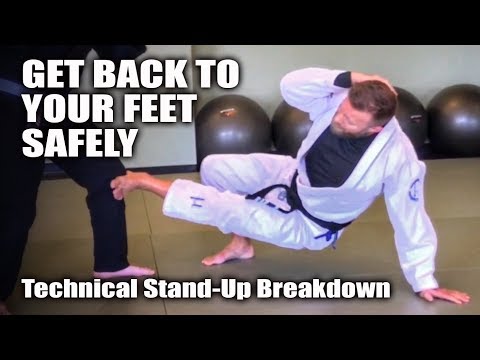
The Standard Technical Standup Position executes the fundamental standup by posting one hand behind the body, keeping the same-side foot flat on the ground, and extending the opposite leg forward as a kick barrier. [1] The fighter pushes off the posted hand and standing foot, lifting the hips while the extended leg prevents the opponent from rushing in. [1],[2] The standing motion is smooth and continuous — post, push, rise, bring the extended leg back into stance — returning to a fighting stance ready for further engagement. [2],[3]

Also known as
Basic Technical Standup[1]Fundamental Tech Get-Up[2]

History & Origin

The standard technical standup position is the most fundamental ground-to-standing transition in BJJ and MMA, taught as the first standing technique in self-defence curricula. [1] Its importance in MMA has made it one of the most commonly drilled transitions in training. [2],[3]

Effectiveness

The technical standup is one of the most important techniques in MMA and self-defense, allowing a grounded fighter to return to standing while maintaining defensive posture. [1] It uses the posting hand and opposite foot to create a stable base while rising, keeping the free hand up to defend against strikes. [1],[2] Ribeiro identifies the technical standup as an essential technique for all BJJ practitioners. [3]

Lineage

The technical standup is a foundational technique in the Gracie Jiu-Jitsu self-defense curriculum, developed by the Gracie family for situations where returning to standing is the safest option. [4] It has become a universal technique in MMA training and is taught in virtually all martial arts programs. [1]

Competition Record

The technical standup is a standard escape method in MMA and BJJ competition. [1]

Images

No images yet for this technique.

Sign in to suggest an image.

Biomechanical Mechanism

Primary ActionCreating space between the bottom player's body and the top player to recover guard or achieve underhook
Joints InvolvedHips (shrimping/hip escape), elbows and forearms (framing against crossface and hip), knees (re-inserting guard)
Force VectorLateral hip escape (shrimp) — moving the hips away from the opponent creates the space needed to insert knee or recover guard
Escape MechanicFrames create momentary space, hip escape maintains it, and knee insertion re-establishes guard

Position & Entry

From bottom side controlCreate frames with the forearms against the opponent's neck and hip, hip escape (shrimp) to create space, insert the knee to recover guard
From underhook escapeSwim the near arm to an underhook, bridge into the opponent and come to knees or reverse
From opponent's transitionWhen the opponent moves to mount or north-south, use the movement to create space and escape

Variants

Shrimp to guardframing and hip-escaping to recover full guard or half guard
Underhook escapewinning the underhook and coming to knees or reversing
Bridge to kneesbridging into the opponent and transitioning to turtle or single-leg
Ghost escapeinverting under the opponent to re-guard from the opposite side

Videos

The Technical Stand-Up Proper Application | Jiu-Jitsu Self-Defense Basics

0
Standard Technical Standup Position·Knight Jiu-Jitsu·Added by Admin

The technical stand-up, or standing up in base, is one of the cornerstone movements of Jiu-Jitsu. The mechanics of it co

1 video

Learn This Technique

No instructional courses yet for this technique.

Sign in to suggest a course.

Ratings

Danger Rating

Risk of injury to the person this technique is applied to

3
Moderate3/10

Standing escapes from clinch/holds; involves explosive disengagement

Difficulty

Skill level needed to execute this technique reliably

Intermediate
Competition Legality

Whether this technique is allowed under major competition rule sets

Unified MMA — Legal defensive/transitional technique
Unified Rules of MMA, August 2025PDF
FIAS Sport Sambo — Legal
FIAS International Sambo Competition RulesPDF
NCAA Folkstyle — Legal, escape scores 1 point, reversal s...
NCAA Wrestling Rules 2025-26PDF

Training Notes

The standard technical standup position is the starting posture from which the technical standup is executed — a seated position with one hand posted behind, one hand forward guarding, and feet ready (Couture, Wrestling for Fighting, 2007)
The posting hand is placed behind the hip on the mat — fingers pointing away from the opponent
The guarding hand is extended toward the opponent — it frames, blocks, or threatens kicks
The near foot is flat on the mat with the knee up — ready to push off for the rise
The far leg is extended toward the opponent — it creates distance and can threaten with kicks
This starting position should be your default whenever you find yourself seated on the mat facing an opponent
The position provides stability (posted hand), defence (guarding hand), and offensive potential (kicking leg)
Transition to this position from any grounded position: roll from your back, scoot from your side, or adjust from hands-and-knees
Common Mistakes

!Posting the hand too far behind — the post should be close to the hip for maximum base
!Sitting with both hands on the mat — one hand must be free for defence
!Keeping both legs bent — extend one leg for distance and kick threat
!Sitting flat on the tailbone instead of on one hip — sit on the hip for better mobility
!Not facing the opponent — the entire position is oriented toward the threat
!Sitting too upright without the post — the hand post provides structural stability
!Not being ready to transition immediately from this position to standing — the position is transitional, not resting

Related Techniques

Counter Techniques

Setup Chain

1Create Spaceuse frames, hip movement, or leverage to generate room to move
2Disrupt Controlbreak or weaken the opponent's grips and weight placement
3Execute Escapeapply the specific escape mechanic with timing and commitment
4Recover Positionestablish a safe position (guard, standing, or top)

Sources & References

Primary Source

Jiu-Jitsu University (Saulo Ribeiro, 2008)

1BookJiu-Jitsu University (Ribeiro, 2008)

Alias sources — [1] Gracie Jiu-Jitsu (Gracie & Gracie, 2001) [2] Jiu-Jitsu University (Saulo Ribeiro, 2008)

2BookMastering Jujitsu (Gracie & Danaher, 2003)

Effectiveness sources — [1] Wrestling for Fighting (Randy Couture, 2007) [2] Mastering Jujitsu (Renzo Gracie & John Danaher, 2003) [3] Jiu-Jitsu University (Saulo Ribeiro, 2008)

3OtherJapanese Combat Sports Katakana Convention

Standard katakana transliteration of Western martial arts terminology (外来語) — used in Japanese MMA, boxing, and BJJ communities

4CitationJiu-Jitsu University (Ribeiro, 2008)

Alias sources — [1] Gracie Jiu-Jitsu (Gracie & Gracie, 2001) [2] Jiu-Jitsu University (Saulo Ribeiro, 2008)

5CitationMastering Jujitsu (Gracie & Danaher, 2003)

Effectiveness sources — [1] Wrestling for Fighting (Randy Couture, 2007) [2] Mastering Jujitsu (Renzo Gracie & John Danaher, 2003) [3] Jiu-Jitsu University (Saulo Ribeiro, 2008)

Community

Athletics

Requires

hip escape (shrimping) speed, framing strength, timing

Favours

flexible hips and quick lateral movement

Key muscles

hip flexors, obliques, triceps (framing), core

Frequently Asked Questions

Why should I show the bottom of my feet during a technical standup?

Showing the bottom of your feet keeps your legs in a strong defensive position. If your opponent sees the top of your feet instead, it means your legs are in a weak position where they can be kicked or controlled.

How do I avoid overextending during a technical standup?

Keep your legs close rather than dropping them too far away, which could give your opponent a clear opportunity to wrap your legs and take the top position. Use both feet together to maintain control of the distance.

How does the Standard Technical Standup Position work?

The Standard Technical Standup Position executes the fundamental standup by posting one hand behind the body, keeping the same-side foot flat on the ground, and extending the opposite leg forward as a kick barrier. The fighter pushes off the posted hand and standing foot, lifting the hips while the extended leg prevents the opponent from rushing in.

Where does the Standard Technical Standup Position come from?

The standard technical standup position is the most fundamental ground-to-standing transition in BJJ and MMA, taught as the first standing technique in self-defence curricula. Its importance in MMA has made it one of the most commonly drilled transitions in training.

Is the Standard Technical Standup Position legal in competition?

Unified MMA: legal — Legal defensive/transitional technique; IBJJF: legal — Legal; IJF: legal — Legal; ADCC: legal — Legal; UWW: legal — Legal, escape scores 1 point (freestyle), reversal scores 1 point; FIAS Sport Sambo: legal — Legal; NCAA Folkstyle: legal — Legal, escape scores 1 point, reversal scores 2 points

How dangerous is the Standard Technical Standup Position?

Danger rating 3/10. Moderate — standing escapes from clinch/holds; involves explosive disengagement

How do I set up the Standard Technical Standup Position?

The standard setup chain: Create Space → Disrupt Control → Execute Escape → Recover Position.

How do I defend against the Standard Technical Standup Position?

Standard counters include: Maintain Pressure — keep consistent weight distribution to limit escape space / Anticipate Direction — read escape attempt direction and block early / Transition — flow to a new position when the current one is threatened.

What are the variants of the Standard Technical Standup Position?

Common variants: Shrimp to guard (framing and hip-escaping to recover full guard or half guard); Underhook escape (winning the underhook and coming to knees or reversing); Bridge to knees (bridging into the opponent and transitioning to turtle or…); Ghost escape (inverting under the opponent to re-guard from the opposit…).

How effective is the Standard Technical Standup Position in competition?

The technical standup is a standard escape method in MMA and BJJ competition.

What are common mistakes when doing the Standard Technical Standup Position?

Top errors to watch for: Posting the hand too far behind — the post should be close to the hip for maximum base / Sitting with both hands on the mat — one hand must be free for defence / Keeping both legs bent — extend one leg for distance and kick threat / Sitting flat on the tailbone instead of on one hip — sit on the hip for better mobility.

What are other names for the Standard Technical Standup Position?

The Standard Technical Standup Position is also known as Sutandādo Tekunikaru Sutando Appu Pojishon, Basic Technical Standup, Fundamental Tech Get-Up.