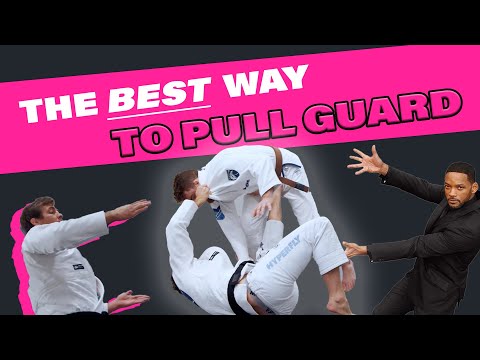
PULL GUARD Quick and Easy! (EVERY White Belt Should Know This)
0
Standard Guard Pull Technique·Keenan Cornelius·Added by Admin
In Judo you'll often see people talking about "Sacrifice Throws" which if done wrong, can lead to a self-inflicted loss.…
Translation: standard guard pull technique
The Standard Guard Pull Technique grips the opponent's collar and sleeve, steps one foot to the opponent's hip, then swings the other leg around the opponent's waist while pulling the upper body in, closing the guard around the opponent's midsection. [1] The technique uses the posted foot on the hip as a platform to climb onto the opponent, while the grips prevent the opponent from disengaging. [1],[2] The guard pull finishes with the practitioner in closed guard with strong grips, ready to immediately begin attacking with sweeps and submissions. [2],[3]
The guard pull is a fundamental technique in BJJ competition that allows a standing practitioner to safely bring the fight to the ground in their guard, bypassing the takedown exchange. [1] It is one of the most commonly used techniques in IBJJF competition, especially by guard players who prefer to fight from bottom. [1],[2]
No images yet for this technique.
Sign in to suggest an image.
In Judo you'll often see people talking about "Sacrifice Throws" which if done wrong, can lead to a self-inflicted loss.…
No instructional courses yet for this technique.
Sign in to suggest a course.
Risk of injury to the person this technique is applied to
Standing escapes from clinch/holds; involves explosive disengagement
Skill level needed to execute this technique reliably
Whether this technique is allowed under major competition rule sets
The Guard (Joe Moreira & Ed Beneville, 2008)
Alias sources — [1] Jiu-Jitsu University (Saulo Ribeiro, 2008) [2] Brazilian Jiu-Jitsu: Theory and Technique (Renzo Gracie & Royler Gracie, 2001)
Effectiveness sources — [1] Jiu-Jitsu University (Saulo Ribeiro, 2008) [2] Brazilian Jiu-Jitsu: Theory and Technique (Renzo Gracie & Royler Gracie, 2001)
Standard katakana transliteration of Western martial arts terminology (外来語) — used in Japanese MMA, boxing, and BJJ communities
Alias sources — [1] Jiu-Jitsu University (Saulo Ribeiro, 2008) [2] Brazilian Jiu-Jitsu: Theory and Technique (Renzo Gracie & Royler Gracie, 2001)
Effectiveness sources — [1] Jiu-Jitsu University (Saulo Ribeiro, 2008) [2] Brazilian Jiu-Jitsu: Theory and Technique (Renzo Gracie & Royler Gracie, 2001)
timing, hip power, off-balancing skill
strong hips and active legs for sweeping leverage
hip flexors, glutes, quadriceps, core rotators
Add momentum to your pull by swinging around your opponent rather than falling straight down. This forces him to think about his balance and base, making him much less likely to grab your leg or take you down. Keenan Cornelius emphasizes that speed and the swinging motion are key to avoiding leg grabs.
You want at least sleeve control, with collar control being a bonus. Keenan Cornelius recommends having both sleeve and collar grips before you step across and execute the pull.
Step all the way across your opponent while pivoting on the ball of your foot, then swing your leg around in one smooth falling motion while pulling your opponent down with you. Point your toes in the direction you're stepping, and make the falling motion as smooth as possible so your opponent's elevation comes at the bottom of the pull.
Focus on the step across—that's what positions your feet correctly. Keenan Cornelius notes that turning your feet the wrong way is a common problem; make sure you end with your feet where they should be rather than over-rotating your body.
The Standard Guard Pull Technique grips the opponent's collar and sleeve, steps one foot to the opponent's hip, then swings the other leg around the opponent's waist while pulling the upper body in, closing the guard around the opponent's midsection. The technique uses the posted foot on the hip as a platform to climb onto the opponent, while the grips prevent the opponent from disengaging.
The standard guard pull technique is a fundamental BJJ competition skill, used since the sport's earliest competitive era. It remains one of the most commonly used methods of initiating the ground phase of competition in sport BJJ.
Unified MMA: legal — Legal defensive technique; IBJJF: legal — Legal — escapes and sweeps are fundamental to BJJ, sweep from bottom scores 2…; IJF: legal — Legal; ADCC: legal — Legal, sweep scores 2 points (4 from mount/back); FIAS Sport Sambo: legal — Legal; FIAS Combat Sambo: legal — Legal
Danger rating 3/10. Moderate — standing escapes from clinch/holds; involves explosive disengagement
The standard setup chain: Create Space → Disrupt Control → Execute Escape → Recover Position.
Standard counters include: Maintain Pressure — keep consistent weight distribution to limit escape space / Anticipate Direction — read escape attempt direction and block early / Transition — flow to a new position when the current one is threatened.
Common variants: Standard sweep (primary off-balancing and reversal technique from the guard); Combination sweep (chaining two sweep directions to catch the opponent's adj…); Counter sweep (sweeping as the opponent initiates a guard pass attempt); Competition sweep (optimised for point-scoring in tournament settings).
The guard pull is ubiquitous in IBJJF competition and is used by the majority of competitors in the lighter weight divisions. Many IBJJF World Champions, including the Mendes Brothers, Cobrinha, and Leandro Lo, regularly pulled guard in competition.
Top errors to watch for: Stepping on the hip with the wrong foot — step with the foot on the same side as the collar grip / Not pulling the opponent forward with the grips during the sit — the grips create the breaking force / Sitting too far from the opponent — the foot on the hip should keep them within guard-closing range / Releasing the collar grip during the pull — the collar grip controls posture and is your primary offensive tool.
The Standard Guard Pull Technique is also known as Sutandādo Gādo Puru Waza, Basic Guard Pull, Fundamental Pulling Guard.