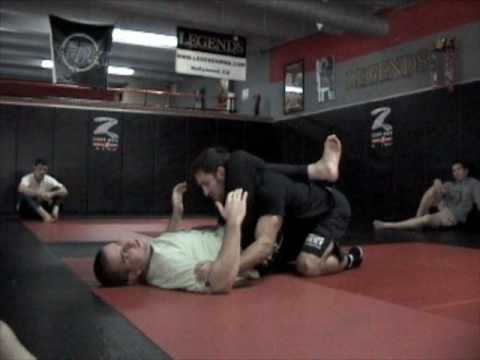
10th Planet Counters: Einstein's Triangle Escape
0
10th Planet Escape·Alder Hampel
Scott "Einstein" Epstein shows us how he gets out of the triangle choke
Translation: 10th Planet escape
The 10th Planet Escape family covers escape techniques for positions unique to Eddie Bravo's 10th Planet Jiu-Jitsu system — addressing the specific challenge of escaping the Truck, Twister Side Control, and other proprietary 10th Planet control positions that don't appear in traditional BJJ. [1] As the 10th Planet system gained popularity and its practitioners began using positions like the Truck (back-body control with a calf-crank hook and far-side leg control) in competition, opponents needed to develop escape knowledge for these unfamiliar positions. [1],[2] 10th Planet escapes require understanding the specific mechanics of each position — for example, the Truck escape requires addressing the calf hook before addressing the seatbelt grip, while the Twister defence prioritises preventing the head-pull that completes the spinal crank. [2],[3] Competitors in ADCC, EBI, and no-gi competition increasingly need these escapes as 10th Planet techniques spread beyond the system's original schools. [3]
10th Planet escape techniques developed as Eddie Bravo's system (founded 2003) gained widespread adoption and opponents began encountering Truck, Twister, and Lockdown positions in competition. [1] The need for specific escapes became apparent when 10th Planet practitioners began winning EBI tournaments and performing well in ADCC. [1],[2] Traditional BJJ practitioners and MMA fighters who encountered these positions without preparation were caught in unfamiliar submissions, driving the development of escape curricula. [2],[3]
10th Planet escapes are increasingly important as the system spreads worldwide. [1] Competitors who understand 10th Planet positions can defend against them effectively; those who don't are vulnerable to unfamiliar submissions. [2] The Truck and Twister have produced numerous submission victories at EBI and ADCC, demonstrating the real competitive threat that makes these escapes necessary. [3]
No images yet for this technique.
Sign in to suggest an image.
Scott "Einstein" Epstein shows us how he gets out of the triangle choke
No instructional courses yet for this technique.
Sign in to suggest a course.
Risk of injury to the person this technique is applied to
10th Planet positions like the Truck and Twister target vulnerable areas (calf/knee for calf crank, cervical spine for Twister); failing to escape can result in submission via calf crank, Twister (spinal crank), or rear naked choke from the Truck's back-control element
Skill level needed to execute this technique reliably
Whether this technique is allowed under major competition rule sets
Mastering the Rubber Guard (Eddie Bravo, 2006)
Description sources — [1] Mastering the Rubber Guard (Bravo, 2006) [2] EBI competition records [3] 10th Planet position evolution in competition
Description sources — [1] Mastering the Rubber Guard (Bravo, 2006) [2] EBI competition records [3] 10th Planet position evolution in competition
flexibility (especially for escaping Rubber Guard), positional knowledge (understanding 10th Planet nomenclature and mechanics), calm under pressure
flexible hips, strong legs (escaping Lockdown), good neck strength (Twister defence)
legs (freeing the calf hook), neck (Twister defence), core (turning and rotating), hip flexors (flexibility for Rubber Guard escape)
Every move, in any martial art, shares a few universal traits. Mix and match below to pinpoint the right tool — or compare equivalents across styles.
The Guantanamo Escape is a 10th Planet Jiu-Jitsu technique for recovering half guard from the mounted position, using a specific hip movement combined with knee insertion that differs from the standard BJJ elbow-knee mount escape by incorporating the lockdown as the target recovery position rather than simply recovering full guard. [1] When mounted, the standard BJJ escape involves framing with the arms, bridging to create space, and inserting the knee to recover full guard or half guard. [1] The Guantanamo refines this by specifically targeting the lockdown half guard as the recovery position: instead of simply getting a leg inside (standard half guard), the escaping player hooks the opponent's far ankle with their outside foot during the escape, immediately establishing Eddie Bravo's signature lockdown control. [1] This distinction is tactically significant: a standard half guard recovery from mount puts the bottom player in a DEFENSIVE half guard (where they must rebuild their offensive game from scratch), while the Guantanamo's lockdown recovery puts them in an OFFENSIVE half guard (the lockdown immediately threatens sweeps via the Jean Jacques, Electric Chair, and Godfather systems). [1] The name 'Guantanamo' — in Bravo's characteristic naming style — references the idea of being imprisoned (mounted) and executing a sophisticated escape: you're not just getting out of prison (recovering guard), you're escaping into a position where you can fight back immediately (the lockdown offensive system). [1] The technique was specifically designed for the no-gi environment where gi-dependent mount escapes (collar grips, sleeve grips) are unavailable, and the lockdown provides a grip-free leg control that functions without fabric. [1]
Stack Attack Defence is a rubber guard technique for countering the opponent's stacking pressure by adjusting hip angle and maintaining leg control. [1]
The B. Smith Escape recovers half guard from north-south position using a specific bridging and hip movement sequence. [1]
The Cock Block is a defence against being slammed from closed guard or rubber guard, using leg positioning and grip adjustment to prevent the opponent from lifting. [1]
The Jailbreak Variation is an alternate version of the standard Jailbreak side control escape using an arm hook instead of the standard underhook for guard recovery. [1]
The J.J. Back Escape recovers half guard from back control using a specific hip slide and leg hook technique, named after Jean Jacques Machado. [1]
The Tunnel Escape from side control creates space by threading the near-side arm through a tunnel-like gap under the opponent's chest to recover butterfly guard. [1]
10th Planet escapes are specific to Eddie Bravo's system — counters to positions like the truck, twister, and lockdown that don't exist in traditional BJJ. The 10th Planet system appears in 33 passages across 5 books in our corpus. (5 books; Bravo, Mastering the Rubber Guard; Bravo, Mastering the Twister)
According to Alder Hampel, by placing your foot under the opponent's knee, you eliminate their rolling options and escape routes before they can attack your foot with a toe hold.
Alder Hampel explains that the more the opponent's knee is bent on the heel hook, the more effective it becomes, so sitting up as you apply it increases its power.
Alder Hampel recommends avoiding the arching escape if you have a bad back; instead, push your opponent away with your feet and pull to escape, which is easier on the spine.
The 10th Planet Escape family covers escape techniques for positions unique to Eddie Bravo's 10th Planet Jiu-Jitsu system — addressing the specific challenge of escaping the Truck, Twister Side Control, and other proprietary 10th Planet control positions that don't appear in traditional BJJ. As the 10th Planet system gained popularity and its practitioners began using positions like the Truck (back-body control with a calf-crank hook and far-side leg control) in competition, opponents needed to develop escape knowledge for these unfamiliar positions.
10th Planet escape techniques developed as Eddie Bravo's system (founded 2003) gained widespread adoption and opponents began encountering Truck, Twister, and Lockdown positions in competition. The need for specific escapes became apparent when 10th Planet practitioners began winning EBI tournaments and performing well in ADCC.
Unified MMA: legal — Legal defensive/transitional technique; IBJJF: legal — Legal; IJF: legal — Legal; ADCC: legal — Legal; UWW: legal — Legal; FIAS Sport Sambo: legal — Legal
Danger rating 7/10. High — 10th Planet positions like the Truck and Twister target vulnerable areas (calf/knee for calf crank, cervical spine for Twister); failing to escape can result in submission via calf crank, Twister (spinal crank), or rear naked choke from the Truck's back-control element
The standard setup chain: Identify Position → Identify Primary Control → Address First Priority → Break Primary Control → Escape → Recover.
Standard counters include: When attacking with 10th Planet positions: tighten the calf hook immediately when the escape begins / Transition between attacks — if Truck is being escaped, transition to choke or calf crank before the escape completes / Apply the Twister head pull explosively — a gradual head pull gives the defender time to tuck the chin / Maintain the Lockdown by following the opponent's standing attempt and pulling them back down.
Common variants: Truck escape (breaking the calf hook and seatbelt to escape the Truck p…); Twister defence (preventing the head-pull that completes the spinal crank;…); Lockdown escape (standing up to break the figure-four leg lock); Rubber Guard escape (posture up) (driving posture upward to break the leg-on-shoulder contr…); Electric chair defence (fighting the leg split by keeping the knees together and …); Vaporizer escape (preventing the leg-based submission from the Truck positi…).
10th Planet positions have produced numerous submissions at EBI and ADCC; the development of escape knowledge is driven by these competitive results.
Top errors to watch for: Not knowing the position — many traditional BJJ practitioners have never seen the Truck or Twister and panic when cau… / Addressing the wrong control point first — in the Truck, fighting the seatbelt before the calf hook allows the calf c… / Allowing the head pull in Twister defence — once the head is pulled laterally, the Twister crank is extremely powerfu… / Trying to muscle out of the Lockdown — the figure-four leg lock is very strong; standing up uses leverage rather than….
The 10th Planet Escape is also known as Tensu Puranetto Esukēpu, 10th Planet Jiu-Jitsu Escape, 10P Escape, Eddie Bravo System Escape.