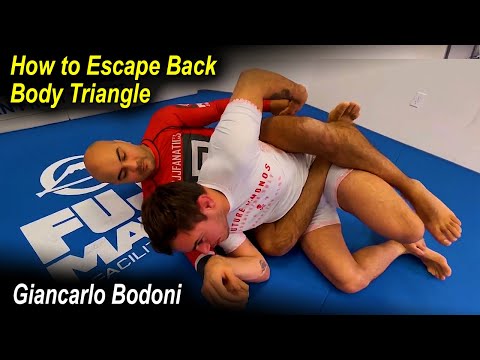
How to Escape Back Body Triangle by Giancarlo Bodoni
0
Body Triangle Escape·Bernardo Faria BJJ Fanatics
How to Escape Back Body Triangle by Giancarlo Bodoni - Click Here To Check Out Giancarlo Bodoni's Instructional Videos -…
Translation: body triangle escape
The Body Triangle Escape subfamily covers techniques for escaping when the opponent has secured back control with a body triangle — legs locked in a figure-four around the defender's torso rather than using standard hooks. [1] The body triangle is one of the most difficult back controls to escape because the interlocked legs create a powerful compression grip that is harder to clear than standard hooks. [1],[2] Body triangle escapes typically involve addressing the locked legs first by prying them apart or adjusting hip angle to relieve the squeeze, then proceeding with standard back escape techniques. [2],[3]
Body triangle escapes became a focused area of study as the body triangle grew in popularity as a preferred back control method in both gi and no-gi grappling. [1] The body triangle's prevalence in MMA, where fighters like Khabib Nurmagomedov and Islam Makhachev used it extensively, accelerated the development of specific escape techniques. [2],[3]
Body triangle escapes address the strong body triangle back control by turning into the legs or prying the triangle open. [1]
Body triangle escapes were developed in response to the body triangle's increasing dominance in competition. [1]
Body triangle escape success is a critical skill in high-level BJJ and MMA competition. [1]
No images yet for this technique.
Sign in to suggest an image.
How to Escape Back Body Triangle by Giancarlo Bodoni - Click Here To Check Out Giancarlo Bodoni's Instructional Videos -…
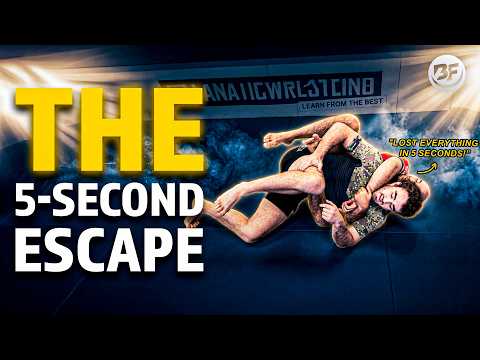
Getting trapped in a body triangle used to mean a slow, exhausting submission. Not anymore. John Danaher student and No-…
No instructional courses yet for this technique.
Sign in to suggest a course.
Risk of injury to the person this technique is applied to
Back escapes must address choke threat while escaping; urgency increases injury risk
Skill level needed to execute this technique reliably
Whether this technique is allowed under major competition rule sets
Jiu-Jitsu University (Saulo Ribeiro, 2008)
Alias sources — [1] Jiu-Jitsu University (Saulo Ribeiro, 2008) [2] Mastering Jujitsu (Renzo Gracie & John Danaher, 2003) [3] The Guard (Joe Moreira & Ed Beneville, 2003)
Effectiveness sources — [1] Jiu-Jitsu University (Ribeiro, 2008)
Standard katakana transliteration of Western martial arts terminology (外来語) — used in Japanese MMA, boxing, and BJJ communities
Alias sources — [1] Jiu-Jitsu University (Saulo Ribeiro, 2008) [2] Mastering Jujitsu (Renzo Gracie & John Danaher, 2003) [3] The Guard (Joe Moreira & Ed Beneville, 2003)
Effectiveness sources — [1] Jiu-Jitsu University (Ribeiro, 2008)
explosive hip bridge power, shrimping ability, timing
strong glutes and hip extensors for powerful bridges
glutes, hip extensors, core, quadriceps
Every move, in any martial art, shares a few universal traits. Mix and match below to pinpoint the right tool — or compare equivalents across styles.
The Leg Pump Escape addresses the body triangle by using a pumping leg motion to create space within the locked triangle. [1] The defender pushes the top leg (the one over the body triangle lock) downward repeatedly while bridging, creating incremental space that weakens the triangle's compression. [1,2] As the triangle loosens, the defender works to slide the hips out of the triangle or transition the locked legs to a position where they can be pried apart. [2,3]
The Standard Body Triangle Escape addresses the body triangle lock by turning into the locked side (toward the leg on top of the triangle), then using hip pressure and leg positioning to pry the triangle open and clear the legs. [1] The key mechanical insight is that turning toward the top leg changes the angle of the triangle, making it easier to slide the hips free. [1,2] Once the triangle is cleared, the escape proceeds as a standard back escape — clearing the hooks and turning to face the opponent. [2,3]
The body triangle is extremely difficult to escape because the opponent's grip configuration and body positioning make it hard to create separation. Bernardo Faria emphasizes that many practitioners struggle with this position due to the effectiveness of the control.
According to Giancarlo Bodoni, the Turning Escape works regardless of which side you're on, what side the opponent's seatbelt is on, or the variation of body triangle being applied—making it a versatile option that doesn't require you to constantly adjust your approach as your opponent switches things up.
The first priority is to separate your opponent's grips and break their ability to maintain you on the back, particularly the body triangle grip itself. Once you've covered their hands, you can then focus on the next phase of the escape.
Yes—Bernardo Faria notes that while you might end up in bottom mount as a result of the escape, bottom mount is a significantly better position than being on the back with a body triangle, so it's an acceptable trade-off.
The Body Triangle Escape subfamily covers techniques for escaping when the opponent has secured back control with a body triangle — legs locked in a figure-four around the defender's torso rather than using standard hooks. The body triangle is one of the most difficult back controls to escape because the interlocked legs create a powerful compression grip that is harder to clear than standard hooks.
Body triangle escapes became a focused area of study as the body triangle grew in popularity as a preferred back control method in both gi and no-gi grappling. The body triangle's prevalence in MMA, where fighters like Khabib Nurmagomedov and Islam Makhachev used it extensively, accelerated the development of specific escape techniques.
Unified MMA: legal — Legal defensive/transitional technique; IBJJF: legal — Legal; IJF: legal — Legal; ADCC: legal — Legal; UWW: legal — Legal; FIAS Sport Sambo: legal — Legal
Danger rating 4/10. Moderate — back escapes must address choke threat while escaping; urgency increases injury risk
The standard setup chain: Create Space → Disrupt Control → Execute Escape → Recover Position.
Standard counters include: Maintain Pressure — keep consistent weight distribution to limit escape space / Anticipate Direction — read escape attempt direction and block early / Transition — flow to a new position when the current one is threatened.
Common variants: Bridge and roll (upa) (explosive bridge trapping arm and leg to reverse position); Elbow-knee escape (framing and shrimping to recover guard); Foot drag escape (dragging the opponent's foot with the heel to create spac…); Combination escape (bridging to force a reaction, then shrimping when the opp…).
Body triangle escape success is a critical skill in high-level BJJ and MMA competition.
Top errors to watch for: Trying standard rear mount escapes without first breaking the body triangle — the triangle prevents the hip movement … / Pushing the ankle in the wrong direction — push the top ankle away from the locking knee, not toward it / Using only arm strength to break the triangle — use your whole body: bridge, turn, and push simultaneously / Ignoring the body triangle to fight the choke — both must be addressed, but the triangle limits your escape options.
The Body Triangle Escape is also known as Bodi Toraianguru Esukēpu, Body Lock Escape, Figure-Four Legs Escape, Body Scissors Escape.