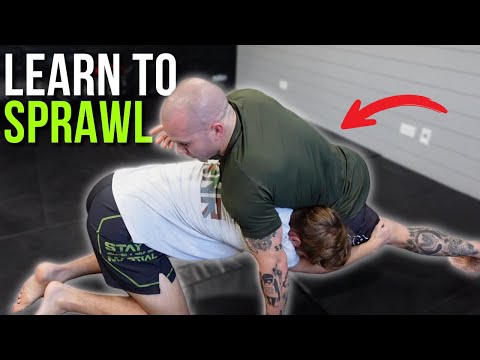
Sprawl: How To Not Get Taken Down In A Fight
0
Standard Sprawl·Stay Safe Martial Arts
In this video, we discuss the fundamentals of sprawling for self defense application. Learn not only how to stop takedo…
Translation: standard sprawl
The Standard Sprawl subfamily covers the full sprawl defence where the defender drives both hips simultaneously backward and downward, landing heavy on the attacker's upper body while removing both legs from reach. [1] The full sprawl is the primary defence against double-leg takedowns and committed shots where both legs are targeted. [1],[2] The standard sprawl can be performed as a hip sprawl (hips driven back while maintaining contact with the attacker) or a heavy sprawl (hips driven directly down onto the attacker's back). [2],[3]
The standard sprawl is the baseline takedown defence. [1]
The fundamental wrestling takedown defence. [1]
The most common takedown defence in MMA. [1]
No images yet for this technique.
Sign in to suggest an image.
In this video, we discuss the fundamentals of sprawling for self defense application. Learn not only how to stop takedo…
No instructional courses yet for this technique.
Sign in to suggest a course.
Risk of injury to the person this technique is applied to
Sprawls and stuffs involve sudden body weight displacement; knee/hip strain risk
Skill level needed to execute this technique reliably
Whether this technique is allowed under major competition rule sets
Freestyle Wrestling: A Complete Guide for Coaches and Wrestlers (Petrov, 1977)
Alias sources — [1] Wrestling Coaching Manual (USA Wrestling, 2015) [2] MMA Instruction Manual (Ryan & Snowden, 2010) [3] MMA Instruction Manual (Ryan & Snowden, 2010)
Effectiveness sources — [1] Wrestling Physical Conditioning Encyclopedia (Petrov, 1977)
Standard katakana transliteration of Western martial arts terminology (外来語) — used in Japanese MMA, boxing, and BJJ communities
Alias sources — [1] Wrestling Coaching Manual (USA Wrestling, 2015) [2] MMA Instruction Manual (Ryan & Snowden, 2010) [3] MMA Instruction Manual (Ryan & Snowden, 2010)
Effectiveness sources — [1] Wrestling Physical Conditioning Encyclopedia (Petrov, 1977)
reaction speed, explosive hip extension, downward driving force
long legs for quick sprawl, heavy upper body
hip extensors, glutes, core, shoulders (dead weight)
Every move, in any martial art, shares a few universal traits. Mix and match below to pinpoint the right tool — or compare equivalents across styles.
The Heavy Sprawl drives the hips directly downward onto the attacker's back and shoulders, using body weight to crush the attacker to the mat and prevent them from completing the takedown. [1] Unlike the hip sprawl which focuses on removing the hips backward, the heavy sprawl emphasises downward pressure — the defender's hips land on the attacker's upper back with maximum weight, flattening them to the mat. [1,2] The heavy sprawl is the most punishing sprawl variation, physically exhausting the attacker and often leading to dominant front headlock position. [2,3]
The Hip Sprawl drives the hips backward and away from the attacker while maintaining light chest contact, creating distance between the defender's legs and the attacker's grasp. [1] The hip sprawl emphasises speed and hip displacement over weight — the defender shoots the hips back explosively to remove them from the attacker's reach before the penetration step can be completed. [1,2] The hip sprawl is the faster of the two sprawl variations and is typically the initial defensive reaction to a shot, with the heavy sprawl following if the hip sprawl doesn't fully stop the takedown. [2,3]
Keep your chest directly on the back of his shoulder blades and maintain head pressure in front of you so he's carrying all your weight. Stay Safe Martial Arts emphasizes that if he cuts an angle to the side, you should square back up rather than follow, keeping constant chest-to-shoulder contact.
Keeping the opponent's head stuffed under your hip prevents them from shooting up and continuing the takedown. Stay Safe Martial Arts notes that releasing pressure on the head allows it to come up and gives them an escape route.
Turning into your opponent shifts all your weight to your outside hip, which gives them the takedown they need. Stay Safe Martial Arts stresses maintaining square positioning instead of cutting angles to preserve your weight distribution.
The Standard Sprawl subfamily covers the full sprawl defence where the defender drives both hips simultaneously backward and downward, landing heavy on the attacker's upper body while removing both legs from reach. The full sprawl is the primary defence against double-leg takedowns and committed shots where both legs are targeted.
The full sprawl is the most fundamental takedown defence in wrestling and has been taught since the development of leg-attack takedowns as a primary competition technique. Its importance in MMA elevated the sprawl to one of the most recognisable defensive techniques in combat sports.
Unified MMA: legal — Legal defensive technique; IBJJF: legal — Legal — defensive techniques are fundamental to grappling; IJF: legal — Legal defensive action; ADCC: legal — Legal; UWW: legal — Legal defensive technique; FIAS Sport Sambo: legal — Legal
Danger rating 3/10. Moderate — sprawls and stuffs involve sudden body weight displacement; knee/hip strain risk
The standard setup chain: Recognize the Shot → Hips Back → Drive Weight Down → Establish Front Headlock or Scramble.
Standard counters include: Snap Down — use the sprawl momentum to redirect into a front headlock / Fake Shot to Go-Behind — fake the takedown to draw the sprawl then circle behind / Ankle Pick — attack the far ankle while the opponent is sprawled and weight-forward.
Common variants: Full sprawl (both legs kicked back, hips dropped to the mat); Half sprawl (one leg back while the other posts for balance); Sprawl to front headlock (sprawling and immediately securing head control).
The most common takedown defence in MMA.
Top errors to watch for: Sprawling to one side instead of straight back — an angled sprawl allows the opponent to continue to the open side / Landing on the hands instead of the chest — the chest must drive down onto the opponent's back / Not extending the legs after the hip drop — bent legs after sprawling let the opponent grab the knees / Sprawling without the crossface — the crossface prevents the opponent from continuing to drive forward.
The Standard Sprawl is also known as Sutandādo Supurōru, Basic Sprawl, Fundamental Sprawl, Hip Sprawl Base.