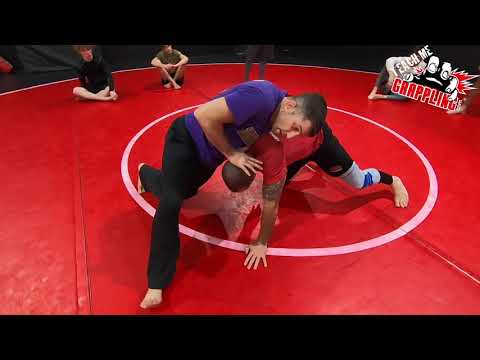
How to do a BASIC Sprawl for BJJ or Wrestling!
0
Heavy Sprawl·TeachMeGrappling Coach Brian·Added by Admin
PLEASE Click this link to SUPPORT the TeachMeGrappling Channel!!! https://www.patreon.com/TeachMeGrappling or https:/…
Translation: heavy sprawl
The Heavy Sprawl drives the hips directly downward onto the attacker's back and shoulders, using body weight to crush the attacker to the mat and prevent them from completing the takedown. [1] Unlike the hip sprawl which focuses on removing the hips backward, the heavy sprawl emphasises downward pressure — the defender's hips land on the attacker's upper back with maximum weight, flattening them to the mat. [1],[2] The heavy sprawl is the most punishing sprawl variation, physically exhausting the attacker and often leading to dominant front headlock position. [2],[3]
The heavy sprawl is more punishing than the standard hip sprawl because it drives the defender's full body weight directly onto the attacker's upper back and shoulders, crushing them flat to the mat. [1] This variation is preferred by fighters who want to physically exhaust takedown-heavy opponents over the course of a fight. [2]
Chuck Liddell's heavy sprawl was central to his UFC light heavyweight championship reign, as his ability to stuff takedowns and punish wrestlers with heavy hip pressure allowed him to keep fights standing and use his striking advantage. [1]
No images yet for this technique.
Sign in to suggest an image.
PLEASE Click this link to SUPPORT the TeachMeGrappling Channel!!! https://www.patreon.com/TeachMeGrappling or https:/…
No instructional courses yet for this technique.
Sign in to suggest a course.
Risk of injury to the person this technique is applied to
Sprawls and stuffs involve sudden body weight displacement; knee/hip strain risk
Skill level needed to execute this technique reliably
Whether this technique is allowed under major competition rule sets
Freestyle Wrestling: A Complete Guide for Coaches and Wrestlers (Petrov, 1977)
Alias sources — [1] Wrestling Coaching Manual (USA Wrestling, 2015) [2] MMA Instruction Manual (Ryan & Snowden, 2010) [3] MMA Instruction Manual (Ryan & Snowden, 2010)
Effectiveness sources — [1] Wrestling Coaching Manual (USA Wrestling, 2015) [2] MMA Instruction Manual (Ryan & Snowden, 2010)
Standard katakana transliteration of Western martial arts terminology (外来語) — used in Japanese MMA, boxing, and BJJ communities
Alias sources — [1] Wrestling Coaching Manual (USA Wrestling, 2015) [2] MMA Instruction Manual (Ryan & Snowden, 2010) [3] MMA Instruction Manual (Ryan & Snowden, 2010)
Effectiveness sources — [1] Wrestling Coaching Manual (USA Wrestling, 2015) [2] MMA Instruction Manual (Ryan & Snowden, 2010)
reaction speed, explosive hip extension, downward driving force
long legs for quick sprawl, heavy upper body
hip extensors, glutes, core, shoulders (dead weight)
Coach Brian emphasizes that using your hands is essential—don't listen to people who say reaching is bad. When your opponent shoots, use your hands to block and defend, keeping your elbows in and maintaining deep hand position to control their head and upper body.
Once you block their head and hands, immediately cover their head and drop your chest and hips over it to pin their upper back and neck. This prevents them from gripping your legs, and from this position you can circle behind them for a back take or go-behind.
Think of your hips like a strike—as your opponent comes in, pop your hips forward to disrupt their momentum, then jump back into your sprawl position. Coach Brian notes this hip pop is often powerful enough on its own to stop the takedown before you even need the leg sprawl.
If they have an angle, sprawl your legs out in the direction they're attacking and drive your weight and hips into their body to crunch and control them, rather than sprawling directly backward. Adjust your body angle to match their entry angle.
The Heavy Sprawl drives the hips directly downward onto the attacker's back and shoulders, using body weight to crush the attacker to the mat and prevent them from completing the takedown. Unlike the hip sprawl which focuses on removing the hips backward, the heavy sprawl emphasises downward pressure — the defender's hips land on the attacker's upper back with maximum weight, flattening them to the mat.
The heavy sprawl has been a competitive wrestling technique used by defensive specialists who recognised that crushing weight could be more effective than simply evading the shot. It became a signature defensive technique in MMA for fighters who wanted to punish takedown attempts.
Unified MMA: legal — Legal defensive technique; IBJJF: legal — Legal — defensive techniques are fundamental to grappling; IJF: legal — Legal defensive action; ADCC: legal — Legal; UWW: legal — Legal defensive technique; FIAS Sport Sambo: legal — Legal
Danger rating 3/10. Moderate — sprawls and stuffs involve sudden body weight displacement; knee/hip strain risk
The standard setup chain: Recognize the Shot → Hips Back → Drive Weight Down → Establish Front Headlock or Scramble.
Standard counters include: Snap Down — use the sprawl momentum to redirect into a front headlock / Fake Shot to Go-Behind — fake the takedown to draw the sprawl then circle behind / Ankle Pick — attack the far ankle while the opponent is sprawled and weight-forward.
Common variants: Full sprawl (both legs kicked back, hips dropped to the mat); Half sprawl (one leg back while the other posts for balance); Sprawl to front headlock (sprawling and immediately securing head control).
Chuck Liddell's heavy sprawl was central to his UFC light heavyweight championship reign, as his ability to stuff takedowns and punish wrestlers with heavy hip pressure allowed him to keep fights standing and use his striking advantage.
Top errors to watch for: Sprawling heavy but not transitioning to offence — the heavy sprawl is a position, not a destination; attack from it / Staying heavy with hips too high — walk your feet back to lower your centre of gravity onto the opponent / Not maintaining the crossface during the heavy sprawl — the crossface keeps the opponent from circling or re-shooting / Using the heavy sprawl in every situation — it's slower to recover from; use it when you need to definitively kill a ….
The Heavy Sprawl is also known as Hebī Supurōru, Dead Weight Sprawl, Crushing Sprawl, Pressure Sprawl.