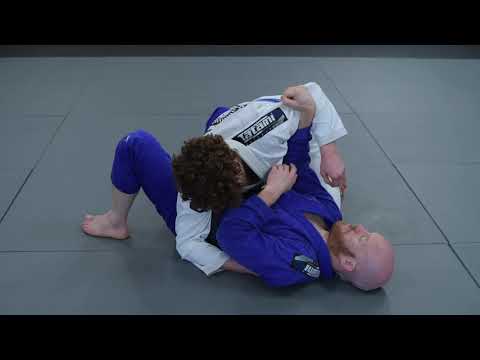
Side Control Bottom - Blocking Cross Face / Defending Near Arm
0
Standard Crossface Block·Darragh O Conaill BJJ·Added by Admin
Translation: standard crossface block
The Standard Crossface Block executes the crossface defence by placing the forearm bone directly across the attacker's jaw or cheekbone as they shoot, then driving the hips back while pushing the head to the side. [1] The forearm is placed firmly across the face with the hand hooking around the far side of the head, and the defender drives forward pressure through the forearm while simultaneously sprawling. [1],[2] The standard crossface block forces the attacker's head to turn, which turns their shoulders and hips, making it impossible to complete the penetration step. [2],[3]
The crossface is one of the most effective takedown defences in wrestling because it attacks the opponent's head position — the single most important factor in takedown completion. [1] By driving the forearm across the attacker's face, the defender forces the head to turn, which turns the shoulders and hips, destroying the alignment needed to finish the takedown. [2]
The crossface block is a standard wrestling defensive technique. [1]
No images yet for this technique.
Sign in to suggest an image.
No instructional courses yet for this technique.
Sign in to suggest a course.
Risk of injury to the person this technique is applied to
Sprawls and stuffs involve sudden body weight displacement; knee/hip strain risk
Skill level needed to execute this technique reliably
Whether this technique is allowed under major competition rule sets
Karate-Do Kyohan: The Master Text (Gichin Funakoshi, 1935)
Alias sources — [1] Wrestling Coaching Manual (USA Wrestling, 2015) [2] MMA Instruction Manual (Ryan & Snowden, 2010) [3] MMA Instruction Manual (Ryan & Snowden, 2010)
Effectiveness sources — [1] Wrestling Coaching Manual (USA Wrestling, 2015) [2] MMA Instruction Manual (Ryan & Snowden, 2010)
Standard katakana transliteration of Western martial arts terminology (外来語) — used in Japanese MMA, boxing, and BJJ communities
Alias sources — [1] Wrestling Coaching Manual (USA Wrestling, 2015) [2] MMA Instruction Manual (Ryan & Snowden, 2010) [3] MMA Instruction Manual (Ryan & Snowden, 2010)
Effectiveness sources — [1] Wrestling Coaching Manual (USA Wrestling, 2015) [2] MMA Instruction Manual (Ryan & Snowden, 2010)
forearm conditioning, reaction speed, structural stability
dense bone structure, strong forearms
forearm flexors/extensors, deltoids, biceps, core (absorbing impact)
Blocking the crossface prevents your opponent from controlling your head and pinning your near arm, which would make escaping much harder. Darragh O Conaill emphasizes that allowing head control leads to worse positions and limits your options, whereas blocking it gives you more space to escape and makes everything easier.
Use a forearm shield on the near side with a tight elbow, then apply a c-grip deep into the crook of your opponent's arm using your thumb. According to Darragh O Conaill, the thumb is essential because without it their arm will slip; the grip should be tight and prevent their arm from sliding down.
If they trick you and open their elbow, continuously try to pummel with your hand to regain control. Darragh O Conaill notes that you should always be ready to pummel and maintain the use of your blocking hand throughout the exchange.
The Standard Crossface Block executes the crossface defence by placing the forearm bone directly across the attacker's jaw or cheekbone as they shoot, then driving the hips back while pushing the head to the side. The forearm is placed firmly across the face with the hand hooking around the far side of the head, and the defender drives forward pressure through the forearm while simultaneously sprawling.
The standard crossface block is one of the most fundamental wrestling defensive techniques, taught as a basic takedown defence at all levels of competition. Its effectiveness and simplicity have made it a universal defensive tool in combat sports.
Unified MMA: legal — Legal defensive technique; IBJJF: legal — Legal; IJF: legal — Legal defensive action; WBC/Boxing: legal — Legal; WKF: legal — Legal; WT: legal — Legal
Danger rating 3/10. Moderate — sprawls and stuffs involve sudden body weight displacement; knee/hip strain risk
The standard setup chain: Read the Attack → Position the Guard → Absorb Impact → Counter or Reset.
Standard counters include: Feint — fake an attack to draw out the block then strike the opening / Level Change — switch attack levels to go around the blocking defence / Combination — throw multiple strikes to overwhelm the single defensive response.
Common variants: High block (forearm raised above the head to protect against overhead…); Low block (forearm driven downward to deflect kicks or body strikes); Cross block (forearm crosses the body to protect the opposite side); Double forearm block (both forearms together for maximum coverage).
The crossface block is a standard wrestling defensive technique.
Top errors to watch for: Blocking too late after the forearm is already across the face — the block must intercept the arm before it crosses t… / Blocking with the hand on the wrist instead of the bicep/elbow — the bicep block gives better leverage and control / Blocking the crossface but staying flat — combine the block with hip movement to create space / Not transitioning after the block — the block creates a momentary opening; use it immediately.
The Standard Crossface Block is also known as Sutandādo Kurosu Feisu Burokku, Basic Crossface Block, Forearm Cross Face, Head Block Crossface.