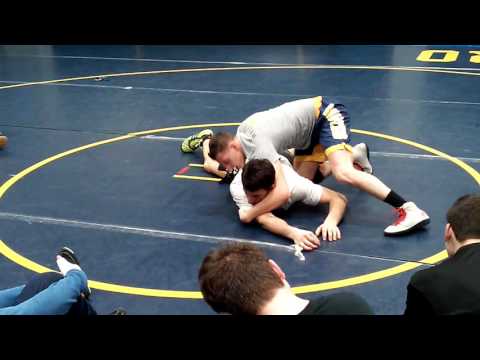
Cradle- Crossface 1/2
0
Standard Crossface Defence·Will Terrell
Cradle basics
Translation: standard crossface defence
The Standard Crossface Defence subfamily applies the crossface by driving the forearm across the shooting opponent's jaw or cheekbone during their takedown attempt, turning the head and disrupting the shot's alignment. [1] The crossface is applied from the collar tie position — as the opponent shoots, the defender drives the forearm across the face while simultaneously sprawling the hips. [1],[2] The combination of crossface and sprawl creates a powerful defensive combination that breaks the shot by both removing the hips (sprawl) and disrupting the alignment (crossface). [2],[3]
The standard crossface defence is the baseline crossface takedown defence. [1]
A fundamental wrestling defence. [1]
Used in wrestling and MMA. [1]
No images yet for this technique.
Sign in to suggest an image.
Cradle basics
No instructional courses yet for this technique.
Sign in to suggest a course.
Risk of injury to the person this technique is applied to
Sprawls and stuffs involve sudden body weight displacement; knee/hip strain risk
Skill level needed to execute this technique reliably
Whether this technique is allowed under major competition rule sets
Freestyle Wrestling: A Complete Guide for Coaches and Wrestlers (Petrov, 1977)
Alias sources — [1] Wrestling Coaching Manual (USA Wrestling, 2015) [2] MMA Instruction Manual (Ryan & Snowden, 2010) [3] MMA Instruction Manual (Ryan & Snowden, 2010)
Effectiveness sources — [1] Wrestling Physical Conditioning Encyclopedia (Petrov, 1977)
Standard katakana transliteration of Western martial arts terminology (外来語) — used in Japanese MMA, boxing, and BJJ communities
Alias sources — [1] Wrestling Coaching Manual (USA Wrestling, 2015) [2] MMA Instruction Manual (Ryan & Snowden, 2010) [3] MMA Instruction Manual (Ryan & Snowden, 2010)
Effectiveness sources — [1] Wrestling Physical Conditioning Encyclopedia (Petrov, 1977)
reaction speed, explosive hip extension, downward driving force
long legs for quick sprawl, heavy upper body
hip extensors, glutes, core, shoulders (dead weight)
Every move, in any martial art, shares a few universal traits. Mix and match below to pinpoint the right tool — or compare equivalents across styles.
According to Will Terrell, it's crucial to push your hand between the opponent's legs and put your weight on that hand while keeping it stable. If that hand moves around, you'll lose control and the opponent will be able to run around.
Will Terrell emphasizes that this move cannot be executed if your near hip is up—your back must be flat against the opponent for the technique to work effectively.
Will Terrell clarifies that while you keep your hand between the legs stable and weighted, your other hand should be actively moving to work toward the opponent's wrist.
The Standard Crossface Defence subfamily applies the crossface by driving the forearm across the shooting opponent's jaw or cheekbone during their takedown attempt, turning the head and disrupting the shot's alignment. The crossface is applied from the collar tie position — as the opponent shoots, the defender drives the forearm across the face while simultaneously sprawling the hips.
The standard crossface defence has been taught in wrestling as a fundamental takedown defence for over a century, valued for its effectiveness in breaking the opponent's alignment during shots. It is a universal defensive technique across wrestling and MMA.
Unified MMA: legal — Legal defensive technique; IBJJF: legal — Legal — defensive techniques are fundamental to grappling; IJF: legal — Legal defensive action; ADCC: legal — Legal; UWW: legal — Legal defensive technique; FIAS Sport Sambo: legal — Legal
Danger rating 3/10. Moderate — sprawls and stuffs involve sudden body weight displacement; knee/hip strain risk
The standard setup chain: Anticipate the Attack → Execute Defence → Recover Stance → Counter or Disengage.
Standard counters include: Timing — attack when the defence is recovering or between movements / Feint — use deception to create openings in the defensive structure / Angle Change — attack from an unexpected angle that the defence does not cover.
Common variants: Full sprawl (both legs kicked back, hips dropped to the mat); Half sprawl (one leg back while the other posts for balance); Sprawl to front headlock (sprawling and immediately securing head control).
Used in wrestling and MMA.
Top errors to watch for: Applying the crossface with limp arm pressure — the crossface must have driving force; a gentle forearm does nothing / Placing the forearm too high (on the forehead) or too low (on the neck) — the jaw/cheek line is the target / Not driving through after contact — the crossface must turn the head; static contact isn't enough / Losing the crossface during transitions — maintain forearm contact as you move from sprawl to front headlock.
The Standard Crossface Defence is also known as Sutandādo Kurosu Feisu Difensu, Basic Crossface, Standard Cross Face, Forearm Crossface.