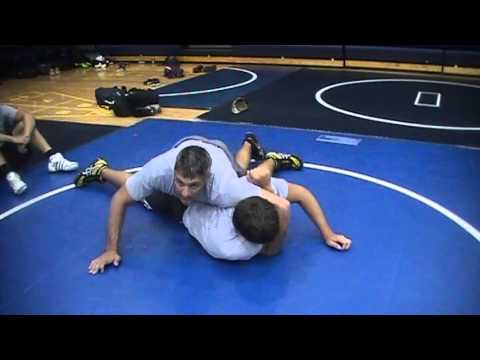
Buckbee Crossface series 3
0
Crossface Defence·alowder01
Translation: crossface defence
The Crossface Defence family covers takedown defence techniques where the defender drives a forearm across the attacker's face during a takedown attempt, using the crossface to turn the attacker's head, break their alignment, and prevent them from completing the takedown. [1] The crossface is effective because it targets the head — the body follows the head, so turning the head with a crossface forces the attacker's body to rotate, disrupting their takedown mechanics. [1],[2] The crossface defence is used against both single-leg and double-leg takedowns. [2],[3]
The crossface is a fundamental wrestling defensive technique. [1]
The crossface is used in wrestling and MMA competition. [1]
No images yet for this technique.
Sign in to suggest an image.
No instructional courses yet for this technique.
Sign in to suggest a course.
Risk of injury to the person this technique is applied to
Sprawls and stuffs involve sudden body weight displacement; knee/hip strain risk
Skill level needed to execute this technique reliably
Whether this technique is allowed under major competition rule sets
Boxing (Edwin Haislet, 1940)
Alias sources — [1] Wrestling Physical Conditioning Encyclopedia (Welker, 2010) [2] NCAA Wrestling Rules and Interpretations
Effectiveness sources — [1] Wrestling Physical Conditioning Encyclopedia (Petrov, 1977) [2] Wrestling for Fighting (Couture, 2007)
Standard katakana transliteration of Western martial arts terminology (外来語) — used in Japanese MMA, boxing, and BJJ communities
Alias sources — [1] Wrestling Physical Conditioning Encyclopedia (Welker, 2010) [2] NCAA Wrestling Rules and Interpretations
Effectiveness sources — [1] Wrestling Physical Conditioning Encyclopedia (Petrov, 1977) [2] Wrestling for Fighting (Couture, 2007)
reaction speed, structural body mechanics, defensive awareness
quick reflexes and conditioned defensive surfaces
varies — forearms (blocking), legs (movement), core (stability)
Every move, in any martial art, shares a few universal traits. Mix and match below to pinpoint the right tool — or compare equivalents across styles.
The crossface — driving the forearm across the opponent's face — appears in 11 passages across 4 books. Used both offensively (to control head position while passing guard) and defensively (to prevent turns and escapes). A fundamental control tool in wrestling and BJJ. (4 books; wrestling and BJJ manuals)
After applying the crossface, tuck your arm down rather than leaving it extended. This arm positioning is crucial for controlling your opponent's shoulder and maintaining pressure on the position.
Keep constant pressure and never let your opponent rest—continuously drive through them. If they try to base back up, maintain your crossface position and keep pulling them into you to prevent them from escaping.
Make sure your opponent's arm is positioned correctly before attempting the crossface—if their arm is in the wrong position, you won't be able to get across effectively and establish good control.
The Crossface Defence family covers takedown defence techniques where the defender drives a forearm across the attacker's face during a takedown attempt, using the crossface to turn the attacker's head, break their alignment, and prevent them from completing the takedown. The crossface is effective because it targets the head — the body follows the head, so turning the head with a crossface forces the attacker's body to rotate, disrupting their takedown mechanics.
The crossface as takedown defence has been a standard wrestling technique for generations, used at all levels of competition as a fundamental method of breaking an opponent's shot. It transferred directly to MMA where it remains one of the most commonly used takedown defences.
Unified MMA: legal — Legal defensive technique; IBJJF: legal — Legal — defensive techniques are fundamental to grappling; IJF: legal — Legal defensive action; ADCC: legal — Legal; UWW: legal — Legal defensive technique; FIAS Sport Sambo: legal — Legal
Danger rating 3/10. Moderate — sprawls and stuffs involve sudden body weight displacement; knee/hip strain risk
The standard setup chain: Anticipate the Attack → Execute Defence → Recover Stance → Counter or Disengage.
Standard counters include: Timing — attack when the defence is recovering or between movements / Feint — use deception to create openings in the defensive structure / Angle Change — attack from an unexpected angle that the defence does not cover.
Common variants: Standard defence (primary defensive technique from the most common position); Reactive defence (triggered by the opponent's attack, minimal movement for …); Proactive defence (anticipating the attack and positioning to neutralise it …); Counter defence (using the defensive movement to create an immediate count…).
The crossface is used in wrestling and MMA competition.
Top errors to watch for: Applying the crossface with the hand instead of the forearm bone — the forearm provides a larger, stronger surface / Crossfacing without hip movement — the crossface alone is insufficient; combine with sprawl, hip escape, or re-positi… / Reaching too far for the crossface and losing balance — stay tight and apply the crossface within your frame / Crossfacing the forehead instead of the jaw/cheek — the forehead is structurally strong; the jaw is the effective target.
The Crossface Defence is also known as Kurosu Feisu Difensu, Cross-Face, Face Pressure Defence.