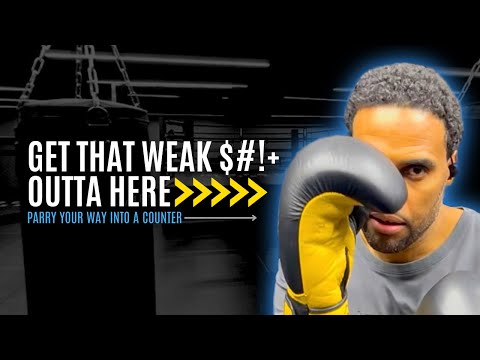
COUNTERPUNCH With A PARRY
0
Parry·Fast Eddie Chambers Boxing
The Parry Is One Of The Most Essential And Effective Defensive Techniques In Boxing. In This Video, I’ll Show You How To…
Translation: parry
The Parry family covers defensive techniques that redirect incoming strikes by using a quick hand movement to deflect the attack off its intended path, rather than absorbing the impact through blocking or evading entirely. [1] Parrying is the most energy-efficient interception defence because it uses minimal force to redirect the attack rather than meeting it head-on — a small deflection of the attacking limb is sufficient to make the strike miss its target. [1],[2] This family includes jab parries, cross parries, and kick catch parries, each designed to redirect specific types of attacks. [2],[3]
Parrying has been a core defensive technique in Western boxing and fencing for centuries, with the concept of deflecting rather than blocking being a fundamental principle of efficient defence. [1] The parrying techniques in boxing were heavily influenced by fencing's deflection methodology, reflecting the cross-pollination between European combat systems. [2],[3]
Parrying is used at all levels of boxing and MMA competition. [1]
No images yet for this technique.
Sign in to suggest an image.
The Parry Is One Of The Most Essential And Effective Defensive Techniques In Boxing. In This Video, I’ll Show You How To…
No instructional courses yet for this technique.
Sign in to suggest a course.
Risk of injury to the person this technique is applied to
Blocking and parrying absorb strike force; hand/forearm injury from repeated blocking
Skill level needed to execute this technique reliably
Whether this technique is allowed under major competition rule sets
Karate-Do Kyohan: The Master Text (Gichin Funakoshi, 1935)
Alias sources — [1] Championship Fighting (Dempsey, 1950) [2] Championship Fighting (Dempsey, 1950) [3] Boxing Mastery (Hatmaker, 2004)
Effectiveness sources — [1] Boxing: The Complete Guide to Training and Fitness (Hatmaker, 2004) [2] Comprehensive Asian Fighting Arts (Draeger & Smith, 1969)
Standard katakana transliteration of Western martial arts terminology (外来語) — used in Japanese MMA, boxing, and BJJ communities
Alias sources — [1] Championship Fighting (Dempsey, 1950) [2] Championship Fighting (Dempsey, 1950) [3] Boxing Mastery (Hatmaker, 2004)
Effectiveness sources — [1] Boxing: The Complete Guide to Training and Fitness (Hatmaker, 2004) [2] Comprehensive Asian Fighting Arts (Draeger & Smith, 1969)
forearm conditioning, reaction speed, structural stability
dense bone structure, strong forearms
forearm flexors/extensors, deltoids, biceps, core (absorbing impact)
Every move, in any martial art, shares a few universal traits. Mix and match below to pinpoint the right tool — or compare equivalents across styles.
The Cross Parry subfamily covers parrying techniques that use the rear hand to deflect the opponent's cross (rear straight punch), redirecting the straight punch off its intended path to the chin or head. [1] The cross parry is executed with a quick, short movement of the rear hand — a sharp tap or push on the inside of the incoming straight punch that deflects it across the defender's body. [1,2] A well-executed cross parry opens the opponent's guard by pulling their rear hand across their body, creating a counter-attacking opportunity on the now-exposed side. [2,3]
The Jab Parry subfamily covers parrying techniques that deflect the opponent's jab, the most commonly thrown punch in boxing and MMA. [1] Jab parries are the most frequently used parrying technique because the jab is the most frequent attack in striking — a fighter who cannot parry the jab will be constantly peppered with scoring shots. [1,2] Jab parries can be executed to the inside (pushing the jab across the opponent's body) or to the outside (pushing the jab away from the defender's centreline), each creating different counter-attacking angles. [2,3]
The Kick Catch Parry subfamily covers defensive techniques where the fighter catches an incoming kick by grabbing the kicking leg, simultaneously defending against the strike and trapping the opponent's limb for counter-attacks or takedowns. [1] The kick catch is one of the highest-risk, highest-reward defensive techniques — if successful, it completely neutralises the kick and creates an immediate takedown or sweep opportunity. [1,2] Kick catches are primarily used against round kicks and front kicks to the body, where the kicking leg travels at a catchable height and speed. [2,3]
Parrying appears in 5,648 passages across our corpus — one of the most referenced defensive concepts. A parry redirects an incoming attack rather than absorbing it. In boxing, the catch-and-parry is the most fundamental defensive hand skill. In fencing, the parry is the primary defensive action. (200+ books; Dempsey, Championship Fighting; fencing texts)
You want to keep your hands close to your body when defending shots with a parry. Getting too much space between you and your hands makes it too late to defend effectively, and you won't be able to throw strikes from that distance.
When parrying, get rid of the incoming shot without using a lot of extra movement—just deflect it cleanly and efficiently so you can counter immediately after.
If there's going to be another shot coming, take the angle and get the space after your parry; though you don't always have to exit if you don't want to, it's typically the safer option.
The Parry family covers defensive techniques that redirect incoming strikes by using a quick hand movement to deflect the attack off its intended path, rather than absorbing the impact through blocking or evading entirely. Parrying is the most energy-efficient interception defence because it uses minimal force to redirect the attack rather than meeting it head-on — a small deflection of the attacking limb is sufficient to make the strike miss its target.
Parrying has been a core defensive technique in Western boxing and fencing for centuries, with the concept of deflecting rather than blocking being a fundamental principle of efficient defence. The parrying techniques in boxing were heavily influenced by fencing's deflection methodology, reflecting the cross-pollination between European combat systems.
Unified MMA: legal — Legal defensive technique; WBC/Boxing: legal — Legal — blocking and evasion are core boxing skills; WKF: legal — Legal — blocking is a fundamental karate skill; Kyokushin: legal — Legal; WT: legal — Legal; WAKO: legal — Legal; K: legal — 1/GLORY — Legal; IFMA: legal — Legal
Danger rating 3/10. Moderate — blocking and parrying absorb strike force; hand/forearm injury from repeated blocking
The standard setup chain: Anticipate the Attack → Execute Defence → Recover Stance → Counter or Disengage.
Standard counters include: Feint — fake an attack to draw out the block then strike the opening / Level Change — switch attack levels to go around the blocking defence / Combination — throw multiple strikes to overwhelm the single defensive response.
Common variants: High block (forearm raised above the head to protect against overhead…); Low block (forearm driven downward to deflect kicks or body strikes); Cross block (forearm crosses the body to protect the opposite side); Double forearm block (both forearms together for maximum coverage).
Parrying is used at all levels of boxing and MMA competition.
Top errors to watch for: Parrying too hard — a parry is a redirection, not a slap; excessive force pulls you out of position / Parrying too early — the opponent hasn't committed to the punch and can adjust / Reaching out to parry — keep the parrying hand close to your body and use a small deflection / Parrying with an open hand and fingers extended — close the fingers to avoid jammed or broken fingers.
The Parry is also known as Parī, Deflection, Tap, Redirect.