10 Counters for the Right Cross
0
Cross Parry·expertboxing
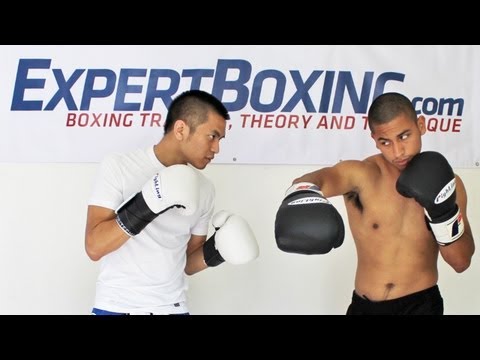
10 common boxing counters for dealing with a right hand punch (right cross or straight right). Includes some evasive man…
Translation: cross parry
The Cross Parry subfamily covers parrying techniques that use the rear hand to deflect the opponent's cross (rear straight punch), redirecting the straight punch off its intended path to the chin or head. [1] The cross parry is executed with a quick, short movement of the rear hand — a sharp tap or push on the inside of the incoming straight punch that deflects it across the defender's body. [1],[2] A well-executed cross parry opens the opponent's guard by pulling their rear hand across their body, creating a counter-attacking opportunity on the now-exposed side. [2],[3]
The cross parry has been a standard boxing defensive technique since the sport's formalisation, taught alongside the jab parry as the fundamental interception defences against straight punches. [1] Its effectiveness in creating counter-attacking angles has made it a favourite of technical boxers. [2],[3]
The cross parry deflects punches using the rear hand across the body. [1]
A fundamental boxing parry technique. [1]
Used in boxing and MMA. [1]
No images yet for this technique.
Sign in to suggest an image.
10 common boxing counters for dealing with a right hand punch (right cross or straight right). Includes some evasive man…
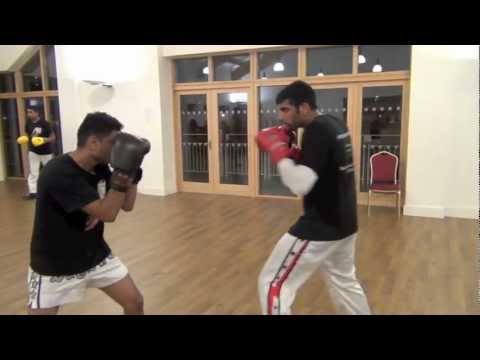
Practicing and drilling some parrying and interceptions against the jab with the jab - for the first time in the class
The cross parry family encompasses defensive interception techniques that meet an incoming strike—typically a jab or cross—with a deflecting hand motion rather than a full block. The unifying principle is economy of movement: the defender uses minimal hand travel to redirect the opponent's punch off-line while maintaining position and readiness for immediate counter-attack. KhalsaWarrior emphasizes the critical importance of timing and distance work in parry drills, stressing that practitioners must remain engaged and advance rather than retreat, as backward movement breaks the reflex chain needed for effective follow-up. Expert Boxing demonstrates the cross parry's complementary role within a counter system, showing how a parry down with the left hand—a light tap that projects force rather than a full glove drop—creates the opening for a jab or hook counter over the top. The strategic context hinges on recognition: a parry is chosen when the defender has positioned awareness and anticipation, allowing them to commit to a small deflection rather than a large block. Both instructors highlight that parries require superior timing calibration compared to blocks; the margin for error is smaller, but the defensive footprint is tighter and the counter window larger. The choice between parry variants depends on the incoming punch's angle and the defender's preferred counter (jab, hook, or body shot).
Synthesized from 2 instructors
No instructional courses yet for this technique.
Sign in to suggest a course.
Risk of injury to the person this technique is applied to
Blocking and parrying absorb strike force; hand/forearm injury from repeated blocking
Skill level needed to execute this technique reliably
Whether this technique is allowed under major competition rule sets
Boxing (Edwin Haislet, 1940)
Alias sources — [1] Championship Fighting (Dempsey, 1950) [2] Boxing Mastery (Hatmaker, 2004) [3] Fighter's Fact Book (Christensen, 2000)
Effectiveness sources — [1] Boxing: The Complete Guide to Training and Fitness (Hatmaker, 2004)
Standard katakana transliteration of Western martial arts terminology (外来語) — used in Japanese MMA, boxing, and BJJ communities
Alias sources — [1] Championship Fighting (Dempsey, 1950) [2] Boxing Mastery (Hatmaker, 2004) [3] Fighter's Fact Book (Christensen, 2000)
Effectiveness sources — [1] Boxing: The Complete Guide to Training and Fitness (Hatmaker, 2004)
hand-eye coordination, quick reflexes, precise hand placement
fast hands, good reaction time
deltoids, forearms, core (for counter-rotation readiness)
Every move, in any martial art, shares a few universal traits. Mix and match below to pinpoint the right tool — or compare equivalents across styles.
The easiest counter is to throw your jab straight down the middle to intercept the opponent's right hand as it comes in (expertboxing).
Wait for the opponent's right hand to pass, then throw a left hook either on the inside or over the top of their extended arm (expertboxing).
Yes—parry the right hand and then counter over the top, or slip the right hand and throw a left punch (uppercut or hook) to the head or body (expertboxing).
Avoid building the wrong reflex by moving backward—stay in position when you parry so you can execute your counter (KHALSAWARRIOR).
The Cross Parry subfamily covers parrying techniques that use the rear hand to deflect the opponent's cross (rear straight punch), redirecting the straight punch off its intended path to the chin or head. The cross parry is executed with a quick, short movement of the rear hand — a sharp tap or push on the inside of the incoming straight punch that deflects it across the defender's body.
The cross parry has been a standard boxing defensive technique since the sport's formalisation, taught alongside the jab parry as the fundamental interception defences against straight punches. Its effectiveness in creating counter-attacking angles has made it a favourite of technical boxers.
Unified MMA: legal — Legal defensive technique; WBC/Boxing: legal — Legal — blocking and evasion are core boxing skills; WKF: legal — Legal — blocking is a fundamental karate skill; Kyokushin: legal — Legal; WT: legal — Legal; WAKO: legal — Legal; K: legal — 1/GLORY — Legal; IFMA: legal — Legal
Danger rating 3/10. Moderate — blocking and parrying absorb strike force; hand/forearm injury from repeated blocking
The standard setup chain: Anticipate the Attack → Execute Defence → Recover Stance → Counter or Disengage.
Standard counters include: Feint — fake an attack to draw out the block then strike the opening / Level Change — switch attack levels to go around the blocking defence / Combination — throw multiple strikes to overwhelm the single defensive response.
Common variants: Inside parry (deflecting the punch to the inside (toward the centre line)); Outside parry (deflecting the punch to the outside (away from the centre…); Catch parry (catching the punch in the open hand for a brief control m…).
Used in boxing and MMA.
Top errors to watch for: Reaching too far across the body — the parry should be close to your own guard, not at the opponent's arm / Over-rotating the body to cross-parry — the hand crosses the centreline but the body stays squared / Not returning the parrying hand to guard after the deflection — the hand must snap back / Parrying too late and catching the punch on the forearm instead of deflecting with the hand.
The Cross Parry is also known as Kurosu Parī, Rear Hand Parry, Cross Deflection, Power Hand Parry.