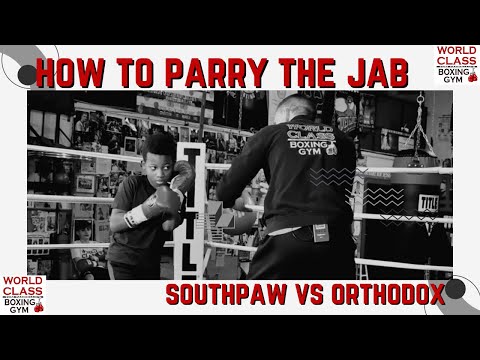
Learn How To Parry the Jab with a Hook - Southpaw vs Orthodox
0
Jab Parry·World Class Boxing Channel
Tom Yankello of the @World Class Boxing Channel gives a southpaw fighter a way to counter the orthodox fighter's jab w…
Translation: jab parry
The Jab Parry subfamily covers parrying techniques that deflect the opponent's jab, the most commonly thrown punch in boxing and MMA. [1] Jab parries are the most frequently used parrying technique because the jab is the most frequent attack in striking — a fighter who cannot parry the jab will be constantly peppered with scoring shots. [1],[2] Jab parries can be executed to the inside (pushing the jab across the opponent's body) or to the outside (pushing the jab away from the defender's centreline), each creating different counter-attacking angles. [2],[3]
The jab parry deflects the opponent's jab using the rear hand, creating counter-offensive openings. [1]
A fundamental boxing technique. [1]
Used in boxing and MMA. [1]
No images yet for this technique.
Sign in to suggest an image.
Tom Yankello of the @World Class Boxing Channel gives a southpaw fighter a way to counter the orthodox fighter's jab w…
Please LIKE and SUBSCRIBE for more content! In this video, we will discuss parrying the jab, distance management, and c…
The jab parry subfamily encompasses defensive hand techniques used to deflect, redirect, or intercept the opponent's jab while simultaneously setting up offensive counters. The unifying principle is economical hand displacement combined with positional advantage: rather than blocking with force, practitioners use minimal contact to divert the jab's trajectory, preserving energy and creating openings for immediate response. World Class Boxing emphasizes the mechanics of hip rotation and weight transfer during parry execution—using counterclockwise hip torque (in southpaw vs. orthodox scenarios) to amplify the deflection effect and load the hips for a power counter like the rear hook, with the instructor noting that faster incoming jabs naturally divert further despite light contact. Path of the Brave frames jab parrying within a broader defensive hierarchy, distinguishing the jab as a lower-threat setup punch compared to follow-up strikes (hooks, crosses) and emphasizing rear-hand parry as a safety choice that maintains front-hand guard coverage and keeps the defender angled away from the opponent's power side. Both instructors stress that parry success depends on distance awareness, timing, and repetitive drilling; Path of the Brave additionally highlights how disrupting the opponent's stance weight distribution through parry-integrated footwork creates strategic advantages beyond the immediate defensive action.
Synthesized from 2 instructors
No instructional courses yet for this technique.
Sign in to suggest a course.
Risk of injury to the person this technique is applied to
Blocking and parrying absorb strike force; hand/forearm injury from repeated blocking
Skill level needed to execute this technique reliably
Whether this technique is allowed under major competition rule sets
Boxing (Edwin Haislet, 1940)
Alias sources — [1] Championship Fighting (Dempsey, 1950) [2] Boxing Mastery (Hatmaker, 2004) [3] Fighter's Fact Book (Christensen, 2000)
Effectiveness sources — [1] Boxing: The Complete Guide to Training and Fitness (Hatmaker, 2004)
Standard katakana transliteration of Western martial arts terminology (外来語) — used in Japanese MMA, boxing, and BJJ communities
Alias sources — [1] Championship Fighting (Dempsey, 1950) [2] Boxing Mastery (Hatmaker, 2004) [3] Fighter's Fact Book (Christensen, 2000)
Effectiveness sources — [1] Boxing: The Complete Guide to Training and Fitness (Hatmaker, 2004)
hand-eye coordination, quick reflexes, precise hand placement
fast hands, good reaction time
deltoids, forearms, core (for counter-rotation readiness)
Every move, in any martial art, shares a few universal traits. Mix and match below to pinpoint the right tool — or compare equivalents across styles.
The Inside Jab Parry uses the rear hand to tap the incoming jab inward, across the defender's body and toward the opponent's centreline, deflecting the jab past the defender's head on the inside. [1] The inside parry pulls the opponent's guard open and turns their shoulders slightly, creating an opening for the defender's cross or overhand counter on the outside line. [1,2] The inside jab parry is the more commonly taught parry direction because it opens the opponent to the defender's power hand. [2,3]
The Outside Jab Parry uses the lead hand to push the incoming jab outward, away from the defender's face and toward the outside, deflecting the punch past the defender's lead shoulder. [1] The outside parry turns the opponent's lead shoulder inward, closing their guard and limiting their follow-up options while creating an angle for the defender's jab or lead hook counter. [1,2] The outside jab parry is less common than the inside parry but creates unique counter-attacking angles. [2,3]
Distance and timing are extremely important because most knockouts happen when you're at the wrong position at the wrong time. According to Path of the Brave, learning to use distance and timing requires repetition and drilling to develop proper body mechanics.
Path of the Brave emphasizes that you need to know the fundamentals first, then practice them through repetition—this is how all the core skills are developed in jab parry defense.
Yes, using your rear hand to parry is described as a good safety feature according to Path of the Brave, though the instructor notes it's important to know the fundamental rules before applying variations.
The Jab Parry subfamily covers parrying techniques that deflect the opponent's jab, the most commonly thrown punch in boxing and MMA. Jab parries are the most frequently used parrying technique because the jab is the most frequent attack in striking — a fighter who cannot parry the jab will be constantly peppered with scoring shots.
The jab parry has been a fundamental boxing defensive technique since the jab became the primary weapon in scientific boxing during the 19th century. The ability to parry the jab is considered one of the most essential defensive skills in boxing and MMA striking.
Unified MMA: legal — Legal defensive technique; WBC/Boxing: legal — Legal — blocking and evasion are core boxing skills; WKF: legal — Legal — blocking is a fundamental karate skill; Kyokushin: legal — Legal; WT: legal — Legal; WAKO: legal — Legal; K: legal — 1/GLORY — Legal; IFMA: legal — Legal
Danger rating 3/10. Moderate — blocking and parrying absorb strike force; hand/forearm injury from repeated blocking
The standard setup chain: Anticipate the Attack → Execute Defence → Recover Stance → Counter or Disengage.
Standard counters include: Feint — fake an attack to draw out the block then strike the opening / Level Change — switch attack levels to go around the blocking defence / Combination — throw multiple strikes to overwhelm the single defensive response.
Common variants: Inside parry (deflecting the punch to the inside (toward the centre line)); Outside parry (deflecting the punch to the outside (away from the centre…); Catch parry (catching the punch in the open hand for a brief control m…).
Used in boxing and MMA.
Top errors to watch for: Swatting at the jab with a wide motion — the parry is a small, tight movement / Reaching forward to parry — keep the hand close to your chin and parry as the jab arrives / Using too much force — the parry needs only enough force to deflect the punch off target / Dropping the other hand while parrying — both hands should be available immediately after the parry.
The Jab Parry is also known as Jabu Parī, Jab Deflection, Pat Parry, Tap Parry.