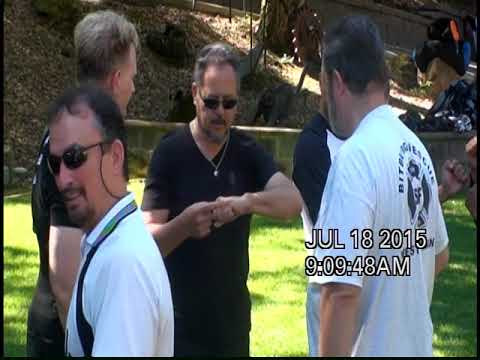
Interception, Deception and Cutting the lines
0
Striking Interception Defence·Mark Harrell
Interception, Deception and Cutting the lines Professors Mark Harrell and Mario Magdangal teaching JKD, Jeet Kune Do, Ju…
Translation: striking interception defence
The Striking Interception Defence group encompasses all defensive techniques that physically intercept, redirect, or absorb incoming strikes using the arms, legs, or body as shields and deflectors. [1] Unlike evasion-based defence which removes the target from the attack's path, interception defence meets the attack with a defensive structure — blocking it, parrying it aside, covering against it, or catching it. [1],[2] This group includes blocks (hard interceptions that stop the strike), parries (redirections that deflect the strike's path), and covers (protective postures that absorb impact on non-vulnerable areas). [2],[3] Interception defence is the most universal defensive system across martial arts, found in every fighting tradition from karate's formal blocking to boxing's guard and cover system. [3]
Interception defence techniques are among the oldest documented fighting techniques, with blocking and parrying described in ancient Greek, Chinese, Indian, and Japanese martial arts texts. [1] Karate's formalised blocking system (uke-waza) — including age uke, soto uke, uchi uke, and gedan barai — represents one of the most systematic interception defence curricula in any martial art. [2] Boxing's guard and parrying system evolved through centuries of prizefighting into the sport's refined defensive methodology. [2],[3]
Striking interception uses a pre-emptive strike to stop the opponent's attack before it develops. [1]
Interception theory is central to Jeet Kune Do and is also found in fencing and boxing. [1]
Interception striking is used in MMA by fighters with precise timing. [1]
No images yet for this technique.
Sign in to suggest an image.
Interception, Deception and Cutting the lines Professors Mark Harrell and Mario Magdangal teaching JKD, Jeet Kune Do, Ju…
Bruce Lee's Fighting Method (Jeet Kune Do 截拳道) What is Jeet Kune Do ? Jeet Kune Do, or the Art of the Intercepting Fist,…
No instructional courses yet for this technique.
Sign in to suggest a course.
Risk of injury to the person this technique is applied to
Blocking and parrying absorb strike force; hand/forearm injury from repeated blocking
Skill level needed to execute this technique reliably
Whether this technique is allowed under major competition rule sets
Karate-Do Kyohan: The Master Text (Gichin Funakoshi, 1935)
Alias sources — [1] Championship Fighting (Dempsey, 1950) [2] Boxing Mastery (Hatmaker, 2004) [3] Championship Fighting (Dempsey, 1950) [4] Boxing Mastery (Hatmaker, 2004)
Effectiveness sources — [1] Comprehensive Asian Fighting Arts (Draeger & Smith, 1969)
Official karate technique names (和語/漢語)
Established Japanese martial arts naming convention — native Japanese term (和語/漢語)
Alias sources — [1] Championship Fighting (Dempsey, 1950) [2] Boxing Mastery (Hatmaker, 2004) [3] Championship Fighting (Dempsey, 1950) [4] Boxing Mastery (Hatmaker, 2004)
Effectiveness sources — [1] Comprehensive Asian Fighting Arts (Draeger & Smith, 1969)
forearm conditioning, reaction speed, structural stability
dense bone structure, strong forearms
forearm flexors/extensors, deltoids, biceps, core (absorbing impact)
Every move, in any martial art, shares a few universal traits. Mix and match below to pinpoint the right tool — or compare equivalents across styles.
The Block family covers defensive techniques that physically stop incoming strikes by interposing a rigid body part — typically the forearm, shin, or elbow — in the path of the attack. [1] Blocks are the most direct form of striking defence, using hard surfaces of the body to meet the incoming strike and prevent it from reaching its target. [1,2] Blocks are classified by the height and direction they defend — high blocks protect the head, middle blocks protect the torso, low blocks protect the legs, and elbow blocks use the elbow's hard surface to damage the attacker's striking limb. [2,3]
The Cover Defence family encompasses defensive postures and techniques where the fighter positions the arms, hands, and shoulders to create a protective shell that absorbs strikes on non-vulnerable areas rather than attempting to block or evade each individual attack. [1] Cover defences are used when the volume or speed of incoming strikes makes individual blocking impractical — the fighter tightens their guard and weathers the storm until they can counter, clinch, or escape. [1,2] This family includes high guard covers, shell covers, and cross-arm covers, each offering different levels of protection and mobility. [2,3]
The Parry family covers defensive techniques that redirect incoming strikes by using a quick hand movement to deflect the attack off its intended path, rather than absorbing the impact through blocking or evading entirely. [1] Parrying is the most energy-efficient interception defence because it uses minimal force to redirect the attack rather than meeting it head-on — a small deflection of the attacking limb is sufficient to make the strike miss its target. [1,2] This family includes jab parries, cross parries, and kick catch parries, each designed to redirect specific types of attacks. [2,3]
Striking interception — blocks, parries, and covers — stops attacks before they reach the target. Parry appears in 5,648 passages and block in 7,254 across our corpus. Each striking art has its own interception system: boxing parries, karate uke-waza, Muay Thai long guard. (200+ books; Dempsey, Championship Fighting; Nakayama, Dynamic Karate)
The Striking Interception Defence group encompasses all defensive techniques that physically intercept, redirect, or absorb incoming strikes using the arms, legs, or body as shields and deflectors. Unlike evasion-based defence which removes the target from the attack's path, interception defence meets the attack with a defensive structure — blocking it, parrying it aside, covering against it, or catching it.
Interception defence techniques are among the oldest documented fighting techniques, with blocking and parrying described in ancient Greek, Chinese, Indian, and Japanese martial arts texts. Karate's formalised blocking system (uke-waza) — including age uke, soto uke, uchi uke, and gedan barai — represents one of the most systematic interception defence curricula in any martial art.
Unified MMA: legal — Legal defensive technique; WBC/Boxing: legal — Legal — blocking and evasion are core boxing skills; WKF: legal — Legal — blocking is a fundamental karate skill; Kyokushin: legal — Legal; WT: legal — Legal; WAKO: legal — Legal; K: legal — 1/GLORY — Legal; IFMA: legal — Legal
Danger rating 3/10. Moderate — blocking and parrying absorb strike force; hand/forearm injury from repeated blocking
The standard setup chain: Anticipate the Attack → Execute Defence → Recover Stance → Counter or Disengage.
Standard counters include: Timing — attack when the defence is recovering or between movements / Feint — use deception to create openings in the defensive structure / Angle Change — attack from an unexpected angle that the defence does not cover.
Common variants: High block (forearm raised above the head to protect against overhead…); Low block (forearm driven downward to deflect kicks or body strikes); Cross block (forearm crosses the body to protect the opposite side); Double forearm block (both forearms together for maximum coverage).
Interception striking is used in MMA by fighters with precise timing.
Top errors to watch for: Blocking with the hands open and fingers extended — close the fists and use the forearms for structural blocking / Reaching to block strikes far from your body — keep the blocks close; arms should form a tight guard around the head … / Blocking only and never countering — every block should flow into a counter-strike / Looking away or closing eyes during strikes — you must watch the strike to defend accurately.
The Striking Interception Defence is also known as Dageki Geigeki Bōgyo, Strike Defence, Blocking Defence, Striking Interception, Anti-Striking.
![Bruce Lee's Jeet Kune Do Defence System (Blocking) Technique The Outside High Parry in [Hindi]](https://img.youtube.com/vi/ul3KLqY9pgY/hqdefault.jpg)