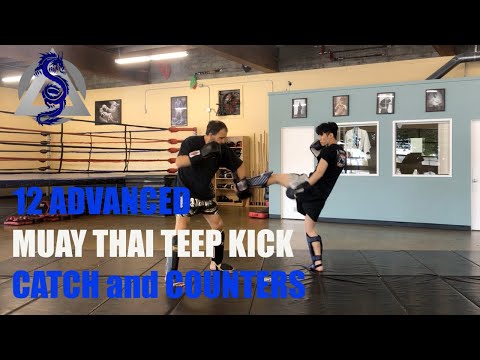
12 Advanced Muay Thai Teep Kick Catch and Counters
0
Kick Catch Parry·Northwest Fighting Arts
Muay Thai Teep kick catch and counter. Keep up with the training and if you have any questions let us know. Be well ht…
Translation: kick catch
The Kick Catch Parry subfamily covers defensive techniques where the fighter catches an incoming kick by grabbing the kicking leg, simultaneously defending against the strike and trapping the opponent's limb for counter-attacks or takedowns. [1] The kick catch is one of the highest-risk, highest-reward defensive techniques — if successful, it completely neutralises the kick and creates an immediate takedown or sweep opportunity. [1],[2] Kick catches are primarily used against round kicks and front kicks to the body, where the kicking leg travels at a catchable height and speed. [2],[3]
Kick catch parry intercepts and catches the opponent's kick, creating takedown and counter opportunities. [1]
Kick catching is fundamental in Muay Thai, sanda, and MMA. [1]
Kick catches are used in Muay Thai and MMA competition. [1]
No images yet for this technique.
Sign in to suggest an image.
Muay Thai Teep kick catch and counter. Keep up with the training and if you have any questions let us know. Be well ht…
No instructional courses yet for this technique.
Sign in to suggest a course.
Risk of injury to the person this technique is applied to
Blocking and parrying absorb strike force; hand/forearm injury from repeated blocking
Skill level needed to execute this technique reliably
Whether this technique is allowed under major competition rule sets
Boxing (Edwin Haislet, 1940)
Alias sources — [1] Muay Thai: The Most Distinguished Art of Fighting (Kraitus, 1988) [2] MMA Instruction Manual (Ryan & Snowden, 2010) [3] MMA Instruction Manual (Ryan & Snowden, 2010)
Effectiveness sources — [1] Muay Thai Unleashed (Delp, 2006)
Standard katakana transliteration of Western martial arts terminology (外来語) — used in Japanese MMA, boxing, and BJJ communities
Alias sources — [1] Muay Thai: The Most Distinguished Art of Fighting (Kraitus, 1988) [2] MMA Instruction Manual (Ryan & Snowden, 2010) [3] MMA Instruction Manual (Ryan & Snowden, 2010)
Effectiveness sources — [1] Muay Thai Unleashed (Delp, 2006)
hand-eye coordination, quick reflexes, precise hand placement
fast hands, good reaction time
deltoids, forearms, core (for counter-rotation readiness)
Every move, in any martial art, shares a few universal traits. Mix and match below to pinpoint the right tool — or compare equivalents across styles.
You need to check and scoop right away when you come in to catch the kick, before your opponent has a chance to grab your neck and escape. Northwest Fighting Arts emphasizes this immediate checking action as critical to controlling the exchange.
Start your sweep kick while your opponent is still moving down, so that when they're up in the air from the catch, you're already hitting them and can sweep the leg out from underneath them. Northwest Fighting Arts recommends initiating the sweep early in the sequence for maximum effectiveness.
Make sure you have good padding or a suitable surface to land on if you're throwing your partner down, and keep your eyes open to defend against being caught or swept yourself. Northwest Fighting Arts stresses being careful during partner drills to prevent injury.
The Kick Catch Parry subfamily covers defensive techniques where the fighter catches an incoming kick by grabbing the kicking leg, simultaneously defending against the strike and trapping the opponent's limb for counter-attacks or takedowns. The kick catch is one of the highest-risk, highest-reward defensive techniques — if successful, it completely neutralises the kick and creates an immediate takedown or sweep opportunity.
Kick catching has been a fundamental defensive technique in Muay Thai, where catching round kicks and executing sweeps from the catch is a standard competitive tactic. The technique was adopted into MMA where kick catches became a common setup for single-leg takedowns.
Unified MMA: legal — Legal defensive technique; IBJJF: legal — Legal; IJF: legal — Legal defensive action; WBC/Boxing: legal — Legal; WKF: legal — Legal; WT: legal — Legal
Danger rating 3/10. Moderate — blocking and parrying absorb strike force; hand/forearm injury from repeated blocking
The standard setup chain: Anticipate the Attack → Execute Defence → Recover Stance → Counter or Disengage.
Standard counters include: Feint — fake an attack to draw out the block then strike the opening / Level Change — switch attack levels to go around the blocking defence / Combination — throw multiple strikes to overwhelm the single defensive response.
Common variants: Inside parry (deflecting the punch to the inside (toward the centre line)); Outside parry (deflecting the punch to the outside (away from the centre…); Catch parry (catching the punch in the open hand for a brief control m…).
Kick catches are used in Muay Thai and MMA competition.
Top errors to watch for: Reaching out to catch the kick — let it arrive at your body; reaching extends you and risks being faked out / Catching with one hand — use both hands for a secure grip; one hand lets the leg slip free / Holding the caught leg without following up — immediately sweep, throw, or strike; holding gives the opponent time to… / Catching kicks that are too fast or too close — only attempt catches against medium-range round kicks.
The Kick Catch Parry is also known as Kikku Kyacchi, Kick Catch, Leg Catch, Jap Khao.