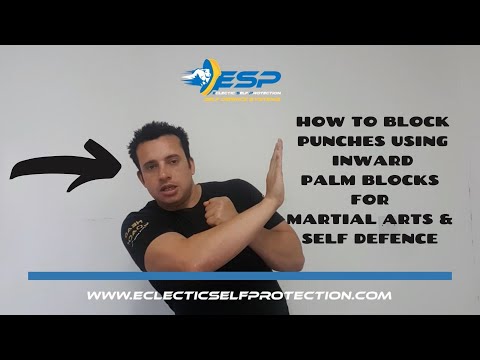
How To Block Punches Using Inward Palm Blocks For Martial Arts & Self Defence
North London Martial Arts & Self Defence teach how to block punches using inward palm blocks for martial arts and self d…

下段受け(Gedan Uke)
TraditionalTranslation: lower level block
The Low Block subfamily covers blocking techniques that defend the lower body — legs, midsection, and groin — by positioning the arms or legs downward to intercept low-targeting attacks. [1] Low blocks are essential for defending against leg kicks, low punches, and kicks targeting the body below the ribs. [1],[2] This subfamily includes traditional karate-style downward sweeping blocks (gedan barai) and the Muay Thai shin check, which uses the shin to block incoming leg kicks. [2],[3]
Low blocks and check kicks are used in all kickboxing and MMA competition. [1]
No images yet for this technique.
Sign in to suggest an image.
Low block techniques represent a defensive family unified by the principle of intercepting incoming strikes—particularly jabs and straight punches directed at the head and upper body—while simultaneously creating offensive opportunities. The strategic context involves timing the block to coincide with the attacker's committed movement, allowing the defender to exploit the moment of contact. BAM Channel emphasizes the timing dimension across multiple variations: early parries on half-beats that precede the attacker's strike, full-beat blocks synchronized exactly with impact, and progressively closer-range techniques (parry-jab, parry-cross, rising elbow) that adapt to distance and available space. The instructor notes that parry angle matters—pushing straight down may miss the incoming hand, whereas angling slightly outward creates better contact geometry. Eclectic Self Protection frames low blocks as inward palm deflections anchored to structural alignment (a vertical "pole" through the spine), with simultaneous head evasion and body movement to avoid the blocked strike. Both instructors advocate for interception methods: BAM Channel demonstrates follow-up striking (jabs, crosses, uppercuts, elbows) timed with the block itself, while Eclectic Self Protection emphasizes reverse punches, spear hands, and hammer fists delivered during the deflective motion. The family thus unifies around the principle of parry-and-counter, where defensive positioning creates the geometry for immediate offensive response.
Synthesized from 2 instructors
No instructional courses yet for this technique.
Sign in to suggest a course.
Risk of injury to the person this technique is applied to
Blocking and parrying absorb strike force; hand/forearm injury from repeated blocking
Skill level needed to execute this technique reliably
Whether this technique is allowed under major competition rule sets
Karate-Do Kyohan: The Master Text (Gichin Funakoshi, 1935)
Alias sources — [1] Karate-Do Kyohan (Funakoshi, 1935) [2] The Kyokushin Way (Oyama, 1979) [3] Dynamic Karate (Nakayama, 1966)
Effectiveness sources — [1] Muay Thai Unleashed (Delp, 2006) [2] Comprehensive Asian Fighting Arts (Draeger & Smith, 1969)
Official karate technique names (和語/漢語)
Established Japanese martial arts naming convention — native Japanese term (和語/漢語)
Alias sources — [1] Karate-Do Kyohan (Funakoshi, 1935) [2] The Kyokushin Way (Oyama, 1979) [3] Dynamic Karate (Nakayama, 1966)
Effectiveness sources — [1] Muay Thai Unleashed (Delp, 2006) [2] Comprehensive Asian Fighting Arts (Draeger & Smith, 1969)
forearm conditioning, reaction speed, structural stability
dense bone structure, strong forearms
forearm flexors/extensors, deltoids, biceps, core (absorbing impact)
Gedan Barai (downward sweeping block) is the traditional karate low block where the forearm sweeps downward in a diagonal arc across the body to intercept a low-level attack targeting the midsection or groin. [1] The block is executed by driving the forearm from a high chambered position across the body and downward, deflecting the attack down and to the side. [1,2] Gedan barai is one of karate's fundamental blocks and appears in virtually every beginner kata, serving as the primary defence against low-level attacks in traditional karate. [2,3]
The Shin Check is the primary defence against low kicks in Muay Thai and MMA, executed by lifting the lead leg and turning the shin outward to intercept the incoming kick with the harder surface of the shin bone. [1] The shin check works on the principle of meeting the soft part of the attacker's foot or lower shin with the harder upper shin, creating a painful collision that discourages further leg kicks. [1,2] A well-timed shin check can damage the attacker's leg, as demonstrated in several famous MMA fights where checked kicks resulted in leg fractures. [2,3]
According to BAM Channel, when you're further away from your opponent use the jab, but when you're closer use the uppercut—just make sure it's a long uppercut that can actually reach your opponent.
Eclectic Self Protection emphasizes staying on the center line as you deflect; when the first punch comes toward you, deflect it across while maintaining that alignment.
The Low Block subfamily covers blocking techniques that defend the lower body — legs, midsection, and groin — by positioning the arms or legs downward to intercept low-targeting attacks. Low blocks are essential for defending against leg kicks, low punches, and kicks targeting the body below the ribs.
Low blocks are fundamental defensive techniques found in all martial arts traditions, from karate's gedan barai to Muay Thai's shin check. The systematic classification of low-line blocking was developed through traditional Asian martial arts.
Unified MMA: legal — Legal defensive technique; WBC/Boxing: legal — Legal — blocking and evasion are core boxing skills; WKF: legal — Legal — blocking is a fundamental karate skill; Kyokushin: legal — Legal; WT: legal — Legal; WAKO: legal — Legal; K: legal — 1/GLORY — Legal; IFMA: legal — Legal
Danger rating 3/10. Moderate — blocking and parrying absorb strike force; hand/forearm injury from repeated blocking
The standard setup chain: Read the Attack → Position the Guard → Absorb Impact → Counter or Reset.
Standard counters include: Feint — fake an attack to draw out the block then strike the opening / Level Change — switch attack levels to go around the blocking defence / Combination — throw multiple strikes to overwhelm the single defensive response.
Common variants: High block (forearm raised above the head to protect against overhead…); Low block (forearm driven downward to deflect kicks or body strikes); Cross block (forearm crosses the body to protect the opposite side); Double forearm block (both forearms together for maximum coverage).
Low blocks and check kicks are used in all kickboxing and MMA competition.
Top errors to watch for: Bending too far forward to execute the low block — maintain upright posture; only the arm moves down / Blocking with a limp arm — the sweeping motion must be firm and controlled / Dropping the guard completely — the non-blocking hand stays at chin level / Using the low block against powerful round kicks — shin checks are more effective; the arm block is for lighter strikes.
The Low Block is also known as Gedan Uke, Downward Block, Low Sweep Block.