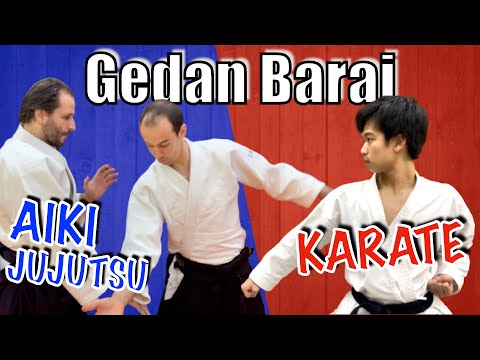
❌DON'T❌ Turn Your Hips!?!?|Gedan Barai Aiki-Jujutsu Style
0
Gedan Barai·Karate Dojo waKu·Added by Admin
Yokohama Budokan: https://budokan.buntai.jp/ Aikido in Japan https://www.youtube.com/user/SenNoSenProject Guillaume Er…
Translation: lower level sweep
Gedan Barai (downward sweeping block) is the traditional karate low block where the forearm sweeps downward in a diagonal arc across the body to intercept a low-level attack targeting the midsection or groin. [1] The block is executed by driving the forearm from a high chambered position across the body and downward, deflecting the attack down and to the side. [1],[2] Gedan barai is one of karate's fundamental blocks and appears in virtually every beginner kata, serving as the primary defence against low-level attacks in traditional karate. [2],[3]
Gedan barai is effective as a sweeping defence against low-level attacks in traditional karate practice and kata. [1] In full-contact competition, the large sweeping motion is considered too slow against fast leg kicks, and fighters typically use the shin check or simple leg lift instead. [2] The technique retains value in point-fighting karate where the rules allow time for classical blocking form. [1]
Gedan barai (downward block) is a standard karate block used in kata and kumite. [1]
No images yet for this technique.
Sign in to suggest an image.
Yokohama Budokan: https://budokan.buntai.jp/ Aikido in Japan https://www.youtube.com/user/SenNoSenProject Guillaume Er…
No instructional courses yet for this technique.
Sign in to suggest a course.
Risk of injury to the person this technique is applied to
Blocking and parrying absorb strike force; hand/forearm injury from repeated blocking
Skill level needed to execute this technique reliably
Whether this technique is allowed under major competition rule sets
Karate-Do Kyohan: The Master Text (Gichin Funakoshi, 1935)
Alias sources — [1] Karate-Do Kyohan (Funakoshi, 1935) [2] The Kyokushin Way (Oyama, 1979) [3] Dynamic Karate (Nakayama, 1966)
Effectiveness sources — [1] Karate-Do Kyohan (Funakoshi, 1935) [2] Dynamic Karate (Nakayama, 1966)
Official karate technique names (和語/漢語)
Established Japanese martial arts naming convention — native Japanese term (和語/漢語)
Alias sources — [1] Karate-Do Kyohan (Funakoshi, 1935) [2] The Kyokushin Way (Oyama, 1979) [3] Dynamic Karate (Nakayama, 1966)
Effectiveness sources — [1] Karate-Do Kyohan (Funakoshi, 1935) [2] Dynamic Karate (Nakayama, 1966)
forearm conditioning, reaction speed, structural stability
dense bone structure, strong forearms
forearm flexors/extensors, deltoids, biceps, core (absorbing impact)
Instead of dispersing energy through your hips and into the ground, use a vertical axis that directs the force straight down. According to Karate Dojo waKu, this approach eliminates wasted energy that would otherwise leave your body in multiple directions.
Gedan barai can be used to break a grip, but Karate Dojo waKu emphasizes there's a more efficient way: direct your body weight downward and pull simultaneously, using gravity and the mat rather than relying solely on hip rotation and horizontal force.
If you feel pressure starting to increase toward the ground during the technique, it means you're directing force incorrectly. Practicing with a partner is important for developing the awareness to feel this feedback and adjust your execution.
Gedan Barai (downward sweeping block) is the traditional karate low block where the forearm sweeps downward in a diagonal arc across the body to intercept a low-level attack targeting the midsection or groin. The block is executed by driving the forearm from a high chambered position across the body and downward, deflecting the attack down and to the side.
Gedan barai is one of the foundational blocks in Okinawan and Japanese karate, appearing in the earliest training methods and kata. It is one of the first techniques taught to karate students worldwide and appears in the first kata (Taikyoku Shodan) of the Shotokan curriculum.
Unified MMA: legal — Legal defensive technique; WBC/Boxing: legal — Legal — blocking and evasion are core boxing skills; WKF: legal — Legal — blocking is a fundamental karate skill; Kyokushin: legal — Legal; WT: legal — Legal; WAKO: legal — Legal; K: legal — 1/GLORY — Legal; IFMA: legal — Legal
Danger rating 3/10. Moderate — blocking and parrying absorb strike force; hand/forearm injury from repeated blocking
The standard setup chain: Anticipate the Attack → Execute Defence → Recover Stance → Counter or Disengage.
Standard counters include: Timing — attack when the defence is recovering or between movements / Feint — use deception to create openings in the defensive structure / Angle Change — attack from an unexpected angle that the defence does not cover.
Common variants: High block (forearm raised above the head to protect against overhead…); Low block (forearm driven downward to deflect kicks or body strikes); Cross block (forearm crosses the body to protect the opposite side); Double forearm block (both forearms together for maximum coverage).
Gedan barai (downward block) is a standard karate block used in kata and kumite.
Top errors to watch for: Sweeping too far past the body — the block should stop at the outside of the knee, not swing past / Not starting the sweep from the opposite shoulder — the cross-body starting position generates the sweeping force / Bending forward during the block — maintain upright posture; only the arm moves downward / Blocking with a limp arm — the forearm must be firm at the moment of contact.
The Gedan Barai is also known as Gedan Barai, Downward Sweep Block, Low Sweeping Block, Gedan Uke.