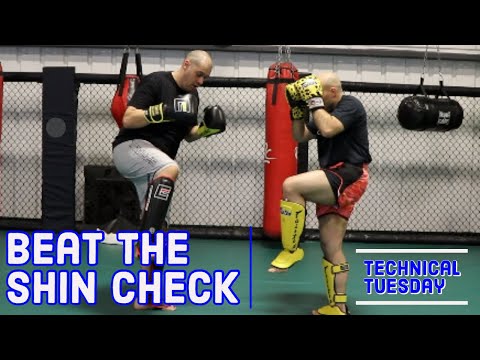
Beat The Muay Thai Shin Check
0
Shin Check·Combat Theory·Added by Admin
In This Week’s Technical Tuesday, we look at ways to beat the Muay Thai Shin Check! Modern American Muay Thai Tank - h…
Translation: shin check
The Shin Check is the primary defence against low kicks in Muay Thai and MMA, executed by lifting the lead leg and turning the shin outward to intercept the incoming kick with the harder surface of the shin bone. [1] The shin check works on the principle of meeting the soft part of the attacker's foot or lower shin with the harder upper shin, creating a painful collision that discourages further leg kicks. [1],[2] A well-timed shin check can damage the attacker's leg, as demonstrated in several famous MMA fights where checked kicks resulted in leg fractures. [2],[3]
The shin check is a fundamental Muay Thai defensive technique developed over centuries of competition in Thailand. [1] The technique gained widespread attention in MMA after Anderson Silva's leg break against Chris Weidman at UFC 168 (2013), caused by a checked kick, highlighting the technique's effectiveness and the danger of unchecked leg kicks. [2],[3]
The shin check is considered the single most effective defence against low kicks in Muay Thai and MMA, as it both blocks the kick and inflicts damage on the attacker. [1] A properly conditioned shin can cause severe injury to the kicker's foot or lower leg upon impact, making the shin check a deterrent that discourages further leg attacks. [2] The technique is most effective when the defender turns the shin outward and lifts the knee high, presenting the hardest part of the shin bone. [1]
The shin check is a fundamental Muay Thai defensive technique that has been part of Thai boxing training for centuries, refined through generations of stadium competition at Lumpinee and Rajadamnern stadiums. [1] The technique was adopted wholesale into MMA and kickboxing training as these sports developed. [2]
The shin check's most famous moment in combat sports occurred at UFC 168 (December 2013), when Chris Weidman's check of Anderson Silva's lead leg kick caused Silva's tibia to fracture on impact, resulting in a TKO victory. [1] A similar incident occurred when Corey Hill suffered a leg fracture against Dale Hartt at UFC Fight Night 16 (2008) from a checked kick. [2]
No images yet for this technique.
Sign in to suggest an image.
In This Week’s Technical Tuesday, we look at ways to beat the Muay Thai Shin Check! Modern American Muay Thai Tank - h…
No instructional courses yet for this technique.
Sign in to suggest a course.
Risk of injury to the person this technique is applied to
Blocking and parrying absorb strike force; hand/forearm injury from repeated blocking
Skill level needed to execute this technique reliably
Whether this technique is allowed under major competition rule sets
Karate-Do Kyohan: The Master Text (Gichin Funakoshi, 1935)
Alias sources — [1] Muay Thai: The Most Distinguished Art of Fighting (Kraitus, 1988) [2] MMA Instruction Manual (Ryan & Snowden, 2010) [3] MMA Instruction Manual (Ryan & Snowden, 2010)
Effectiveness sources — [1] Muay Thai: The Most Distinguished Art of Fighting (Kraitus, 1988) [2] Muay Thai Counters (Delp, 2005)
Standard katakana transliteration of Western martial arts terminology (外来語) — used in Japanese MMA, boxing, and BJJ communities
Alias sources — [1] Muay Thai: The Most Distinguished Art of Fighting (Kraitus, 1988) [2] MMA Instruction Manual (Ryan & Snowden, 2010) [3] MMA Instruction Manual (Ryan & Snowden, 2010)
Effectiveness sources — [1] Muay Thai: The Most Distinguished Art of Fighting (Kraitus, 1988) [2] Muay Thai Counters (Delp, 2005)
forearm conditioning, reaction speed, structural stability
dense bone structure, strong forearms
forearm flexors/extensors, deltoids, biceps, core (absorbing impact)
Throw a blanket kick up in the air on that side to see your opponent's response. Combat Theory explains that you're looking to gauge whether they register the kick as a threat or don't react at all, which tells you whether they're actively defending.
You don't want to spend the whole fight absorbing damage from repeated shin checks—your goal should be to overcome the defense, not prove you can endure it. Combat Theory emphasizes that getting repeatedly shin checked isn't a winning strategy.
Use a four-count sequence: lift your leg, plant, step, then kick. Combat Theory teaches this as a way to cue your opponent's shin check and control the timing of your actual attack.
You can target different parts of the leg, convert your round kick into different angles (like a deep kick or a kick to the body), or come up on top of the shin check rather than into it. Combat Theory outlines multiple defensive options depending on how your opponent responds.
The Shin Check is the primary defence against low kicks in Muay Thai and MMA, executed by lifting the lead leg and turning the shin outward to intercept the incoming kick with the harder surface of the shin bone. The shin check works on the principle of meeting the soft part of the attacker's foot or lower shin with the harder upper shin, creating a painful collision that discourages further leg kicks.
The shin check is a fundamental Muay Thai defensive technique developed over centuries of competition in Thailand. The technique gained widespread attention in MMA after Anderson Silva's leg break against Chris Weidman at UFC 168 (2013), caused by a checked kick, highlighting the technique's effectiveness and the danger of unchecked leg kicks.
Unified MMA: legal — Legal defensive technique; WBC/Boxing: legal — Legal — blocking and evasion are core boxing skills; WKF: legal — Legal — blocking is a fundamental karate skill; Kyokushin: legal — Legal; WT: legal — Legal; WAKO: legal — Legal; K: legal — 1/GLORY — Legal; IFMA: legal — Legal
Danger rating 3/10. Moderate — blocking and parrying absorb strike force; hand/forearm injury from repeated blocking
The standard setup chain: Anticipate the Attack → Execute Defence → Recover Stance → Counter or Disengage.
Standard counters include: Timing — attack when the defence is recovering or between movements / Feint — use deception to create openings in the defensive structure / Angle Change — attack from an unexpected angle that the defence does not cover.
Common variants: High block (forearm raised above the head to protect against overhead…); Low block (forearm driven downward to deflect kicks or body strikes); Cross block (forearm crosses the body to protect the opposite side); Double forearm block (both forearms together for maximum coverage).
The shin check's most famous moment in combat sports occurred at UFC 168 (December 2013), when Chris Weidman's check of Anderson Silva's lead leg kick caused Silva's tibia to fracture on impact, resulting in a TKO victory. A similar incident occurred when Corey Hill suffered a leg fracture against Dale Hartt at UFC Fight Night 16 (2008) from a checked kick.
Top errors to watch for: Checking with the foot instead of the shin — the foot absorbs impact poorly; present the shin bone / Not turning the shin outward — a straight-up shin doesn't deflect the kick; angle it slightly out / Dropping the hands while checking — maintain full guard during the check / Leaning away while checking — stay balanced over the support foot.
The Shin Check is also known as Shin Chekku, Leg Check, Shin Block, Muay Thai Check.