Judo: Ashi Waza Lesson 2 - Lateral Movement
0
Lateral Movement·Kaze Uta Budo Kai / Windsong Dojo
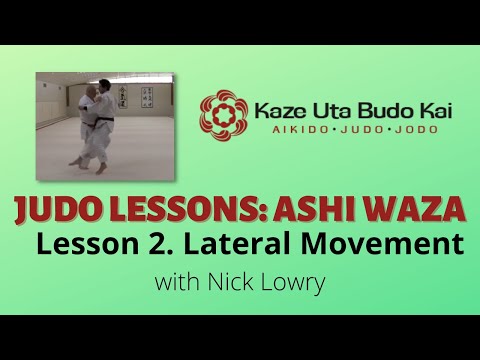
At Windsong dojo (http://www.windsongdojo.com), ashi waza is considered to be the primary foundation for building a good…
Translation: lateral movement
The Lateral Movement subfamily covers defensive techniques where the fighter moves sideways (laterally) to evade attacks, maintain distance, or circle away from the opponent's power side. [1] Lateral movement keeps the fighter at a consistent distance while changing the angle, making it difficult for the opponent to set their feet and generate power. [1],[2] This subfamily includes circling out, pivoting, and side-stepping, each offering different speeds and angle changes. [2],[3]
Lateral movement has been a fundamental element of boxing defence since the sport's scientific era, with fighters like Gene Tunney and Willie Pep demonstrating that constant lateral movement could frustrate aggressive opponents. [1] The technique is equally important in fencing, where lateral movement controls the line of engagement. [2],[3]
Lateral movement creates distance and angles by stepping sideways, avoiding linear attacks. [1]
Lateral movement is a fundamental boxing defensive skill. [1]
Used by elite boxers and MMA fighters. [1]
No images yet for this technique.
Sign in to suggest an image.
At Windsong dojo (http://www.windsongdojo.com), ashi waza is considered to be the primary foundation for building a good…
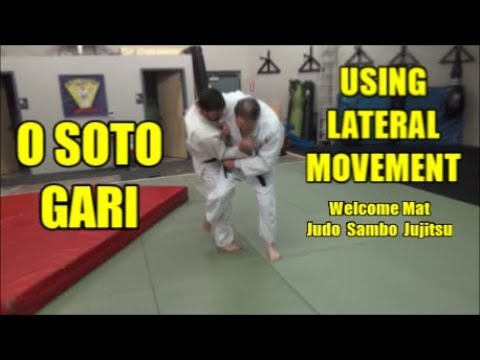
In this video, we show how to move an opponent laterally or sideways and throw him with O Soto Gari. Go to www.amazon.c…
Lateral movement in footwork defence comprises directional shifting perpendicular to the standard forward-backward axis of engagement. This subfamily addresses the strategic principle that human biomechanics present asymmetric vulnerabilities: while balance is relatively stable along the front-back plane, lateral (side-to-side) positioning exploits natural weakness in stabilizer muscles, making practitioners more susceptible to disruption. Kaze Uta Budo Kai frames lateral movement as a foundational ashi waza (leg technique) skill requiring deliberate training, since sideways actions fall outside normal human mobility patterns and demand specific footwork adaptation—shuffling on the balls of the feet with controlled knee bending rather than upper-body-driven movement. welcomematstevescott emphasizes lateral movement as both a gripping strategy and throw setup, demonstrating how controlled sidesteps combined with proper upper-body posture (squared shoulders, anchored hand placement, close proximity) break an opponent's balance before executing techniques like o soto gari. Both instructors agree that practitioners must progress from large, gross lateral steps down to minimal weight shifts, building sensitivity to pressure changes. The strategic context involves using lateral momentum to transition from grip-fighting into throwing sequences, exploiting the biomechanical reality that lateral resistance requires more muscular effort than forward-backward defence, making it the preferred angle of attack in competitive judo.
Synthesized from 2 instructors
No instructional courses yet for this technique.
Sign in to suggest a course.
Risk of injury to the person this technique is applied to
Evasion techniques avoid contact entirely; lowest injury risk of all techniques
Skill level needed to execute this technique reliably
Whether this technique is allowed under major competition rule sets
Boxing (Edwin Haislet, 1940)
Effectiveness sources — [1] Boxing: The Complete Guide to Training and Fitness (Hatmaker, 2004)
Alias sources — [1] Championship Fighting (Dempsey, 1950) [2] Boxing Mastery (Hatmaker, 2004) [3] Fighter's Fact Book (Christensen, 2000)
Standard katakana transliteration of Western martial arts terminology (外来語) — used in Japanese MMA, boxing, and BJJ communities
Alias sources — [1] Championship Fighting (Dempsey, 1950) [2] Boxing Mastery (Hatmaker, 2004) [3] Fighter's Fact Book (Christensen, 2000)
Effectiveness sources — [1] Boxing: The Complete Guide to Training and Fitness (Hatmaker, 2004)
agility, quick directional changes, balance in motion
light feet, strong calves and ankles
calves, tibialis anterior, quadriceps, hip stabilisers
Every move, in any martial art, shares a few universal traits. Mix and match below to pinpoint the right tool — or compare equivalents across styles.
The Circle Out is a lateral movement technique where the fighter moves in a circular path away from the opponent, maintaining distance while continuously changing the angle. [1] Circling out is the primary defensive movement for fighters who want to stay at range, using the circular path to keep the opponent constantly adjusting their position and unable to set up combinations. [1,2] The direction of the circle is tactically significant — circling away from the opponent's power hand is generally preferred. [2,3]
The Pivot is a rotational footwork technique where the fighter plants one foot and swings the other foot in an arc, rotating the entire body to face a new direction while remaining in the same location. [1] The pivot is the fastest directional change available in defensive footwork because it requires no lateral travel — the fighter simply rotates on the spot. [1,2] Pivots are used to escape the corner or cage, to change the angle after an exchange, or to redirect the opponent's forward pressure into empty space. [2,3]
The Side Step is a quick lateral movement where the fighter steps directly to the side, perpendicular to the line of attack, to evade an incoming strike or takedown. [1] The side step removes the fighter from the attack's path without retreating, maintaining the original distance while creating a lateral angle. [1,2] The side step is particularly effective against linear attacks like jabs, crosses, and single-leg takedown entries that travel in a straight line. [2,3]
Getting close proximity allows you to control your opponent's posture and break their balance effectively. Steve Scott emphasizes that you want to 'suck his body to you' and get your hip almost touching him, which prevents him from having room to counter-attack and sets up techniques like o soto gari.
Keep your elbows in tight, imagining you're wrapping your opponent with a belt or rope around their body. Steve Scott stresses not to extend your arms too far out, as this gives your opponent room to attack and breaks your own balance.
Lateral movement attacks where opponents are weakest—on the sides. Steve Scott notes that 'he's a lot stronger forward,' so moving laterally exploits this natural weakness and makes it harder for them to defend.
The Lateral Movement subfamily covers defensive techniques where the fighter moves sideways (laterally) to evade attacks, maintain distance, or circle away from the opponent's power side. Lateral movement keeps the fighter at a consistent distance while changing the angle, making it difficult for the opponent to set their feet and generate power.
Lateral movement has been a fundamental element of boxing defence since the sport's scientific era, with fighters like Gene Tunney and Willie Pep demonstrating that constant lateral movement could frustrate aggressive opponents. The technique is equally important in fencing, where lateral movement controls the line of engagement.
Unified MMA: legal — Legal defensive technique; WBC/Boxing: legal — Legal — blocking and evasion are core boxing skills; WKF: legal — Legal — blocking is a fundamental karate skill; Kyokushin: legal — Legal; WT: legal — Legal; WAKO: legal — Legal; K: legal — 1/GLORY — Legal; IFMA: legal — Legal
Danger rating 1/10. Low — evasion techniques avoid contact entirely; lowest injury risk of all techniques
The standard setup chain: Anticipate the Attack → Execute Defence → Recover Stance → Counter or Disengage.
Standard counters include: Timing — attack when the defence is recovering or between movements / Feint — use deception to create openings in the defensive structure / Angle Change — attack from an unexpected angle that the defence does not cover.
Common variants: Standard defence (primary defensive technique from the most common position); Reactive defence (triggered by the opponent's attack, minimal movement for …); Proactive defence (anticipating the attack and positioning to neutralise it …); Counter defence (using the defensive movement to create an immediate count…).
Used by elite boxers and MMA fighters.
Top errors to watch for: Stepping too wide and losing your stance — maintain shoulder-width distance between the feet / Moving the rear foot first — the lead foot steps first in the direction of lateral movement / Moving laterally without any counter-offensive action — use lateral movement to create angles for attacks / Circling toward the opponent's power hand — generally circle toward their jab side unless you have a specific plan.
The Lateral Movement is also known as Rateraru Mūbumento, Circling, Side Movement, Lateral Footwork.