Wado Ki Karate Workout, Lesson 19 90 Degree Pivot
0
Pivot·Ben Hillis·Added by Admin
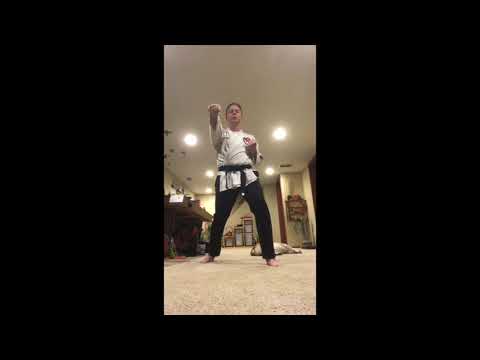
In this video, I will be going over how to to 90 pivot. This whole drill is done in a stance called a zen, also know as …
Translation: pivot
The Pivot is a rotational footwork technique where the fighter plants one foot and swings the other foot in an arc, rotating the entire body to face a new direction while remaining in the same location. [1] The pivot is the fastest directional change available in defensive footwork because it requires no lateral travel — the fighter simply rotates on the spot. [1],[2] Pivots are used to escape the corner or cage, to change the angle after an exchange, or to redirect the opponent's forward pressure into empty space. [2],[3]
Vasyl Lomachenko's pivot footwork became a signature of his style, using the technique to score from unusual angles in wins over Nicholas Walters (2016) and Guillermo Rigondeaux (2017). [1]
No images yet for this technique.
Sign in to suggest an image.
In this video, I will be going over how to to 90 pivot. This whole drill is done in a stance called a zen, also know as …
No instructional courses yet for this technique.
Sign in to suggest a course.
Risk of injury to the person this technique is applied to
Evasion techniques avoid contact entirely; lowest injury risk of all techniques
Skill level needed to execute this technique reliably
Whether this technique is allowed under major competition rule sets
Boxing (Edwin Haislet, 1940)
Alias sources — [1] Championship Fighting (Dempsey, 1950) [2] Boxing Mastery (Hatmaker, 2004) [3] Karate-Do Kyohan (Funakoshi, 1935)
Effectiveness sources — [1] Championship Fighting (Dempsey, 1950) [2] Boxing Mastery (Hatmaker, 2004)
Standard katakana transliteration of Western martial arts terminology (外来語) — used in Japanese MMA, boxing, and BJJ communities
Alias sources — [1] Championship Fighting (Dempsey, 1950) [2] Boxing Mastery (Hatmaker, 2004) [3] Karate-Do Kyohan (Funakoshi, 1935)
Effectiveness sources — [1] Championship Fighting (Dempsey, 1950) [2] Boxing Mastery (Hatmaker, 2004)
agility, quick directional changes, balance in motion
light feet, strong calves and ankles
calves, tibialis anterior, quadriceps, hip stabilisers
Your feet should be shoulder and a half apart. According to Wado Ki Karate Workout, you can measure this by placing your shoulders as a reference point and adding about half a shoulder width to each side.
Both of your back feet should be pointing straight ahead—if even one is crooked, it throws off your entire stance and zen. Wado Ki Karate Workout emphasizes that this detail matters significantly for the drill.
You need to switch your feet using a two-step motion: take your right foot and slide it in then out, let your left foot meet your right foot, then slide your left foot back. Wado Ki Karate Workout compares this to a two-step in a country line dance.
The Pivot is a rotational footwork technique where the fighter plants one foot and swings the other foot in an arc, rotating the entire body to face a new direction while remaining in the same location. The pivot is the fastest directional change available in defensive footwork because it requires no lateral travel — the fighter simply rotates on the spot.
The pivot has been a core boxing footwork technique for over a century, refined through the sport's evolution from flat-footed fighting to dynamic movement-based styles. In MMA, the pivot became essential for avoiding cage pressure and maintaining ring control.
Unified MMA: legal — Legal defensive technique; WBC/Boxing: legal — Legal — blocking and evasion are core boxing skills; WKF: legal — Legal — blocking is a fundamental karate skill; Kyokushin: legal — Legal; WT: legal — Legal; WAKO: legal — Legal; K: legal — 1/GLORY — Legal; IFMA: legal — Legal
Danger rating 1/10. Low — evasion techniques avoid contact entirely; lowest injury risk of all techniques
The standard setup chain: Anticipate the Attack → Execute Defence → Recover Stance → Counter or Disengage.
Standard counters include: Timing — attack when the defence is recovering or between movements / Feint — use deception to create openings in the defensive structure / Angle Change — attack from an unexpected angle that the defence does not cover.
Common variants: Standard defence (primary defensive technique from the most common position); Reactive defence (triggered by the opponent's attack, minimal movement for …); Proactive defence (anticipating the attack and positioning to neutralise it …); Counter defence (using the defensive movement to create an immediate count…).
Vasyl Lomachenko's pivot footwork became a signature of his style, using the technique to score from unusual angles in wins over Nicholas Walters (2016) and Guillermo Rigondeaux (2017).
Top errors to watch for: Pivoting without keeping the guard up — the pivot is a defensive movement; maintain protection throughout / Pivoting too far (180°+) — a quarter-turn (90°) is usually sufficient; over-pivoting turns your back / Not using the ball of the foot — the pivot must rotate on the ball of the lead foot, not the heel / Pivoting slowly — the pivot must be a sharp, quick turn; slow pivots get caught.
The Pivot is also known as Pibotto, Pivot Step, Turning Step, Tai Sabaki Pivot.