Footwork in self-defense
0
Footwork Defence·Demian Maia Channel
"The new self-defense by Demian Maia" is based in BJJ and Demian's experience in MMA
Translation: footwork defence
The Footwork Defence family covers all defensive techniques that use foot and body movement to evade attacks, reposition, or create distance from the opponent. [1] Footwork defence is the foundation of all evasion-based defence because it moves the entire body out of danger, not just the head or limbs. [1],[2] This family includes angling off (stepping to the side to create a new angle), lateral movement (circling), retreating steps (moving backward), and push-offs (creating distance with an explosive backward step). [2],[3] Superior footwork is consistently identified as one of the most important defensive attributes in striking-based combat sports. [3]
Defensive footwork has been a core element of fighting since the ancient Greek Olympic games, where boxers and pankratiasts used movement to avoid strikes. [1] The systematic teaching of defensive footwork was refined through European fencing traditions and later adopted into boxing methodology during the 18th and 19th centuries. [2],[3]
Defensive footwork is a cornerstone of boxing, developed through centuries of pugilistic tradition. [1]
Footwork defence is a key element in boxing and MMA at the highest levels. [1]
No images yet for this technique.
Sign in to suggest an image.
"The new self-defense by Demian Maia" is based in BJJ and Demian's experience in MMA
No instructional courses yet for this technique.
Sign in to suggest a course.
Risk of injury to the person this technique is applied to
Evasion techniques avoid contact entirely; lowest injury risk of all techniques
Skill level needed to execute this technique reliably
Whether this technique is allowed under major competition rule sets
Boxing (Edwin Haislet, 1940)
Alias sources — [1] Championship Fighting (Dempsey, 1950) [2] Championship Fighting (Dempsey, 1950) [3] Boxing Mastery (Hatmaker, 2004)
Effectiveness sources — [1] Boxing: The Complete Guide to Training and Fitness (Hatmaker, 2004) [2] Mastering Jujitsu (Gracie & Danaher, 2003)
Standard katakana transliteration of Western martial arts terminology (外来語) — used in Japanese MMA, boxing, and BJJ communities
Alias sources — [1] Championship Fighting (Dempsey, 1950) [2] Championship Fighting (Dempsey, 1950) [3] Boxing Mastery (Hatmaker, 2004)
Effectiveness sources — [1] Boxing: The Complete Guide to Training and Fitness (Hatmaker, 2004) [2] Mastering Jujitsu (Gracie & Danaher, 2003)
agility, quick directional changes, balance in motion
light feet, strong calves and ankles
calves, tibialis anterior, quadriceps, hip stabilisers
Every move, in any martial art, shares a few universal traits. Mix and match below to pinpoint the right tool — or compare equivalents across styles.
The Angle Off subfamily covers defensive footwork techniques where the fighter steps to the side at an angle rather than retreating straight backward, simultaneously avoiding the attack and creating a new positional angle relative to the opponent. [1] Angling off is considered superior to straight retreating because it removes the defender from the line of attack while placing them in a position to counter from the opponent's blind side or flank. [1,2] The technique requires precise timing — the step must occur as the opponent commits to their attack, so they are unable to adjust their trajectory. [2,3]
The Lateral Movement subfamily covers defensive techniques where the fighter moves sideways (laterally) to evade attacks, maintain distance, or circle away from the opponent's power side. [1] Lateral movement keeps the fighter at a consistent distance while changing the angle, making it difficult for the opponent to set their feet and generate power. [1,2] This subfamily includes circling out, pivoting, and side-stepping, each offering different speeds and angle changes. [2,3]
The Push Off subfamily covers defensive techniques where the fighter uses an explosive backward step or push to create distance from an advancing opponent. [1] The push off is a reactive defence used when the opponent closes distance rapidly and the defender needs to create immediate separation. [1,2] Unlike a retreating step which is measured and controlled, the push off uses explosive force to cover more distance quickly, often combined with a frame or stiff arm against the opponent's body. [2,3]
The Retreating Step subfamily covers defensive footwork where the fighter steps directly backward to move out of the opponent's striking range. [1] The retreating step is the simplest defensive footwork technique — moving straight back to create distance — but must be executed with proper mechanics to maintain balance and stance integrity. [1,2] While simpler than angling off or pivoting, the retreating step is the fastest way to create distance when under pressure from forward-moving attacks. [2,3]
Defensive footwork — lateral movement, pivots, and angles — determines whether a fighter gets hit. In boxing, the pivot is the most important single defensive movement. In MMA, the 45-degree angle step is the primary evasive footwork. (Dempsey, Championship Fighting; MMA training manuals)
Demian Maia emphasizes that many self-defense courses skip foundational footwork and posture, jumping straight to defending strikes and grabs. However, keeping proper posture and learning how to walk safely is a simple but critical skill that prevents you from being pushed, pulled, or knocked off balance before an attack even lands.
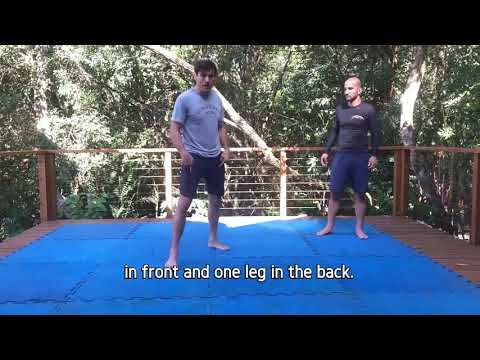
Demian Maia teaches imagining a square in front of you and stepping with one foot in front and one in back on opposite corners of that square—roughly shoulder-width apart—rather than keeping both legs in the same line. This diagonal stance gives you a much stronger base and better balance when pushed or pulled.
Demian Maia recommends using parallel footwork (both legs moving in the same direction) rather than a staggered stance when you need to circle away from fast aggression. Open the leg in the direction you want to go, move with bent knees keeping your feet slightly off the ground and separated, and when you stop, pull one leg back to reset your proper base.
Lowering your center of gravity keeps you safer because attackers typically target high (punches, holds to the upper body), and a lower position helps you maintain balance and avoid falling if you get pushed or pulled.
The Footwork Defence family covers all defensive techniques that use foot and body movement to evade attacks, reposition, or create distance from the opponent. Footwork defence is the foundation of all evasion-based defence because it moves the entire body out of danger, not just the head or limbs.
Defensive footwork has been a core element of fighting since the ancient Greek Olympic games, where boxers and pankratiasts used movement to avoid strikes. The systematic teaching of defensive footwork was refined through European fencing traditions and later adopted into boxing methodology during the 18th and 19th centuries.
Unified MMA: legal — Legal defensive technique; IBJJF: legal — Legal; IJF: legal — Legal defensive action; WBC/Boxing: legal — Legal; WKF: legal — Legal; WT: legal — Legal
Danger rating 1/10. Low — evasion techniques avoid contact entirely; lowest injury risk of all techniques
The standard setup chain: Anticipate the Attack → Execute Defence → Recover Stance → Counter or Disengage.
Standard counters include: Timing — attack when the defence is recovering or between movements / Feint — use deception to create openings in the defensive structure / Angle Change — attack from an unexpected angle that the defence does not cover.
Common variants: Standard defence (primary defensive technique from the most common position); Reactive defence (triggered by the opponent's attack, minimal movement for …); Proactive defence (anticipating the attack and positioning to neutralise it …); Counter defence (using the defensive movement to create an immediate count…).
Footwork defence is a key element in boxing and MMA at the highest levels.
Top errors to watch for: Crossing the feet — this destroys your base and makes you vulnerable to being pushed off-balance / Moving only backward — lateral movement and angles are more effective and don't corner you / Taking flat-footed steps — defensive footwork uses the balls of the feet for quick, light movement / Moving without maintaining stance width — keep your feet shoulder-width apart throughout the movement.
The Footwork Defence is also known as Futtowāku Difensu, Evasive Footwork, Defensive Movement, Ring Craft.