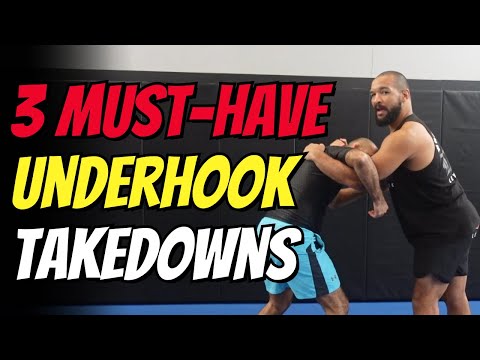
3 Underhook Takedowns That EVERYONE Should Know (That Actually WORK)
0
Double Underhook·Brandon Reed BJJ
In today's video I go over 3 pretty basic takedown options from the underhook. The reason I choose to show these is bec…
Translation: double underhook
The Double Underhook subfamily covers the clinch position where both arms are hooked under the opponent's arms, giving the attacker bilateral inside position and direct access to the body. [1] Double underhooks is one of the most dominant standing clinch positions because the attacker has complete inside control — they can lock the hands for body lock takedowns, control the opponent's posture by driving the elbows upward, and prevent the opponent from establishing any meaningful offensive position. [1],[2] Achieving double underhooks is often the decisive moment in a clinch exchange, and most wrestlers consider it a winning position. [2],[3]
Double underhooks have been recognised as a dominant clinch position since the earliest wrestling traditions, representing the gold standard of inside position in standing grappling. [1] The position's importance has only grown with the development of MMA, where double underhooks are the primary platform for clinch takedowns against the cage. [2],[3]
Double underhooks represent the dominant clinch position in wrestling — the fighter who achieves double underhooks controls the exchange. [1] Welker describes double underhooks as 'the gold standard of clinch control' because they eliminate the opponent's ability to frame, grip fight, or generate meaningful offence from inside the clinch. [1] In MMA, double underhooks are the primary platform for cage takedowns and body lock throws. [2]
Double underhooks provide the most dominant upper-body clinch position in wrestling, used for takedowns, throws, and cage work in MMA. [1]
Double underhooks are the most sought-after clinch position in wrestling and MMA competition. [1]
No images yet for this technique.
Sign in to suggest an image.
In today's video I go over 3 pretty basic takedown options from the underhook. The reason I choose to show these is bec…
No instructional courses yet for this technique.
Sign in to suggest a course.
Risk of injury to the person this technique is applied to
Upper body clinch positions for control and transitions
Skill level needed to execute this technique reliably
Whether this technique is allowed under major competition rule sets
Freestyle Wrestling: A Complete Guide for Coaches and Wrestlers (Petrov, 1977)
Alias sources — [1] Wrestling Physical Conditioning Encyclopedia (Welker, 2010) [2] NCAA Wrestling Rules and Interpretations (NCAA, 2020) [3] Clinch Fighting for MMA (Couture, 2011)
Effectiveness sources — [1] Wrestling Physical Conditioning Encyclopedia (Welker, 2010) [2] Clinch Fighting for MMA (Couture, 2011)
Standard katakana transliteration of Western martial arts terminology (外来語) — used in Japanese MMA, boxing, and BJJ communities
Alias sources — [1] Wrestling Physical Conditioning Encyclopedia (Welker, 2010) [2] NCAA Wrestling Rules and Interpretations (NCAA, 2020) [3] Clinch Fighting for MMA (Couture, 2011)
Effectiveness sources — [1] Wrestling Physical Conditioning Encyclopedia (Welker, 2010) [2] Clinch Fighting for MMA (Couture, 2011)
swimming speed for inside position, shoulder drive, hip pressure
strong shoulders and low centre of gravity
deltoids, pectorals, core, quadriceps
Every move, in any martial art, shares a few universal traits. Mix and match below to pinpoint the right tool — or compare equivalents across styles.
Brandon Reed emphasizes keeping your head really into your partner's neck rather than up high, because opponents with good head and arm control will be able to defend more easily if your head position is too high.
Brandon Reed points out that you don't want your shoulder extended too far out, as this gives your partner the ability to cut the corner on you—instead, keep your shoulder in to maintain control and set up follow-up techniques like the double leg.
For jiu jitsu specifically, Brandon Reed recommends backing stuff rather than grabbing the ankle, as it allows you to get into the seatbelt position more effectively.
Brandon Reed stresses not to do it softly—you should punch the underhook super hard after building off the wrist, and then continue driving through until your opponent's body actually hits the mat.
The Double Underhook subfamily covers the clinch position where both arms are hooked under the opponent's arms, giving the attacker bilateral inside position and direct access to the body. Double underhooks is one of the most dominant standing clinch positions because the attacker has complete inside control — they can lock the hands for body lock takedowns, control the opponent's posture by driving the elbows upward, and prevent the opponent from establishing any meaningful offensive position.
Double underhooks have been recognised as a dominant clinch position since the earliest wrestling traditions, representing the gold standard of inside position in standing grappling. The position's importance has only grown with the development of MMA, where double underhooks are the primary platform for clinch takedowns against the cage.
Unified MMA: legal — Legal — clinching is integral to MMA; IJF: legal — Legal — kumi-kata (grip fighting) is fundamental to judo; IBJJF: legal — Legal — standing grip fighting and clinch work permitted; IFMA: legal — Legal — the clinch is a core element of Muay Thai, clinch dominance is highly…; WBC/Boxing: restricted — Holding is technically a foul — referee breaks clinch, excessive holding resu…; K: restricted — 1/GLORY — One attack from clinch allowed, then referee breaks; WAKO: restricted — Clinch generally broken by referee — limited or no clinch fighting in most fo…; UWW: legal — Legal — clinch is fundamental to wrestling, the primary position in Greco-Roman
Danger rating 4/10. Moderate — upper body clinch positions for control and transitions
The standard setup chain: Close Distance → Swim Inside → Hip Position → Head Position.
Standard counters include: Pummeling — fight for inside position by swimming arms under opponent's grips / Frame and Push — create distance using forearm frames against the chest or neck / Overhook (Whizzer) — trap the underhook arm with an overhook to neutralize it / Arm Drag — pull the underhooking arm past to take the back.
Common variants: Single underhook (one arm inside for angle and control); Double underhooks (both arms inside for maximum inside position); Underhook with collar tie (combining the underhook with head control).
Double underhooks are the most sought-after clinch position in wrestling and MMA competition.
Top errors to watch for: Getting double underhooks and not attacking — a skilled opponent will pummel one arm back inside within seconds / Not clasping hands behind the opponent's back — the body lock is the natural completion of double underhooks / Standing too upright — bend knees and maintain forward drive / Leaving space between your chest and the opponent — chest-to-chest contact prevents pummelling back in.
The Double Underhook is also known as Daburu Andāfukku, Double Unders, Double Inside Ties, Double Under Position.