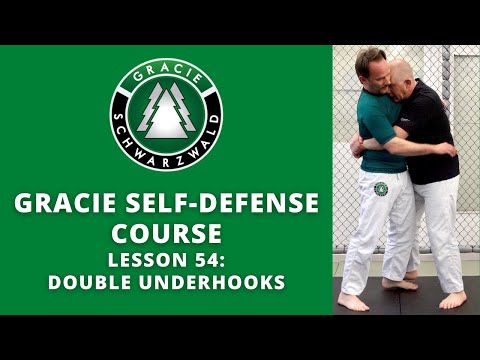
BJJ Self-Defense Course | Lesson 54: Double Under Hooks
0
Standard Double Underhook·Gracie Schwarzwald Jiu-Jitsu·Added by Admin
We hope everyone is enjoying our Gracie Jiu-Jitsu Self-Defense Course. We are offering these lessons for free, but If y…
Translation: standard double underhook
The Standard Double Underhook positions both arms under the opponent's armpits, hooking up and around the shoulders or upper back, with hands clasped behind the opponent's back in a Gable grip or similar lock. [1] The attacker drives the elbows upward to elevate the opponent's arms, eliminating their ability to frame or grip fight, while pressing the chest forward into the opponent's chest to maintain pressure. [1],[2] From standard double underhooks, the attacker can transition to body lock takedowns, lifting throws, or use the position to drive the opponent backward for cage or wall takedowns. [2],[3]
The standard double underhook position — both arms under the opponent's armpits with hands clasped behind the back — provides maximum clinch control for drives, lifts, and body lock takedowns. [1] Welker notes that in collegiate wrestling, the fighter who achieves standard double underhooks scores a takedown the majority of the time. [1]
The standard double underhook is taught as the most dominant standing clinch position in wrestling. [1]
Daniel Cormier used double underhook body lock takedowns as his primary weapon throughout his UFC career, including his heavyweight championship victories. [1] His double underhook-to-body lock takedown was statistically his highest-percentage technique, used to control opponents like Stipe Miocic (UFC 226, July 2018) and Derrick Lewis (UFC 230, November 2018). [2]
No images yet for this technique.
Sign in to suggest an image.
We hope everyone is enjoying our Gracie Jiu-Jitsu Self-Defense Course. We are offering these lessons for free, but If y…
No instructional courses yet for this technique.
Sign in to suggest a course.
Risk of injury to the person this technique is applied to
Upper body clinch positions for control and transitions
Skill level needed to execute this technique reliably
Whether this technique is allowed under major competition rule sets
Mastering Jujitsu (Renzo Gracie & John Danaher, 2003)
Alias sources — [1] Wrestling Physical Conditioning Encyclopedia (Welker, 2010) [2] NCAA Wrestling Rules and Interpretations (NCAA, 2020) [3] Clinch Fighting for MMA (Couture, 2011)
Effectiveness sources — [1] Wrestling Physical Conditioning Encyclopedia (Welker, 2010)
Standard katakana transliteration of Western martial arts terminology (外来語) — used in Japanese MMA, boxing, and BJJ communities
Alias sources — [1] Wrestling Physical Conditioning Encyclopedia (Welker, 2010) [2] NCAA Wrestling Rules and Interpretations (NCAA, 2020) [3] Clinch Fighting for MMA (Couture, 2011)
Effectiveness sources — [1] Wrestling Physical Conditioning Encyclopedia (Welker, 2010)
swimming speed for inside position, shoulder drive, hip pressure
strong shoulders and low centre of gravity
deltoids, pectorals, core, quadriceps
You want to adopt a slightly bladed position at approximately a 45-degree angle with your opponent's leg between your legs, keeping your hips as close as possible to maintain control. Gracie Schwarzwald emphasizes not standing directly in front, as this makes it easy for your opponent to pull their hips away and escape.
The farther away your opponent's hips are, the weaker your grip becomes as it gets stretched, and you risk losing the clinch entirely and having to start over. Gracie Schwarzwald stresses that maintaining close hip contact is essential to prevent escape attempts.
You should generally lock high and low—when you go low, you maximize control of the hips; when you go high, you maximize control of the shoulders and limit your opponent's hip mobility. This 'twos and nines' approach gives you better overall control than matching hand heights.
You can switch your grip from the double underhook to an S-grip to maintain control, and learn to transition fluidly between low and high clinches as your opponent moves. Gracie Schwarzwald emphasizes that clinch fighting skills are critical for adapting to escape attempts.
The Standard Double Underhook positions both arms under the opponent's armpits, hooking up and around the shoulders or upper back, with hands clasped behind the opponent's back in a Gable grip or similar lock. The attacker drives the elbows upward to elevate the opponent's arms, eliminating their ability to frame or grip fight, while pressing the chest forward into the opponent's chest to maintain pressure.
The standard double underhook position is one of the most fundamental and widely recognised clinch positions in wrestling, considered a dominant control position since the sport's ancient origins. It remains the position most associated with clinch dominance in both wrestling and MMA.
Unified MMA: legal — Legal — clinching is integral to MMA; IJF: legal — Legal — kumi-kata (grip fighting) is fundamental to judo; IBJJF: legal — Legal — standing grip fighting and clinch work permitted; IFMA: legal — Legal — the clinch is a core element of Muay Thai, clinch dominance is highly…; WBC/Boxing: restricted — Holding is technically a foul — referee breaks clinch, excessive holding resu…; K: restricted — 1/GLORY — One attack from clinch allowed, then referee breaks; WAKO: restricted — Clinch generally broken by referee — limited or no clinch fighting in most fo…; UWW: legal — Legal — clinch is fundamental to wrestling, the primary position in Greco-Roman
Danger rating 4/10. Moderate — upper body clinch positions for control and transitions
The standard setup chain: Close Distance → Swim Inside → Hip Position → Head Position.
Standard counters include: Pummeling — fight for inside position by swimming arms under opponent's grips / Frame and Push — create distance using forearm frames against the chest or neck / Overhook (Whizzer) — trap the underhook arm with an overhook to neutralize it / Arm Drag — pull the underhooking arm past to take the back.
Common variants: Single underhook (one arm inside for angle and control); Double underhooks (both arms inside for maximum inside position); Underhook with collar tie (combining the underhook with head control).
Daniel Cormier used double underhook body lock takedowns as his primary weapon throughout his UFC career, including his heavyweight championship victories. His double underhook-to-body lock takedown was statistically his highest-percentage technique, used to control opponents like Stipe Miocic (UFC 226, July 2018) and Derrick Lewis (UFC 230, November 2018).
Top errors to watch for: Not clasping hands — double underhooks without a body lock are less secure / Keeping elbows close to the opponent's ribs instead of driving deep past the armpits / Standing tall — bend knees and maintain a driving posture / Leaving space between chests — the opponent pummels back in through any gap.
The Standard Double Underhook is also known as Sutandādo Daburu Andāfukku, Basic Double Underhooks, Fundamental Double Unders, Standard Double Inside Position.