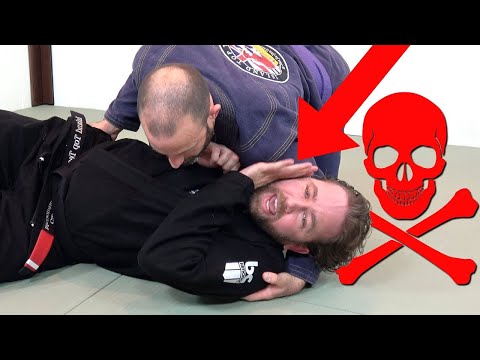
How to Make Side Control BRUTAL with the Crossface
0
Standard Crossface Control·Stephan Kesting·Added by Admin
BJJ black belt Cal MacDonald came into the Grapplearts dojo to share the details of the side control crossface for maxim…
Translation: standard crossface control
The Standard Crossface Control drives the forearm bone (radius/ulna) across the opponent's jaw or cheekbone, using the rigid bone structure to turn the head while the other arm controls the opponent's near arm or body. [1] The crossface is applied by driving the forearm from the near side across to the far side of the opponent's face, forcing the head to rotate away from the attacker. [1],[2] This head rotation disrupts the opponent's alignment and balance, creating opportunities for the attacker to advance position, execute takedowns, or prevent the opponent's movement. [2],[3]
The crossface is a fundamental control tool in wrestling, used to turn the opponent's head away and break their posture. [1] Welker describes it as one of the most effective means of controlling an opponent from the side or front, as turning the head forces the body to follow. [1] In MMA, the crossface is used both standing and on the ground to create angles for passing and striking. [2]
A core wrestling and BJJ technique taught at all levels. [1]
Standard crossface control is a ubiquitous technique in folkstyle and freestyle wrestling competition, essential for top control at NCAA and international levels. [1]
No images yet for this technique.
Sign in to suggest an image.
BJJ black belt Cal MacDonald came into the Grapplearts dojo to share the details of the side control crossface for maxim…
This video I teach in detail the very basic crossface and ankle from wrestling. Check out the details and you are sure …
Transform Yourself 1% a Day ➜ Visit https://www.qilifestore.com/?ref=yt ★☆★ Explore Our Most Popular Playlists ★☆★ **Q…
Standard crossface control is a dominant head-control technique applied primarily in grappling positions such as side control and wrestling top position. The mechanics, as described across instructors, involve threading one arm underneath the opponent's head and securing a deep grip (typically hooking the fingers into the armpit or gripping the tricep), then using the forearm or bicep as a lever against the opponent's chin and face to rotate their head away from their body. Stephan Kesting emphasizes that effective crossface execution requires full-body alignment: the top player drives upward on the toes with hip pressure at an angle, channeling bodyweight through the jaw rather than relying on arm strength alone. TeachMeGrappling Coach Brian details the entry mechanics in wrestling scrambles, noting that the crossface often materializes when an opponent's head springs upward during a sprawl exchange—the attacker times the arm placement to intercept this upward motion and secure the grip on the tricep above the elbow. Both instructors stress the severe immobilization that results: the bottom player's neck is compromised, head mobility is eliminated, and maintaining structural integrity becomes critical. Kesting prioritizes prevention over escape, advocating that practitioners block the crossface preemptively by keeping hands inside the control space and maintaining a side-facing posture rather than being flattened. David Wong's framework, while emphasizing head control in self-defense clinching, reinforces that head positioning is one of five critical control points in any grappling exchange. The three instructors agree on the position's brutality and effectiveness, though they approach it from different contexts—Kesting from bottom-player defense perspective, Brian from wrestling attack perspective, and Wong from clinch control theory.
Synthesized from 3 instructors
No instructional courses yet for this technique.
Sign in to suggest a course.
Risk of injury to the person this technique is applied to
Head/neck control positions create cervical strain; Muay Thai plum is primary striking platform
Skill level needed to execute this technique reliably
Whether this technique is allowed under major competition rule sets
Freestyle Wrestling: A Complete Guide for Coaches and Wrestlers (Petrov, 1977)
Alias sources — [1] Wrestling Physical Conditioning Encyclopedia (Welker, 2010) [2] NCAA Wrestling Rules and Interpretations (NCAA, 2020) [3] Clinch Fighting for MMA (Couture, 2011)
Effectiveness sources — [1] Wrestling Physical Conditioning Encyclopedia (Welker, 2010) [2] Clinch Fighting for MMA (Couture, 2011)
Standard katakana transliteration of Western martial arts terminology (外来語) — used in Japanese MMA, boxing, and BJJ communities
Alias sources — [1] Wrestling Physical Conditioning Encyclopedia (Welker, 2010) [2] NCAA Wrestling Rules and Interpretations (NCAA, 2020) [3] Clinch Fighting for MMA (Couture, 2011)
Effectiveness sources — [1] Wrestling Physical Conditioning Encyclopedia (Welker, 2010) [2] Clinch Fighting for MMA (Couture, 2011)
grip strength, upper body endurance, balance under pressure
strong arms and shoulders, stable base
forearms, deltoids, core, hip muscles
Stay on your side rather than on your back, keep your hip facing your opponent, and frame by getting your fingers inside the space between their arm and your head, then walk your fingers up toward your head to create distance. Stephan Kesting emphasizes that positioning your body on your side and maintaining a solid base with your foot is crucial to preventing neck rotation.
Don't get extended with your head down—keep your base solid and ensure your hand stays on the opponent's leg before your head gets buried to the mat. Coach Brian notes that if you drop your head first, your hands become ineffective and your opponent can run behind you.
If your opponent keeps their leg up while you push their head down, you can circle slightly and move into position for a cradle, giving you control over both their head and leg. Coach Brian demonstrates how this setup allows you to dump them over and maintain control of the position.
Controlling the head prevents your opponent from using it as a weapon and removes one of their primary defensive and offensive options. David Wong notes that head control is one of the most important points that was historically neglected in traditional jiu-jitsu.
The Standard Crossface Control drives the forearm bone (radius/ulna) across the opponent's jaw or cheekbone, using the rigid bone structure to turn the head while the other arm controls the opponent's near arm or body. The crossface is applied by driving the forearm from the near side across to the far side of the opponent's face, forcing the head to rotate away from the attacker.
The standard crossface has been a fundamental wrestling technique for generations, taught as one of the most basic and effective methods of controlling an opponent's head and body position. It remains a universally applied technique across wrestling, BJJ, and MMA.
Unified MMA: legal — Legal — clinching is integral to MMA; IJF: legal — Legal — kumi-kata (grip fighting) is fundamental to judo; IBJJF: legal — Legal — standing grip fighting and clinch work permitted; IFMA: legal — Legal — the clinch is a core element of Muay Thai, clinch dominance is highly…; WBC/Boxing: restricted — Holding is technically a foul — referee breaks clinch, excessive holding resu…; K: restricted — 1/GLORY — One attack from clinch allowed, then referee breaks; WAKO: restricted — Clinch generally broken by referee — limited or no clinch fighting in most fo…; UWW: legal — Legal — clinch is fundamental to wrestling, the primary position in Greco-Roman
Danger rating 5/10. High — head/neck control positions create cervical strain; Muay Thai plum is primary striking platform
The standard setup chain: Close Distance → Establish Primary Grip → Position the Hips → Apply Pressure.
Standard counters include: Pummeling — fight for inside position by swimming arms under opponent's grips / Frame and Push — create distance using forearm frames against the chest or neck / Grip Break — systematically strip the opponent's controlling grips / Posture Up — straighten the spine and drive the hips forward to break clinch control.
Common variants: Standard variation (primary clinch configuration from the most common entry); Gi variation (adapted with collar and sleeve grips for gi-based grappling); No-gi / MMA variation (modified for no-gi or cage fighting conditions); Offensive variation (configured to set up strikes, takedowns, or submissions f…).
Standard crossface control is a ubiquitous technique in folkstyle and freestyle wrestling competition, essential for top control at NCAA and international levels.
Top errors to watch for: Pressing on the nose or eye socket — target the jawline specifically / Pushing down instead of across — the lateral push is what turns the head and controls the body / Releasing the crossface when the opponent resists — maintain it and use their resistance to set up transitions / Applying the crossface without body weight behind it — lean your weight into the forearm for effective control.
The Standard Crossface Control is also known as Sutandādo Kurosu Feisu Kontorōru, Basic Crossface, Fundamental Crossface Position, Standard Cross-Face Tie.
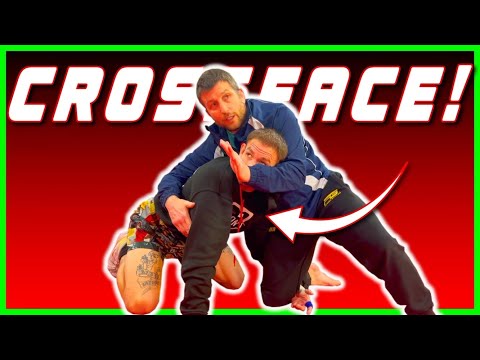
![Self Defense - The Clinch for Close Quarter Combat [Lesson 7]](https://img.youtube.com/vi/qOyK75ysdqo/hqdefault.jpg)