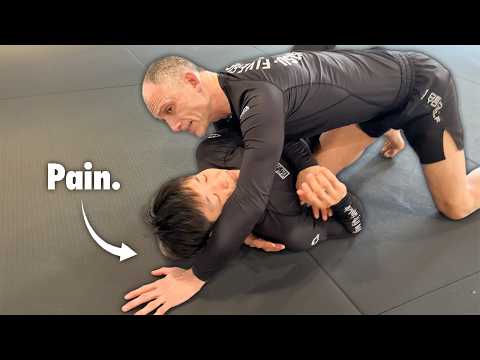
How To Actually Use Your Crossface
0
Crossface Control·Brian Glick
Most people think the crossface is about pushing the chin with your shoulder, but without the underhook that pressure ac…
Translation: crossface control
The Crossface Control subfamily covers clinch positions where the attacker drives a forearm across the opponent's face or jaw to turn the head and control posture, while maintaining arm or body control with the other hand. [1] The crossface uses the forearm as a steering mechanism — by driving across the face, the attacker forces the opponent's head to turn, which rotates the spine and disrupts the opponent's entire structural alignment. [1],[2] Crossface control is used offensively to create angles for takedowns and passes, and defensively to prevent opponents from turning in or recovering position. [2],[3]
The crossface is one of wrestling's most fundamental control techniques, used in folkstyle, freestyle, and Greco-Roman wrestling as a primary tool for turning opponents and controlling position. [1] The technique transferred directly to MMA and BJJ where the crossface from various positions is a standard positional control tool. [2],[3]
Crossface control uses the forearm across the opponent's face or jaw to redirect their head, creating dominant angles for passing, takedowns, and submissions. [1]
Crossface is a fundamental wrestling concept also central to BJJ guard passing. [1]
No images yet for this technique.
Sign in to suggest an image.
Most people think the crossface is about pushing the chin with your shoulder, but without the underhook that pressure ac…
No instructional courses yet for this technique.
Sign in to suggest a course.
Risk of injury to the person this technique is applied to
Head/neck control positions create cervical strain; Muay Thai plum is primary striking platform
Skill level needed to execute this technique reliably
Whether this technique is allowed under major competition rule sets
Freestyle Wrestling: A Complete Guide for Coaches and Wrestlers (Petrov, 1977)
Alias sources — [1] Wrestling Physical Conditioning Encyclopedia (Welker, 2010) [2] NCAA Wrestling Rules and Interpretations (NCAA, 2020) [3] Clinch Fighting for MMA (Couture, 2011)
Effectiveness sources — [1] Wrestling Physical Conditioning Encyclopedia (Petrov, 1977)
Standard katakana transliteration of Western martial arts terminology (外来語) — used in Japanese MMA, boxing, and BJJ communities
Alias sources — [1] Wrestling Physical Conditioning Encyclopedia (Welker, 2010) [2] NCAA Wrestling Rules and Interpretations (NCAA, 2020) [3] Clinch Fighting for MMA (Couture, 2011)
Effectiveness sources — [1] Wrestling Physical Conditioning Encyclopedia (Petrov, 1977)
grip strength, upper body endurance, balance under pressure
strong arms and shoulders, stable base
forearms, deltoids, core, hip muscles
Every move, in any martial art, shares a few universal traits. Mix and match below to pinpoint the right tool — or compare equivalents across styles.
The crossface uses the forearm across the opponent's face/jaw to control head position and deny turns. A fundamental wrestling control and BJJ passing tool. (Coaching Wrestling Successfully, Gable)
According to Brian Glick, you should avoid gripping the neck directly. Instead, use your forearm and elbow to block the chin, which is more effective for controlling your opponent's head position.
Brian Glick explains that you can use your forearm to block your opponent's head from turning inward, and this blocking action allows you to walk their shoulder and maintain control.
Brian Glick notes that you have options depending on the position: you can do an underhook on the far side or near side, or plant your hand on the mat to prevent your opponent from driving in and creating space.
The Crossface Control subfamily covers clinch positions where the attacker drives a forearm across the opponent's face or jaw to turn the head and control posture, while maintaining arm or body control with the other hand. The crossface uses the forearm as a steering mechanism — by driving across the face, the attacker forces the opponent's head to turn, which rotates the spine and disrupts the opponent's entire structural alignment.
The crossface is one of wrestling's most fundamental control techniques, used in folkstyle, freestyle, and Greco-Roman wrestling as a primary tool for turning opponents and controlling position. The technique transferred directly to MMA and BJJ where the crossface from various positions is a standard positional control tool.
Unified MMA: legal — Legal — clinching is integral to MMA; IJF: legal — Legal — kumi-kata (grip fighting) is fundamental to judo; IBJJF: legal — Legal — standing grip fighting and clinch work permitted; IFMA: legal — Legal — the clinch is a core element of Muay Thai, clinch dominance is highly…; WBC/Boxing: restricted — Holding is technically a foul — referee breaks clinch, excessive holding resu…; K: restricted — 1/GLORY — One attack from clinch allowed, then referee breaks; WAKO: restricted — Clinch generally broken by referee — limited or no clinch fighting in most fo…; UWW: legal — Legal — clinch is fundamental to wrestling, the primary position in Greco-Roman
Danger rating 5/10. High — head/neck control positions create cervical strain; Muay Thai plum is primary striking platform
The standard setup chain: Close Distance → Establish Primary Grip → Position the Hips → Apply Pressure.
Standard counters include: Pummeling — fight for inside position by swimming arms under opponent's grips / Frame and Push — create distance using forearm frames against the chest or neck / Grip Break — systematically strip the opponent's controlling grips / Posture Up — straighten the spine and drive the hips forward to break clinch control.
Common variants: Standard variation (primary clinch configuration from the most common entry); Gi variation (adapted with collar and sleeve grips for gi-based grappling); No-gi / MMA variation (modified for no-gi or cage fighting conditions); Offensive variation (configured to set up strikes, takedowns, or submissions f…).
Crossface control is widely used in MMA and wrestling to flatten opponents and control head position. In collegiate wrestling, the crossface is a fundamental ride technique used to accumulate riding time.
Top errors to watch for: Pressing the forearm into the nose or eyes — the crossface should be on the jawline/chin, not the soft face tissue / Pushing straight down instead of across — the crossface turns the head laterally, it doesn't push down / Applying the crossface without controlling the opponent's body with the rest of your position — it's one element of a… / Using excessive force that injures training partners — the crossface is uncomfortable but shouldn't cause injury in t….
The Crossface Control is also known as Kurosu Feisu Kontorōru, Crossface, Cross-Face Position, Crossface Tie.