Dominate the Muay Thai Clinch with Petchboonchu
0
Standard Framing Clinch Position·fightTIPS
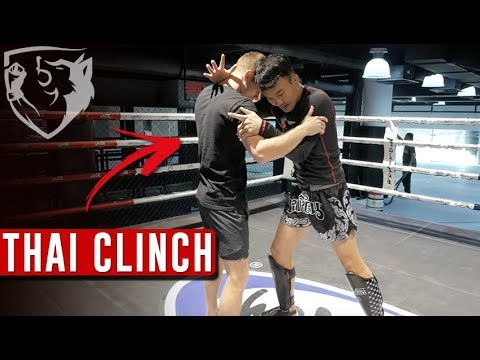
Train with me in Singapore►http://bit.ly/FightTIPSinSingapore I had the honor of taking a private training lesson with P…
Translation: standard framing clinch position
The Standard Framing Clinch Position places one or both forearms against the opponent's upper chest or collarbone area, with the hands positioned at the opponent's shoulders or neck, creating a structural barrier between the fighters. [1] The frame is maintained by keeping the elbows tight to the body and bracing the forearms at the optimal angle — approximately 45-90 degrees — to resist the opponent's forward pressure. [1],[2] From the standard frame, the fighter can push the opponent away to create space, transition to collar ties or underhooks, or use the frame as a platform for disengaging from the clinch entirely. [2],[3]
The framing clinch creates distance between fighters using the forearms as a structural barrier, which is particularly useful for defensive clinch work and for taller fighters managing range. [1] Couture describes the frame as essential for preventing shorter fighters from closing distance and establishing dominant clinch positions. [1]
A core defensive position taught in all grappling and MMA programmes. [1]
The standard framing clinch position is a baseline defensive structure taught in MMA and used at every level of competition from amateur to UFC. [1]
No images yet for this technique.
Sign in to suggest an image.
Train with me in Singapore►http://bit.ly/FightTIPSinSingapore I had the honor of taking a private training lesson with P…
You will, at some point, find yourself inside or dealing with a clinch. It takes two to tango when being in a phonebooth…
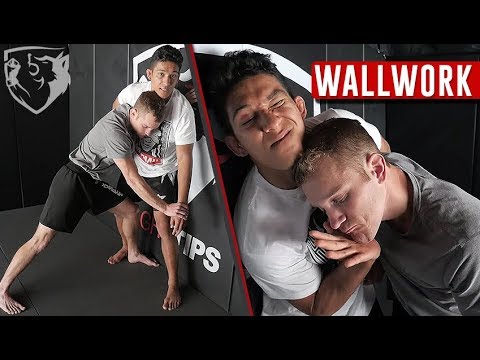
Fighting off the wall or cage is an art in itself, with very specific techniques that utilize leverage and control. 'The…
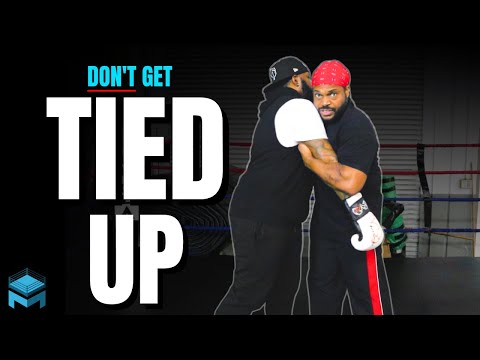
The standard framing clinch position serves as a foundational control structure in clinch fighting, emphasizing hand placement, hip positioning, and postural control. fightTIPS instructor Shane demonstrates with Muay Thai champion Petchboonchu that securing inside arm position—grabbing the triceps in a "steering wheel" configuration—provides dominant control and prevents opponent elbow strikes. Hip positioning must be wider than shoulder-width with bent knees and squared hips to opponent; turning the hips surrenders advantage and invites takedowns. Head placement requires tucked chin while remaining mobile to defend against upward elbows and head pulls. Petchboonchu emphasizes that one hand may grip the back of the head (not neck) while the other controls the arm, with continuous "hand fighting" to contest superior positioning. fightTIPS' Vince demonstrates cage fighting applications, highlighting the same head-hands-hips control framework, noting that head control elevates opponent onto toes and restricts movement. Both instructors stress that the position is not static; it involves constant micro-adjustments and rotations. Marvin Cook provides a philosophical counterpoint, arguing that the clinch is a mutual agreement and can be avoided through angular repositioning and hip mobility, suggesting that shoulder-squared neutral stances should prompt fighters to disengage rather than settle into protracted clinching exchanges.
Synthesized from 3 instructors
No instructional courses yet for this technique.
Sign in to suggest a course.
Risk of injury to the person this technique is applied to
Head/neck control positions create cervical strain; Muay Thai plum is primary striking platform
Skill level needed to execute this technique reliably
Whether this technique is allowed under major competition rule sets
Freestyle Wrestling: A Complete Guide for Coaches and Wrestlers (Petrov, 1977)
Alias sources — [1] Clinch Fighting for MMA (Couture, 2011) [2] MMA Instruction Manual (UFC, 2008) [3] Muay Thai Unleashed (Delp, 2006)
Effectiveness sources — [1] Clinch Fighting for MMA (Couture, 2011)
Standard katakana transliteration of Western martial arts terminology (外来語) — used in Japanese MMA, boxing, and BJJ communities
Alias sources — [1] Clinch Fighting for MMA (Couture, 2011) [2] MMA Instruction Manual (UFC, 2008) [3] Muay Thai Unleashed (Delp, 2006)
Effectiveness sources — [1] Clinch Fighting for MMA (Couture, 2011)
swimming speed for inside position, shoulder drive, hip pressure
strong shoulders and low centre of gravity
deltoids, pectorals, core, quadriceps
You want to get your arms on the inside, grabbing on the triceps in the steering wheel position, or alternatively grab the back of the head instead of both hands on the triceps for more control. According to fightTIPS, adjusting your grip—such as going for the low back instead of the high back—makes a significant difference in how hard it is for your opponent to escape.
Use a wider stance—slightly more than hip-width apart—and bend your knees to lower your center of gravity. Keep your hips square to your opponent; once you start turning and twisting, you're giving your opponent the dominant angle and they'll be able to break your posture.
Control your opponent's head by applying head pressure and managing the chin, which clears space and allows you to move around the cage. Keep your hips low and wide while maintaining centered balance so you can escape or reposition effectively.
Lift your knee while keeping your hips centered underneath you and balanced to break the grip, then swim an underhook or create space to work off the cage. Make sure your hips are nice and low and wide throughout the movement.
The Standard Framing Clinch Position places one or both forearms against the opponent's upper chest or collarbone area, with the hands positioned at the opponent's shoulders or neck, creating a structural barrier between the fighters. The frame is maintained by keeping the elbows tight to the body and bracing the forearms at the optimal angle — approximately 45-90 degrees — to resist the opponent's forward pressure.
The standard framing clinch position is a fundamental defensive tool taught across all combat sports, from boxing's stiff arm to wrestling's post and frame concepts. Its systematic instruction as a clinch defence technique accelerated with the development of MMA coaching methodology.
Unified MMA: legal — Legal — clinching is integral to MMA; IJF: legal — Legal — kumi-kata (grip fighting) is fundamental to judo; IBJJF: legal — Legal — standing grip fighting and clinch work permitted; IFMA: legal — Legal — the clinch is a core element of Muay Thai, clinch dominance is highly…; WBC/Boxing: restricted — Holding is technically a foul — referee breaks clinch, excessive holding resu…; K: restricted — 1/GLORY — One attack from clinch allowed, then referee breaks; WAKO: restricted — Clinch generally broken by referee — limited or no clinch fighting in most fo…; UWW: legal — Legal — clinch is fundamental to wrestling, the primary position in Greco-Roman
Danger rating 5/10. High — head/neck control positions create cervical strain; Muay Thai plum is primary striking platform
The standard setup chain: Close Distance → Establish Primary Grip → Position the Hips → Apply Pressure.
Standard counters include: Pummeling — fight for inside position by swimming arms under opponent's grips / Frame and Push — create distance using forearm frames against the chest or neck / Grip Break — systematically strip the opponent's controlling grips / Posture Up — straighten the spine and drive the hips forward to break clinch control.
Common variants: Single collar tie (one hand on the nape controlling the head); Double collar tie (plum) (both hands behind the head for maximum control); Collar tie with wrist control (one hand on the nape, other controlling the wrist).
The standard framing clinch position is a baseline defensive structure taught in MMA and used at every level of competition from amateur to UFC.
Top errors to watch for: Holding the framing position indefinitely without transitioning — frames buy time, not victory / Letting the opponent collapse the frame by stacking weight on your arms — adjust angle to redirect their pressure / Keeping both arms committed to frames when one could be used offensively — frame with one, act with the other / Not using the hips and legs in conjunction with the frames — frames create space, but hip movement (shrimping) uses it.
The Standard Framing Clinch Position is also known as Furēmingu Kurinchi Pojishon (Kihon-gata), Basic Framing Clinch, Stiff Arm Frame Position, Posting Clinch Position.