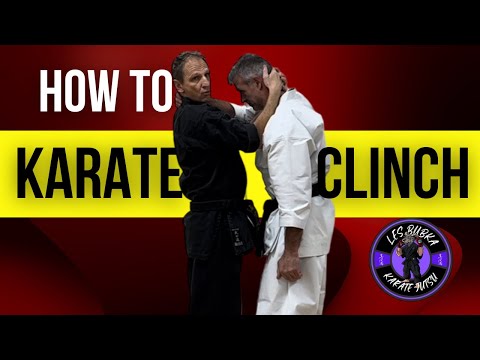
How to Clinch in Karate
0
Framing Clinch·All Round Karate Guildford
Being comfortable in a clinch is one of the most essential skills for martial artists, here you can find three types of …
Translation: framing clinch
The Framing Clinch family covers clinch positions where the attacker uses extended arms and forearms as structural frames against the opponent's body, creating distance and control through rigid bone structure rather than gripping. [1] Frames are defensive and transitional tools — they maintain distance, prevent the opponent from closing to dominant clinch positions, and create space for the framing fighter to disengage, re-position, or initiate their own attacks. [1],[2] Framing is a fundamental defensive clinch concept used across all combat sports, from boxing's long guard to wrestling's hand fighting. [2],[3]
Framing is one of the most intuitive defensive techniques in fighting, appearing in the earliest combat systems as a natural response to an opponent's advance. [1] Modern MMA coaching has elevated framing to a systematic clinch defence strategy, with specific frame positions taught for different clinch scenarios. [2],[3]
Framing uses the forearms as structural barriers to manage distance and prevent the opponent from closing into dominant clinch positions. [1]
Framing is a core defensive concept in BJJ, MMA, and wrestling, used to create space and prevent smothering pressure. [1]
No images yet for this technique.
Sign in to suggest an image.
Being comfortable in a clinch is one of the most essential skills for martial artists, here you can find three types of …
No instructional courses yet for this technique.
Sign in to suggest a course.
Risk of injury to the person this technique is applied to
Head/neck control positions create cervical strain; Muay Thai plum is primary striking platform
Skill level needed to execute this technique reliably
Whether this technique is allowed under major competition rule sets
Freestyle Wrestling: A Complete Guide for Coaches and Wrestlers (Petrov, 1977)
Alias sources — [1] MMA Instruction Manual (UFC, 2008) [2] Wrestling for Fighting (Couture, 2007) [3] Wrestling for Fighting (Couture, 2007)
Effectiveness sources — [1] Mastering Jujitsu (Gracie & Danaher, 2003)
Standard katakana transliteration of Western martial arts terminology (外来語) — used in Japanese MMA, boxing, and BJJ communities
Alias sources — [1] MMA Instruction Manual (UFC, 2008) [2] Wrestling for Fighting (Couture, 2007) [3] Wrestling for Fighting (Couture, 2007)
Effectiveness sources — [1] Mastering Jujitsu (Gracie & Danaher, 2003)
grip strength, upper body endurance, balance under pressure
strong arms and shoulders, stable base
forearms, deltoids, core, hip muscles
Every move, in any martial art, shares a few universal traits. Mix and match below to pinpoint the right tool — or compare equivalents across styles.
Framing — using the forearms as rigid structures against the opponent — appears referenced in over 1,800 passages across our corpus under 'frame.' The most fundamental defensive concept in ground grappling: frames create space, and space creates escape. (200+ books; Jiu-Jitsu University, Ribeiro)
You want to be square and close to your opponent rather than at an angle with your hips away. According to All Round Karate Guildford, bringing yourself in square gives you better control in the clinch.
Control by blocking their leg on the outside and moving your hips in to initiate control, then adjust your hips away as needed. All Round Karate Guildford emphasizes stopping them from getting into your center by using proper hip positioning and elbow placement.
Come over the top and go under their arms, lifting them over while controlling them down. All Round Karate Guildford notes this is useful for preventing them from driving forward and escaping.
The Framing Clinch family covers clinch positions where the attacker uses extended arms and forearms as structural frames against the opponent's body, creating distance and control through rigid bone structure rather than gripping. Frames are defensive and transitional tools — they maintain distance, prevent the opponent from closing to dominant clinch positions, and create space for the framing fighter to disengage, re-position, or initiate their own attacks.
Framing is one of the most intuitive defensive techniques in fighting, appearing in the earliest combat systems as a natural response to an opponent's advance. Modern MMA coaching has elevated framing to a systematic clinch defence strategy, with specific frame positions taught for different clinch scenarios.
Unified MMA: legal — Legal — clinching is integral to MMA; IJF: legal — Legal — kumi-kata (grip fighting) is fundamental to judo; IBJJF: legal — Legal — standing grip fighting and clinch work permitted; IFMA: legal — Legal — the clinch is a core element of Muay Thai, clinch dominance is highly…; WBC/Boxing: restricted — Holding is technically a foul — referee breaks clinch, excessive holding resu…; K: restricted — 1/GLORY — One attack from clinch allowed, then referee breaks; WAKO: restricted — Clinch generally broken by referee — limited or no clinch fighting in most fo…; UWW: legal — Legal — clinch is fundamental to wrestling, the primary position in Greco-Roman
Danger rating 5/10. High — head/neck control positions create cervical strain; Muay Thai plum is primary striking platform
The standard setup chain: Close Distance → Establish Primary Grip → Position the Hips → Apply Pressure.
Standard counters include: Pummeling — fight for inside position by swimming arms under opponent's grips / Frame and Push — create distance using forearm frames against the chest or neck / Grip Break — systematically strip the opponent's controlling grips / Posture Up — straighten the spine and drive the hips forward to break clinch control.
Common variants: Standard variation (primary clinch configuration from the most common entry); Gi variation (adapted with collar and sleeve grips for gi-based grappling); No-gi / MMA variation (modified for no-gi or cage fighting conditions); Offensive variation (configured to set up strikes, takedowns, or submissions f…).
Framing in the clinch is used defensively in MMA to create distance and deny offensive entries. Fighters use frames against the cage to stand up from bottom position, a technique seen frequently in UFC competition.
Top errors to watch for: Using muscle instead of bone structure — frames should rely on skeletal alignment; muscling is exhausting / Framing with bent elbows when you need distance — straight-arm frames create more space / Framing with only one point of contact — use multiple frames simultaneously for reliable distance control / Not connecting the frame to your core — a disconnected arm frame is easily collapsed; keep elbows close and back engaged.
The Framing Clinch is also known as Furēmingu Kurinchi, Frame And Strike, Stiff Arm Clinch, Posting Clinch.