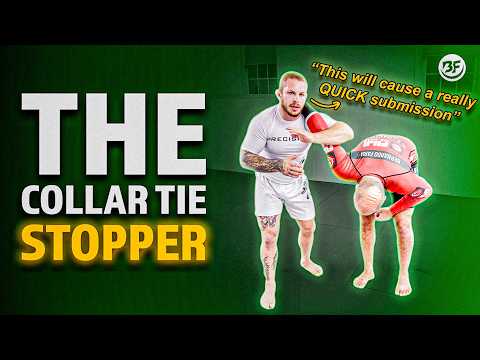
My #1 Attack When Someone Collar Ties Me (Shawn Melanson)
0
Standard Single Collar Tie·Bernardo Faria BJJ Fanatics
Learn Shawn Melanson's number one high-percentage attack from the collar tie! In this Jiu-Jitsu technique video, the hig…
Translation: standard single collar tie
The Standard Single Collar Tie places one hand firmly behind the opponent's neck, gripping at the base of the skull with the thumb on one side and fingers on the other, while the free hand controls the opponent's bicep, wrist, or elbow. [1] The collar tie hand controls the opponent's posture and head position, while the free hand manages the opponent's lead arm to prevent counter-attacks. [1],[2] This is the default starting position for clinch exchanges in wrestling and MMA, serving as the launch point for snap-downs, arm drags, underhook entries, and level changes. [2],[3]
The standard single collar tie has been the foundational clinch engagement position in wrestling for centuries and is the first clinch position taught to beginners in virtually all grappling programmes. [1] Its simplicity and effectiveness have made it a universal starting point for clinch work across all combat disciplines. [2],[3]
The standard single collar tie provides reliable head control with one hand cupping the back of the opponent's neck while maintaining the free hand for offensive or defensive action. [1] Welker identifies it as the single most common clinch position in wrestling, noting that the majority of neutral-position exchanges begin with one or both wrestlers establishing a single collar tie. [1]
A basic wrestling and MMA clinch position taught from beginner level. [1]
No images yet for this technique.
Sign in to suggest an image.
Learn Shawn Melanson's number one high-percentage attack from the collar tie! In this Jiu-Jitsu technique video, the hig…
🔥 BIG ANNOUNCEMENT 🔥 My next instructional "The Easiest Way to Takedown a Bigger Opponent" drops this fall 👀 🗣️ Ge…
0:00 - Start 0:35 - 1. Single Leg 1:06 - 2. Double Leg 1:37 - 3. Single Leg to Double Leg 2:25 - 4. Double Leg to Backta…
The standard single collar tie serves as a foundational clinch position from which multiple attack systems emerge across wrestling, jiu-jitsu, and MMA applications. Wrestling University emphasizes the collar tie as an inevitable position in jiu-jitsu and details three primary methods for transitioning into an underhook when the opponent establishes one: the shoulder slip (the most direct route), the horizontal elbow punch for thumb-blocking defenses, and the inside wrist grip followed by head displacement when the opponent tucks the elbow tight. Once secured in an underhook, the instructor stresses maintaining a high elbow with the hand clasping down to prevent escape. From the underhook, Wrestling University chains multiple high-percentage takedowns including the snatch single leg, knee pick, and snap down, with detailed finishing mechanics for the Cow Catcher arm drag that transitions directly to side control. Bernardo Faria and Shawn Melanson present an alternative attack from the collar tie that targets the elbow itself: by applying thumb pressure to rotate the opponent's elbow upward and inward, the attacker slips into an "elbow-to-elbow" position with continued rotation creating submission pressure that either forces a forward roll into an armbar or generates enough momentum for a takedown. The emphasis across both approaches is continuous rotation and maintaining positional depth. Jeff Chan's contribution on chain takedowns does not directly address collar tie specifics but contextualizes how single and double-leg takedowns can transition through underhook and over-under positions into judo throws and back control. All three instructors agree on the prevalence and utility of the collar tie as a starting point, though they diverge in their preferred attack sequencing: Wrestling University favors leg-based finishes from underhook control, while Melanson favors arm-based submissions triggered by elbow manipulation.
Synthesized from 3 instructors
No instructional courses yet for this technique.
Sign in to suggest a course.
Risk of injury to the person this technique is applied to
Head/neck control positions create cervical strain; Muay Thai plum is primary striking platform
Skill level needed to execute this technique reliably
Whether this technique is allowed under major competition rule sets
Freestyle Wrestling: A Complete Guide for Coaches and Wrestlers (Petrov, 1977)
Alias sources — [1] Wrestling Physical Conditioning Encyclopedia (Welker, 2010) [2] NCAA Wrestling Rules and Interpretations (NCAA, 2020) [3] Clinch Fighting for MMA (Couture, 2011)
Effectiveness sources — [1] Wrestling Physical Conditioning Encyclopedia (Welker, 2010)
Standard katakana transliteration of Western martial arts terminology (外来語) — used in Japanese MMA, boxing, and BJJ communities
Alias sources — [1] Wrestling Physical Conditioning Encyclopedia (Welker, 2010) [2] NCAA Wrestling Rules and Interpretations (NCAA, 2020) [3] Clinch Fighting for MMA (Couture, 2011)
Effectiveness sources — [1] Wrestling Physical Conditioning Encyclopedia (Welker, 2010)
swimming speed for inside position, shoulder drive, hip pressure
strong shoulders and low centre of gravity
deltoids, pectorals, core, quadriceps
Leaving your underhook lazy with your elbow not fully attached allows your opponent to put their bicep to their ear and circle out. Wrestling University emphasizes keeping your elbow as high as possible and your hand clasping down to trap their escape.
According to Shawn Melanson on Bernardo Faria BJJ Fanatics, start by hitting their elbow with your thumb and bringing their arm up to create rotation of their elbow. As their elbow rotates and points toward the sky, slip heavily into an elbow-to-elbow position to set up a submission or takedown.
Wrestling University teaches that you need a solid connection north and south so the grip doesn't slip—punch and clear before stepping in to underhook. If your opponent is quick and avoids the single-leg take down, you can pivot to their far leg for a knee pick instead.
The Standard Single Collar Tie places one hand firmly behind the opponent's neck, gripping at the base of the skull with the thumb on one side and fingers on the other, while the free hand controls the opponent's bicep, wrist, or elbow. The collar tie hand controls the opponent's posture and head position, while the free hand manages the opponent's lead arm to prevent counter-attacks.
The standard single collar tie has been the foundational clinch engagement position in wrestling for centuries and is the first clinch position taught to beginners in virtually all grappling programmes. Its simplicity and effectiveness have made it a universal starting point for clinch work across all combat disciplines.
Unified MMA: legal — Legal — clinching is integral to MMA; IJF: legal — Legal — kumi-kata (grip fighting) is fundamental to judo; IBJJF: legal — Legal — standing grip fighting and clinch work permitted; IFMA: legal — Legal — the clinch is a core element of Muay Thai, clinch dominance is highly…; WBC/Boxing: restricted — Holding is technically a foul — referee breaks clinch, excessive holding resu…; K: restricted — 1/GLORY — One attack from clinch allowed, then referee breaks; WAKO: restricted — Clinch generally broken by referee — limited or no clinch fighting in most fo…; UWW: legal — Legal — clinch is fundamental to wrestling, the primary position in Greco-Roman
Danger rating 5/10. High — head/neck control positions create cervical strain; Muay Thai plum is primary striking platform
The standard setup chain: Close Distance → Cup the Neck → Pull Down → Off-Balance.
Standard counters include: Pummeling — fight for inside position by swimming arms under opponent's grips / Frame and Push — create distance using forearm frames against the chest or neck / Hand Fight — strip grips by peeling fingers or pushing the wrist away / Level Change — change levels to break the collar tie angle and attack the legs.
Common variants: Single collar tie (one hand on the nape controlling the head); Double collar tie (plum) (both hands behind the head for maximum control); Collar tie with wrist control (one hand on the nape, other controlling the wrist).
The single collar tie is one of the most frequently used clinch grips in MMA and wrestling, controlling the opponent's head and posture. It is the standard starting clinch grip in UFC and Bellator competition.
Top errors to watch for: Placing the hand on top of the head instead of behind the neck — the neck cup gives rotational control; head-top give… / Pulling with just the arm — engage the lats, core, and bodyweight for the pulling force / Flaring the elbow outward — the elbow should point down toward the mat for maximum pulling leverage / Holding the collar tie with a stiff arm — maintain a slight bend for shock absorption and dynamic control.
The Standard Single Collar Tie is also known as Sutandādo Shinguru Karā Tai, Basic Single Collar Tie, Fundamental Neck Tie, Standard One-Hand Collar Grip.