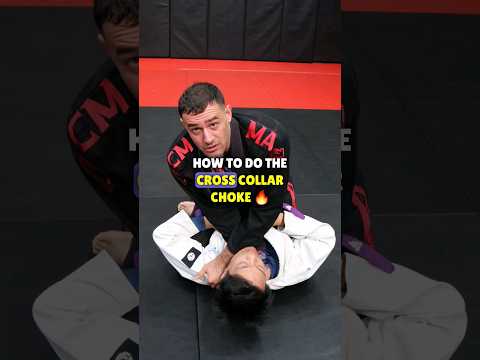
How to Cross Collar Choke from Mount #gordonryan #mma #nogi #bjj #whitebelt #adcc #ufc #adcc #choke
0
Standard Cross-Collar Grip·IsakIvanovicjj
Translation: standard cross-collar grip
The Standard Cross-Collar Grip reaches the attacking hand across the opponent's chest to grip the far lapel or collar, typically at shoulder height. [1] The grip is secured with a deep thumb-inside or thumb-outside hold on the collar material, and the diagonal line of pull creates torque that turns the opponent's body. [1],[2] From the standard cross-collar grip, the attacker can execute powerful forward throws by pulling the opponent's far side forward while driving with the attacking hip. [2],[3]
The standard cross-collar grip is a classical judo gripping technique that has been used in competition since the art's early days, valued for its ability to generate strong rotational forces for throwing. [1] It remains a common offensive gripping strategy in modern judo and BJJ competition. [2],[3]
The standard cross-collar grip reaches across to the opponent's far lapel, creating diagonal tension for rotational throws. [1]
A judo grip variation developed for competition use. [1]
The standard cross-collar grip is a fundamental kumi-kata position in IJF judo competition, used at every level from local to Olympic competition. [1]
No images yet for this technique.
Sign in to suggest an image.
No instructional courses yet for this technique.
Sign in to suggest a course.
Risk of injury to the person this technique is applied to
Grip fighting is primarily positional; finger/wrist strain risk
Skill level needed to execute this technique reliably
Whether this technique is allowed under major competition rule sets
Freestyle Wrestling: A Complete Guide for Coaches and Wrestlers (Petrov, 1977)
Alias sources — [1] Kodokan Judo (Kano, 1986) [2] Kodokan New Japanese-English Dictionary of Judo (IJF, 2000) [3] Best Judo (Inokuma & Sato, 1979)
Effectiveness sources — [1] Kodokan Judo (Kano, 1986)
Official Kodokan ground technique classification system
Standard katakana transliteration of Western martial arts terminology (外来語) — used in Japanese MMA, boxing, and BJJ communities
Alias sources — [1] Kodokan Judo (Kano, 1986) [2] Kodokan New Japanese-English Dictionary of Judo (IJF, 2000) [3] Best Judo (Inokuma & Sato, 1979)
Effectiveness sources — [1] Kodokan Judo (Kano, 1986)
grip strength, upper body endurance, balance under pressure
strong arms and shoulders, stable base
forearms, deltoids, core, hip muscles
The first hand is the hardest to establish because your opponent knows the choke is coming and will defend their neck. You need to overcome their active defense before you can secure the grip.
Keep your weight distributed on the side where you have the grip, and be ready to base out with your other hand if your opponent attempts to roll underneath you.
Your thumb should go right into the back of the lapel heel, then take a solid grip and bring it over your opponent's head to complete the choke.
The Standard Cross-Collar Grip reaches the attacking hand across the opponent's chest to grip the far lapel or collar, typically at shoulder height. The grip is secured with a deep thumb-inside or thumb-outside hold on the collar material, and the diagonal line of pull creates torque that turns the opponent's body.
The standard cross-collar grip is a classical judo gripping technique that has been used in competition since the art's early days, valued for its ability to generate strong rotational forces for throwing. It remains a common offensive gripping strategy in modern judo and BJJ competition.
Unified MMA: legal — Legal — clinching is integral to MMA; IJF: legal — Legal — kumi-kata (grip fighting) is fundamental to judo; IBJJF: legal — Legal — standing grip fighting and clinch work permitted; IFMA: legal — Legal — the clinch is a core element of Muay Thai, clinch dominance is highly…; WBC/Boxing: restricted — Holding is technically a foul — referee breaks clinch, excessive holding resu…; K: restricted — 1/GLORY — One attack from clinch allowed, then referee breaks; WAKO: restricted — Clinch generally broken by referee — limited or no clinch fighting in most fo…; UWW: legal — Legal — clinch is fundamental to wrestling, the primary position in Greco-Roman
Danger rating 2/10. Low — grip fighting is primarily positional; finger/wrist strain risk
The standard setup chain: Close Distance → Establish Primary Grip → Position the Hips → Apply Pressure.
Standard counters include: Pummeling — fight for inside position by swimming arms under opponent's grips / Frame and Push — create distance using forearm frames against the chest or neck / Grip Break — systematically strip the opponent's controlling grips / Posture Up — straighten the spine and drive the hips forward to break clinch control.
Common variants: Standard variation (primary clinch configuration from the most common entry); Gi variation (adapted with collar and sleeve grips for gi-based grappling); No-gi / MMA variation (modified for no-gi or cage fighting conditions); Offensive variation (configured to set up strikes, takedowns, or submissions f…).
The standard cross-collar grip is a fundamental kumi-kata position in IJF judo competition, used at every level from local to Olympic competition.
Top errors to watch for: Inserting the hand on top of the collar instead of inside it — the hand must go inside the collar for a deep grip / Reaching with a straight arm — this exposes you to arm drags and counters / Not controlling the opponent's near arm while inserting — they strip the cross-collar before it's established / Gripping the far collar without pulling to create tension — the grip is only useful when combined with pulling force.
The Standard Cross-Collar Grip is also known as Sutandādo Kurosu Karā Gurippu, Basic Cross Lapel Grab, Standard Gyaku-Eri-Kumi, Fundamental Cross Collar.