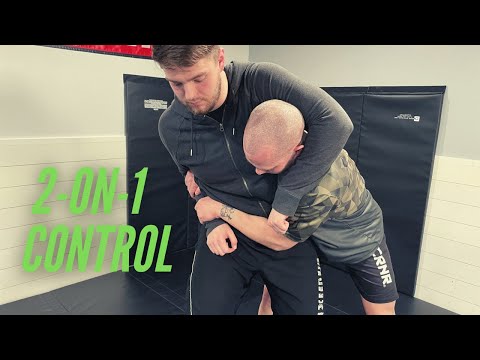
2-On-1 Cross Body Grip Control
0
Cross-Grip·Stay Safe Martial Arts
A powerful grip that can be used to control the movements of your attacker, while also allowing you the ability to take …
Translation: cross-grip
The Cross-Grip family covers clinch gripping configurations where the attacker reaches across the opponent's body to grip the far collar or far sleeve, creating a diagonal or cross-body control that generates strong rotational forces. [1] Cross-grips are powerful because they create torque across the opponent's body — a cross-collar grip pulls the opponent's far shoulder forward, while a cross-sleeve grip controls the far arm at a disadvantageous angle for the defender. [1],[2] Cross-gripping is a recognised offensive strategy in judo, though international rules have periodically restricted defensive or stalling cross-grips. [2],[3]
Cross-gripping strategies developed as judo competition evolved beyond classical hon-kumi gripping. [1] International Judo Federation rules have shaped cross-grip usage through various rule changes — including requirements that an attack must follow within a time limit after establishing a cross-grip — reflecting the technique's power and the desire to prevent purely defensive use. [2],[3]
The cross-grip (reaching across the opponent's body to grip the far lapel or sleeve) creates unique throwing angles that are unavailable from standard gripping. [1] It is a powerful but higher-risk grip strategy — while the cross-grip provides excellent leverage for certain throws, it exposes the attacker to counter-attacks during the reaching phase. [1] Under IJF competition rules, fighters must attack within a time limit after establishing a cross-grip to prevent stalling. [2]
Cross-gripping developed as a tactical grip variation in judo competition, using the opposite hand to grip the collar or sleeve. [1]
Cross-gripping tactics are regulated in IJF competition, with time limits on non-standard grips. [1]
No images yet for this technique.
Sign in to suggest an image.
A powerful grip that can be used to control the movements of your attacker, while also allowing you the ability to take …
No instructional courses yet for this technique.
Sign in to suggest a course.
Risk of injury to the person this technique is applied to
Grip fighting is primarily positional; finger/wrist strain risk
Skill level needed to execute this technique reliably
Whether this technique is allowed under major competition rule sets
Kodokan Judo (Jigoro Kano, 1986)
Alias sources — [1] Kodokan Judo (Kano, 1986) [2] Kodokan Judo (Kano, 1986) [3] Kodokan Judo (Kano, 1986)
Effectiveness sources — [1] Best Judo (Inokuma & Sato, 1979) [2] IJF Sport and Organisation Rules (IJF, 2022)
Standard katakana transliteration of Western martial arts terminology (外来語) — used in Japanese MMA, boxing, and BJJ communities
Alias sources — [1] Kodokan Judo (Kano, 1986) [2] Kodokan Judo (Kano, 1986) [3] Kodokan Judo (Kano, 1986)
Effectiveness sources — [1] Best Judo (Inokuma & Sato, 1979) [2] IJF Sport and Organisation Rules (IJF, 2022)
grip strength, upper body endurance, balance under pressure
strong arms and shoulders, stable base
forearms, deltoids, core, hip muscles
Every move, in any martial art, shares a few universal traits. Mix and match below to pinpoint the right tool — or compare equivalents across styles.
The Cross-Collar Grip subfamily covers positions where the attacker reaches across the opponent's body to grip the far side of the collar or lapel, creating a cross-body connection that generates strong pulling and rotational forces. [1] The cross-collar grip pulls the opponent's far shoulder forward, breaking their posture diagonally and creating entries for throws that exploit the rotational imbalance. [1,2] Techniques like sode-tsurikomi-goshi and cross-grip tai-otoshi are specifically designed to capitalise on the cross-collar grip's unique pulling angle. [2,3]
The Cross-Sleeve Grip subfamily covers positions where the attacker reaches across to grip the opponent's far sleeve, controlling the distant arm at an angle that is mechanically disadvantageous for the defender. [1] The cross-sleeve grip isolates the far arm and creates a diagonal pulling line that can be used to off-balance the opponent or set up techniques that exploit the far-side arm control. [1,2] This grip is commonly combined with a standard collar grip to create an asymmetric control that opens the opponent's body for attacks. [2,3]
Feed one of your opponent's arms down and grab their wrist, keeping it pinched tightly to their side with both hands. Stay Safe Martial Arts emphasizes that this grip control is essential in clinch situations.
Keep the arm pinched as tight as possible, step forward and out with your side leg while bringing your other leg around for a forward takedown. Stay Safe Martial Arts demonstrates this as an effective option from the grip.
Work your way to the side or back quickly to avoid getting caught in their guard, and once their body weight is trapped on the arm, you can release the grip and transition to submissions like arm bars or chokes. Stay Safe Martial Arts notes you'll typically have control of their back at this point.
The Cross-Grip family covers clinch gripping configurations where the attacker reaches across the opponent's body to grip the far collar or far sleeve, creating a diagonal or cross-body control that generates strong rotational forces. Cross-grips are powerful because they create torque across the opponent's body — a cross-collar grip pulls the opponent's far shoulder forward, while a cross-sleeve grip controls the far arm at a disadvantageous angle for the defender.
Cross-gripping strategies developed as judo competition evolved beyond classical hon-kumi gripping. International Judo Federation rules have shaped cross-grip usage through various rule changes — including requirements that an attack must follow within a time limit after establishing a cross-grip — reflecting the technique's power and the desire to prevent purely defensive use.
Unified MMA: legal — Legal — clinching is integral to MMA; IJF: legal — Legal — kumi-kata (grip fighting) is fundamental to judo; IBJJF: legal — Legal — standing grip fighting and clinch work permitted; IFMA: legal — Legal — the clinch is a core element of Muay Thai, clinch dominance is highly…; WBC/Boxing: restricted — Holding is technically a foul — referee breaks clinch, excessive holding resu…; K: restricted — 1/GLORY — One attack from clinch allowed, then referee breaks; WAKO: restricted — Clinch generally broken by referee — limited or no clinch fighting in most fo…; UWW: legal — Legal — clinch is fundamental to wrestling, the primary position in Greco-Roman
Danger rating 2/10. Low — grip fighting is primarily positional; finger/wrist strain risk
The standard setup chain: Close Distance → Establish Primary Grip → Position the Hips → Apply Pressure.
Standard counters include: Pummeling — fight for inside position by swimming arms under opponent's grips / Frame and Push — create distance using forearm frames against the chest or neck / Grip Break — systematically strip the opponent's controlling grips / Posture Up — straighten the spine and drive the hips forward to break clinch control.
Common variants: Standard variation (primary clinch configuration from the most common entry); Gi variation (adapted with collar and sleeve grips for gi-based grappling); No-gi / MMA variation (modified for no-gi or cage fighting conditions); Offensive variation (configured to set up strikes, takedowns, or submissions f…).
Cross-gripping tactics are regulated in IJF competition, with time limits on non-standard grips.
Top errors to watch for: Applying same-side grip tactics to cross-grip situations — the angles and available throws are different / Not fighting for the inside grip — in cross-grip, whoever gets inside lapel grip first dominates / Allowing the opponent to establish a deep cross-grip on your collar without stripping it — this gives them rotational… / Standing square in cross-grip — use angled stances to protect your open side.
The Cross-Grip is also known as Kurosu Gurippu, Gyaku-Kumi, Cross Collar Grip, Diagonal Grip.