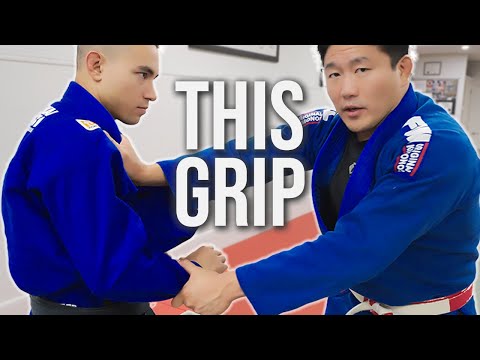
Make the Cross Collar Grip your Go-To System
0
Cross-Collar Grip·Shintaro Higashi
Cross Collar Gripping Series to apply to your judo game! ==============================================================…
Translation: cross-collar grip
The Cross-Collar Grip subfamily covers positions where the attacker reaches across the opponent's body to grip the far side of the collar or lapel, creating a cross-body connection that generates strong pulling and rotational forces. [1] The cross-collar grip pulls the opponent's far shoulder forward, breaking their posture diagonally and creating entries for throws that exploit the rotational imbalance. [1],[2] Techniques like sode-tsurikomi-goshi and cross-grip tai-otoshi are specifically designed to capitalise on the cross-collar grip's unique pulling angle. [2],[3]
The cross-collar grip uses the opposite hand to grip the collar, creating angles for unorthodox throws. [1]
Cross-collar gripping emerged as a competitive tactic in judo to create unexpected throwing angles. [1]
No images yet for this technique.
Sign in to suggest an image.
Cross Collar Gripping Series to apply to your judo game! ==============================================================…
No instructional courses yet for this technique.
Sign in to suggest a course.
Risk of injury to the person this technique is applied to
Grip fighting is primarily positional; finger/wrist strain risk
Skill level needed to execute this technique reliably
Whether this technique is allowed under major competition rule sets
Freestyle Wrestling: A Complete Guide for Coaches and Wrestlers (Petrov, 1977)
Alias sources — [1] Kodokan Judo (Kano, 1986) [2] Kodokan New Japanese-English Dictionary of Judo (IJF, 2000) [3] Best Judo (Inokuma & Sato, 1979)
Effectiveness sources — [1] Kodokan Judo (Kano, 1986)
Official Kodokan ground technique classification system
Standard katakana transliteration of Western martial arts terminology (外来語) — used in Japanese MMA, boxing, and BJJ communities
Alias sources — [1] Kodokan Judo (Kano, 1986) [2] Kodokan New Japanese-English Dictionary of Judo (IJF, 2000) [3] Best Judo (Inokuma & Sato, 1979)
Effectiveness sources — [1] Kodokan Judo (Kano, 1986)
grip strength, upper body endurance, balance under pressure
strong arms and shoulders, stable base
forearms, deltoids, core, hip muscles
Every move, in any martial art, shares a few universal traits. Mix and match below to pinpoint the right tool — or compare equivalents across styles.
Shintaro Higashi emphasizes that you should never reach for the same-side hand, as it causes problems; instead, use the opposite-side hand to establish the cross-collar grip.
Once you secure the grip, take your opponent over your cross-body side rather than the obvious direction, which gives you better control and positioning.
The Cross-Collar Grip subfamily covers positions where the attacker reaches across the opponent's body to grip the far side of the collar or lapel, creating a cross-body connection that generates strong pulling and rotational forces. The cross-collar grip pulls the opponent's far shoulder forward, breaking their posture diagonally and creating entries for throws that exploit the rotational imbalance.
Cross-collar gripping became a prominent strategy in international judo competition as fighters sought to gain advantages outside the classical collar-and-sleeve paradigm. The IJF's evolving regulations on cross-gripping have shaped how this grip is used in modern competition.
Unified MMA: legal — Legal — clinching is integral to MMA; IJF: legal — Legal — kumi-kata (grip fighting) is fundamental to judo; IBJJF: legal — Legal — standing grip fighting and clinch work permitted; IFMA: legal — Legal — the clinch is a core element of Muay Thai, clinch dominance is highly…; WBC/Boxing: restricted — Holding is technically a foul — referee breaks clinch, excessive holding resu…; K: restricted — 1/GLORY — One attack from clinch allowed, then referee breaks; WAKO: restricted — Clinch generally broken by referee — limited or no clinch fighting in most fo…; UWW: legal — Legal — clinch is fundamental to wrestling, the primary position in Greco-Roman
Danger rating 2/10. Low — grip fighting is primarily positional; finger/wrist strain risk
The standard setup chain: Close Distance → Establish Primary Grip → Position the Hips → Apply Pressure.
Standard counters include: Pummeling — fight for inside position by swimming arms under opponent's grips / Frame and Push — create distance using forearm frames against the chest or neck / Grip Break — systematically strip the opponent's controlling grips / Posture Up — straighten the spine and drive the hips forward to break clinch control.
Common variants: Standard variation (primary clinch configuration from the most common entry); Gi variation (adapted with collar and sleeve grips for gi-based grappling); No-gi / MMA variation (modified for no-gi or cage fighting conditions); Offensive variation (configured to set up strikes, takedowns, or submissions f…).
The cross-collar grip is fundamental in judo competition (kumi-kata) and is the starting position for many throws including seoi-nage and tai-otoshi. In BJJ competition, it forms the basis of the cross-collar choke series from guard and mount.
Top errors to watch for: Gripping shallowly — the cross-collar must be deep, with the hand reaching well behind the opponent's neck / Reaching across without controlling the opponent's near-side arm — their free arm can strip your cross-collar grip / Telegraphing the cross-collar reach — disguise it with a push or snap to create the opening / Using the cross-collar grip without knowing the corresponding throw combinations — the grip dictates the technique.
The Cross-Collar Grip is also known as Kurosu Karā Gurippu, Cross Lapel Grip, Gyaku-Eri-Kumi, Opposite Collar Grab.