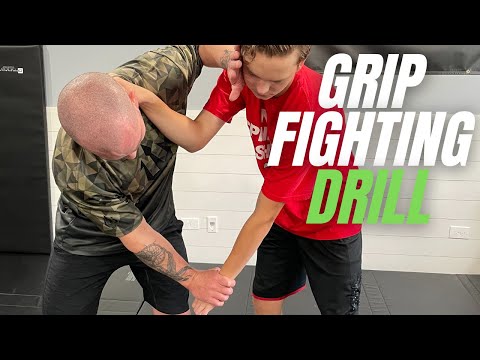
Grip Fighting: Drills for Self Defense
0
Front Belt Grip·Stay Safe Martial Arts
The ability to control as well as break grips is a crucial aspect to self defense. Grip fighting is a great drill to in…
Translation: front belt grip
The Front Belt Grip subfamily covers positions where the attacker grips the opponent's belt from the front, reaching around or over the body to secure the belt at the front of the waist. [1] The front belt grip provides a low, strong anchor point that facilitates forward-direction throws and lifts, as the grip connects the attacker directly to the opponent's centre of gravity. [1],[2] Front belt grips are commonly used in conjunction with collar grips to create powerful pull-and-lift dynamics in judo and sambo. [2],[3]
The front belt grip provides strong hip control through the gi or wrestling singlet, enabling powerful forward throws. [1]
Front belt grips are central to judo and Georgian wrestling (chidaoba). [1]
No images yet for this technique.
Sign in to suggest an image.
The ability to control as well as break grips is a crucial aspect to self defense. Grip fighting is a great drill to in…
No instructional courses yet for this technique.
Sign in to suggest a course.
Risk of injury to the person this technique is applied to
Grip fighting is primarily positional; finger/wrist strain risk
Skill level needed to execute this technique reliably
Whether this technique is allowed under major competition rule sets
Kodokan Judo (Jigoro Kano, 1986)
Alias sources — [1] Kodokan Judo (Kano, 1986) [2] Sumo: A Pocket Guide (Shilling, 2010) [3] Kodokan Judo (Kano, 1986)
Effectiveness sources — [1] Kodokan Judo (Kano, 1986)
Official Kodokan ground technique classification system
Established Japanese martial arts naming convention — native Japanese term (和語/漢語)
Alias sources — [1] Kodokan Judo (Kano, 1986) [2] Sumo: A Pocket Guide (Shilling, 2010) [3] Kodokan Judo (Kano, 1986)
Effectiveness sources — [1] Kodokan Judo (Kano, 1986)
grip strength, upper body endurance, balance under pressure
strong arms and shoulders, stable base
forearms, deltoids, core, hip muscles
Every move, in any martial art, shares a few universal traits. Mix and match below to pinpoint the right tool — or compare equivalents across styles.
The Mawashi Grip is the specific belt grip used in sumo wrestling, where both wrestlers grip each other's mawashi (thick cotton loincloth) to control position and execute throws. [1] The mawashi grip involves reaching around the opponent's body to grab the side or back of the mawashi with a firm overhand or underhand grip, using the fabric as an anchor for pulling, lifting, and throwing manoeuvres. [1,2] In sumo, the quality of the mawashi grip — its depth, position (inside vs. outside), and security — often determines the outcome of the bout. [2,3]
The Standard Front Belt Grip secures the opponent's belt from the front, typically reaching over the opponent's arm or through the clinch to grab the belt at the side or front of the waist. [1] The grip is maintained with a firm overhand wrap around the belt material, pulling it tight to eliminate slack and create a direct connection to the opponent's hips. [1,2] From the standard front belt grip, the attacker can initiate lifts by driving the hips under and pulling up on the belt, or execute throws by combining the belt pull with rotational body movement. [2,3]
If your opponent is grabbing real tight, you can literally grab back to counter their grip and create mutual control.
Design your drills with a beginning accessible to beginners, but construct them so you can build upon and expand them into longer, more complicated sequences rather than just simple one-off techniques.
You can counter-grip slightly and check them back from there, or if they're gripping very tightly, respond by grabbing back to establish your own control.
The Front Belt Grip subfamily covers positions where the attacker grips the opponent's belt from the front, reaching around or over the body to secure the belt at the front of the waist. The front belt grip provides a low, strong anchor point that facilitates forward-direction throws and lifts, as the grip connects the attacker directly to the opponent's centre of gravity.
Front belt grips are a classical judo and sambo gripping strategy, used extensively in competition for initiating forward-throwing techniques like ura-nage and various sacrifice throws. The grip is particularly associated with Georgian and Eastern European judo traditions.
Unified MMA: legal — Legal — clinching is integral to MMA; IJF: legal — Legal — kumi-kata (grip fighting) is fundamental to judo; IBJJF: legal — Legal — standing grip fighting and clinch work permitted; IFMA: legal — Legal — the clinch is a core element of Muay Thai, clinch dominance is highly…; WBC/Boxing: restricted — Holding is technically a foul — referee breaks clinch, excessive holding resu…; K: restricted — 1/GLORY — One attack from clinch allowed, then referee breaks; WAKO: restricted — Clinch generally broken by referee — limited or no clinch fighting in most fo…; UWW: legal — Legal — clinch is fundamental to wrestling, the primary position in Greco-Roman
Danger rating 2/10. Low — grip fighting is primarily positional; finger/wrist strain risk
The standard setup chain: Close Distance → Establish Primary Grip → Position the Hips → Apply Pressure.
Standard counters include: Pummeling — fight for inside position by swimming arms under opponent's grips / Frame and Push — create distance using forearm frames against the chest or neck / Grip Break — systematically strip the opponent's controlling grips / Posture Up — straighten the spine and drive the hips forward to break clinch control.
Common variants: Standard variation (primary clinch configuration from the most common entry); Gi variation (adapted with collar and sleeve grips for gi-based grappling); No-gi / MMA variation (modified for no-gi or cage fighting conditions); Offensive variation (configured to set up strikes, takedowns, or submissions f…).
The front belt grip is a primary attacking grip in judo competition, used to set up throws like uchi-mata and harai-goshi. Under IJF rules, belt grips are legal and commonly used in Olympic and World Championship judo.
Top errors to watch for: Reaching for the belt with a straight arm — bend the elbow to maintain structural connection / Gripping on top of the belt instead of hooking underneath — hooking under gives a stronger grip that's harder to strip / Not using the belt to lift — the front belt grip's advantage is the direct upward pull on the opponent's hips / Holding the belt grip without moving into a throw — the grip is a setup, not an end position.
The Front Belt Grip is also known as Mae Obi-dori, Frontal Obi Grip, Front Mawashi Grip, Mae-Obi-Kumi.