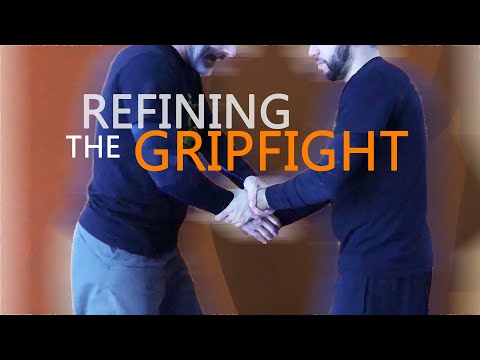
Refining the Grip Fight
0
Belt Grip·Kevin Secours
Grip Fighting is an essential component of entering into a clinch . In this video, we explore how to increase your contr…
Translation: belt grip
The Belt Grip family covers clinch positions where the attacker grips the opponent's belt (obi) as a primary control point, providing direct access to the opponent's hip line through the sturdy belt material. [1] Belt grips are fundamental in judo, sambo, and Georgian wrestling, where the belt serves as a reliable anchor point that cannot be easily stripped. [1],[2] Front belt grips facilitate lifting and forward throws, while rear belt grips provide the dominant back control needed for suplex and mat return techniques. [2],[3]
Belt gripping has been central to judo since its inception, with the obi (belt) serving as one of the primary grip targets in classical kumi-kata. [1] Georgian wrestling (chidaoba) and sambo traditions particularly emphasise belt grips due to the jacket styles worn in these arts. [2] The belt grip remains one of the most powerful positions in gi-based grappling competition. [2],[3]
Belt grip techniques provide direct control of the opponent's centre of mass through the garment, making them among the most mechanically efficient clinch grips in gi-based and belt-based martial arts. [1] Kano describes the belt grip as essential for several major judo throws, particularly those involving hip contact such as o-goshi and tsuri-goshi. [1] In sumo, the belt grip (mawashi grip) determines the outcome of the majority of bouts. [2]
The belt grip has independent lineages in multiple combat traditions. In judo, belt grip techniques (obi-tori) were systematised by Jigoro Kano as part of the Kodokan curriculum from the 1880s onward. [1] In sumo, mawashi grip fighting has been the core of the sport for centuries, formalised through the Japan Sumo Association's training system. [2] In Georgian wrestling (chidaoba), the belt grip is the mandatory starting position, creating a distinct national wrestling tradition centred on belt-based throws. [3]
Belt grips are fundamental in judo competition and were the primary grip in many historical wrestling styles. [1]
No images yet for this technique.
Sign in to suggest an image.
Grip Fighting is an essential component of entering into a clinch . In this video, we explore how to increase your contr…
No instructional courses yet for this technique.
Sign in to suggest a course.
Risk of injury to the person this technique is applied to
Grip fighting is primarily positional; finger/wrist strain risk
Skill level needed to execute this technique reliably
Whether this technique is allowed under major competition rule sets
Kodokan Judo (Jigoro Kano, 1986)
Alias sources — [1] Kodokan Judo (Kano, 1986) [2] Kodokan Judo (Kano, 1986) [3] Greco-Roman Wrestling (Petrov, 1987) [4] Kodokan Judo (Kano, 1986)
Effectiveness sources — [1] Kodokan Judo (Kano, 1986) [2] Sumo: A Pocket Guide (Shilling, 2010)
Official Kodokan ground technique classification system
Established Japanese martial arts naming convention — native Japanese term (和語/漢語)
Alias sources — [1] Kodokan Judo (Kano, 1986) [2] Kodokan Judo (Kano, 1986) [3] Greco-Roman Wrestling (Petrov, 1987) [4] Kodokan Judo (Kano, 1986)
Effectiveness sources — [1] Kodokan Judo (Kano, 1986) [2] Sumo: A Pocket Guide (Shilling, 2010)
grip strength, upper body endurance, balance under pressure
strong arms and shoulders, stable base
forearms, deltoids, core, hip muscles
Every move, in any martial art, shares a few universal traits. Mix and match below to pinpoint the right tool — or compare equivalents across styles.
The Front Belt Grip subfamily covers positions where the attacker grips the opponent's belt from the front, reaching around or over the body to secure the belt at the front of the waist. [1] The front belt grip provides a low, strong anchor point that facilitates forward-direction throws and lifts, as the grip connects the attacker directly to the opponent's centre of gravity. [1,2] Front belt grips are commonly used in conjunction with collar grips to create powerful pull-and-lift dynamics in judo and sambo. [2,3]
The Rear Belt Grip subfamily covers positions where the attacker grips the opponent's belt from behind, reaching around the body to secure the belt at the back of the waist. [1] The rear belt grip establishes powerful back control, connecting the attacker to the opponent's rear hip line where lifting and mat return techniques are most effective. [1,2] Rear belt grips are commonly used in combination with a front grip (collar or lapel) to create a strong asymmetric control position for throws and takedowns. [2,3]
Kevin Secours emphasizes that head position relative to your opponent is more important than hip position in clinching range. You should position your head to one side of your opponent and try to get lower than them regardless of your relative height.
Rather than relying on bicep contractions, Kevin Secours teaches using the longest available levers by pushing with the length of the elbow to liberate the grip. Using your free hand to strike or stabilize your opponent's wrist fulcrum also creates a leverage advantage.
Kevin Secours recommends gripping at the furthest expanse of the firm lever — the bone groove and condyle area — rather than wasting energy on the fingers unless you have a very large hand. This enveloping grip facilitates both rotation and compression.
The Belt Grip family covers clinch positions where the attacker grips the opponent's belt (obi) as a primary control point, providing direct access to the opponent's hip line through the sturdy belt material. Belt grips are fundamental in judo, sambo, and Georgian wrestling, where the belt serves as a reliable anchor point that cannot be easily stripped.
Belt gripping has been central to judo since its inception, with the obi (belt) serving as one of the primary grip targets in classical kumi-kata. Georgian wrestling (chidaoba) and sambo traditions particularly emphasise belt grips due to the jacket styles worn in these arts.
Unified MMA: legal — Legal — clinching is integral to MMA; IJF: legal — Legal — kumi-kata (grip fighting) is fundamental to judo; IBJJF: legal — Legal — standing grip fighting and clinch work permitted; IFMA: legal — Legal — the clinch is a core element of Muay Thai, clinch dominance is highly…; WBC/Boxing: restricted — Holding is technically a foul — referee breaks clinch, excessive holding resu…; K: restricted — 1/GLORY — One attack from clinch allowed, then referee breaks; WAKO: restricted — Clinch generally broken by referee — limited or no clinch fighting in most fo…; UWW: legal — Legal — clinch is fundamental to wrestling, the primary position in Greco-Roman
Danger rating 2/10. Low — grip fighting is primarily positional; finger/wrist strain risk
The standard setup chain: Close Distance → Establish Primary Grip → Position the Hips → Apply Pressure.
Standard counters include: Pummeling — fight for inside position by swimming arms under opponent's grips / Frame and Push — create distance using forearm frames against the chest or neck / Grip Break — systematically strip the opponent's controlling grips / Posture Up — straighten the spine and drive the hips forward to break clinch control.
Common variants: Standard variation (primary clinch configuration from the most common entry); Gi variation (adapted with collar and sleeve grips for gi-based grappling); No-gi / MMA variation (modified for no-gi or cage fighting conditions); Offensive variation (configured to set up strikes, takedowns, or submissions f…).
Belt grips are fundamental in judo competition and were the primary grip in many historical wrestling styles.
Top errors to watch for: Gripping the belt loosely — the belt grip must be firm and deep (fingers hooked under the belt) for maximum control / Pulling the belt without moving your feet — the grip creates opportunities that your footwork must exploit / Relying only on belt grips when the opponent defends them effectively — transition to other grip types / Not pulling the belt upward for lifting throws — the upward pull (tsuri) is what makes belt-grip throws distinctive.
The Belt Grip is also known as Obi-dori, Obi-Kumi, Belt Control, Georgian Grip, Mawashi Grip.