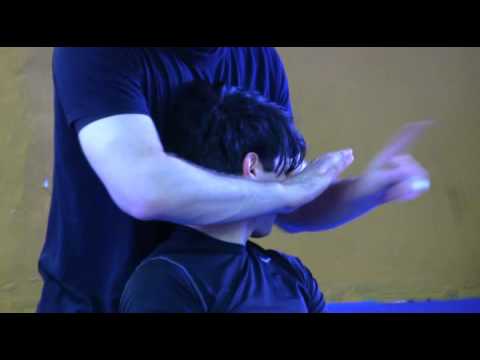
restraint tactics part 10-fine tuning the face lock
0
Front Waist Lock·Kevin Secours
Part 10 of 14 of a class on essential restraint tactics To view Kevin's complete intervention and restraint library, pl…
Translation: front waist lock
The Front Waist Lock subfamily positions the locked grip around the opponent's waist from the front, with the attacker's head typically driven into the opponent's midsection or chest. [1] The front waist lock provides a lower control point than the front body lock, giving the attacker direct access to the opponent's hip line for lift-based takedowns. [1],[2] This position commonly occurs after level changes or when securing double underhooks low on the body, and serves as the immediate precursor to many lifting takedowns. [2],[3]
The front waist lock provides direct control of the opponent's hips, enabling lifts, drives, and trip takedowns. [1]
Front waist lock is a fundamental Greco-Roman and freestyle wrestling position. [1]
No images yet for this technique.
Sign in to suggest an image.
Part 10 of 14 of a class on essential restraint tactics To view Kevin's complete intervention and restraint library, pl…
No instructional courses yet for this technique.
Sign in to suggest a course.
Risk of injury to the person this technique is applied to
Body clinch positions enable throws and takedowns; rib compression risk
Skill level needed to execute this technique reliably
Whether this technique is allowed under major competition rule sets
Freestyle Wrestling: A Complete Guide for Coaches and Wrestlers (Petrov, 1977)
Alias sources — [1] Wrestling Physical Conditioning Encyclopedia (Welker, 2010) [2] Greco-Roman Wrestling (Petrov, 1987) [3] Kodokan Judo (Kano, 1986)
Effectiveness sources — [1] Wrestling Physical Conditioning Encyclopedia (Petrov, 1977)
Established Japanese martial arts naming convention — native Japanese term (和語/漢語)
Alias sources — [1] Wrestling Physical Conditioning Encyclopedia (Welker, 2010) [2] Greco-Roman Wrestling (Petrov, 1987) [3] Kodokan Judo (Kano, 1986)
Effectiveness sources — [1] Wrestling Physical Conditioning Encyclopedia (Petrov, 1977)
swimming speed for inside position, shoulder drive, hip pressure
strong shoulders and low centre of gravity
deltoids, pectorals, core, quadriceps
Every move, in any martial art, shares a few universal traits. Mix and match below to pinpoint the right tool — or compare equivalents across styles.
The front waist lock clasps the hands around the opponent's waist from the front — the primary setup for lifts and slams in Greco-Roman wrestling. In MMA, the front body lock to takedown is one of the highest-percentage clinch sequences. (FILA/UWW Greco-Roman manuals)
You generally want a long lever for maximum mechanical advantage in equal circumstances. Kevin Secours notes that a short lever is only preferable if you need to carry the lock over a long distance, such as on your back.
Avoid pulling the fulcrum, as this will allow your opponent to escape. Kevin Secours emphasizes that once you've positioned the lock properly—with your body embedded in their face—you should lock it in place rather than continuing to adjust the lever angle.
The Front Waist Lock subfamily positions the locked grip around the opponent's waist from the front, with the attacker's head typically driven into the opponent's midsection or chest. The front waist lock provides a lower control point than the front body lock, giving the attacker direct access to the opponent's hip line for lift-based takedowns.
The front waist lock is a fundamental position in both freestyle and Greco-Roman wrestling, serving as the standard clinch position for initiating lifts and hip-displacement takedowns. It has been a core competition technique since the formalisation of modern wrestling.
Unified MMA: legal — Legal — clinching is integral to MMA; IJF: legal — Legal — kumi-kata (grip fighting) is fundamental to judo; IBJJF: legal — Legal — standing grip fighting and clinch work permitted; IFMA: legal — Legal — the clinch is a core element of Muay Thai, clinch dominance is highly…; WBC/Boxing: restricted — Holding is technically a foul — referee breaks clinch, excessive holding resu…; K: restricted — 1/GLORY — One attack from clinch allowed, then referee breaks; WAKO: restricted — Clinch generally broken by referee — limited or no clinch fighting in most fo…; UWW: legal — Legal — clinch is fundamental to wrestling, the primary position in Greco-Roman
Danger rating 4/10. Moderate — body clinch positions enable throws and takedowns; rib compression risk
The standard setup chain: Close Distance → Establish Primary Grip → Position the Hips → Apply Pressure.
Standard counters include: Pummeling — fight for inside position by swimming arms under opponent's grips / Frame and Push — create distance using forearm frames against the chest or neck / Grip Break — systematically strip the opponent's controlling grips / Posture Up — straighten the spine and drive the hips forward to break clinch control.
Common variants: Single underhook (one arm inside for angle and control); Double underhooks (both arms inside for maximum inside position); Underhook with collar tie (combining the underhook with head control).
The front waist lock is a fundamental grip in Greco-Roman wrestling, used to execute lifts and drives at Olympic and World Championship level. It is also the primary clinch position in sambo competition.
Top errors to watch for: Locking above the waist — the grip must be at or below the hip bones for maximum leverage / Not driving the hips into the opponent before throwing — the hip pop initiates the throw / Standing upright with the front waist lock — stay low, knees bent, hips driving forward / Trying to muscle the opponent over without using hip and leg mechanics.
The Front Waist Lock is also known as Mae Koshi-gatame, Front Waist Clinch, Frontal Waist Grip, Mae-Koshi-Kumi.