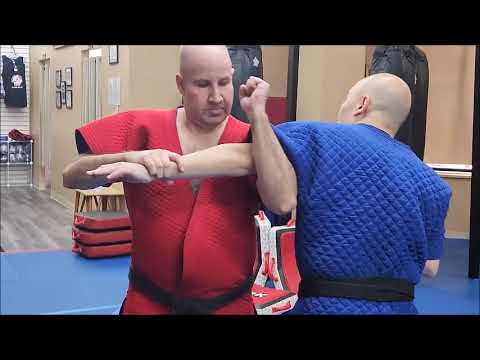
Shuai Jiao essentials! Suǒ Zhǒu Tī the elbow lock and sweep
0
Waist Lock·Lion's Roar Kung Fu
Official Chinese Swai Jiao Association (CSJA) seminar at the national headquarters NY San Da in New York City February 1…
Translation: waist lock
The Waist Lock family covers clinch positions where the attacker's locked grip is specifically positioned around the opponent's waist or hip line, providing direct control of the opponent's centre of gravity. [1] The waist lock is distinguished from the broader body lock by its specific focus on the waist-hip area, where controlling the opponent's base and balance is most effective. [1],[2] Waist locks are the foundation of many wrestling takedown and return techniques, as hip control directly determines an opponent's ability to maintain balance and base. [2],[3]
Waist locks have been central to wrestling since antiquity, with specific waist-grip techniques appearing in every documented wrestling tradition. [1] In Greco-Roman wrestling, the waist lock from par terre position is one of the most fundamental and frequently used control positions for initiating gut wrenches and lifts. [2],[3]
The waist lock is a fundamental control position in both freestyle and Greco-Roman wrestling, providing hip-level control that directly threatens lift and drive takedowns. [1] Welker describes waist lock control as the 'gateway to all lifting attacks' because the grip at the waist maximises the attacker's mechanical advantage for elevation. [1]
The waist lock is one of the oldest grappling positions, fundamental to Greco-Roman wrestling's par terre work and standing clinch fighting. [1]
Waist lock techniques are core scoring methods in Greco-Roman wrestling. [1]
No images yet for this technique.
Sign in to suggest an image.
Official Chinese Swai Jiao Association (CSJA) seminar at the national headquarters NY San Da in New York City February 1…
No instructional courses yet for this technique.
Sign in to suggest a course.
Risk of injury to the person this technique is applied to
Body clinch positions enable throws and takedowns; rib compression risk
Skill level needed to execute this technique reliably
Whether this technique is allowed under major competition rule sets
Freestyle Wrestling: A Complete Guide for Coaches and Wrestlers (Petrov, 1977)
Alias sources — [1] Greco-Roman Wrestling (Petrov, 1987) [2] Kodokan Judo (Kano, 1986) [3] Wrestling Physical Conditioning Encyclopedia (Welker, 2010)
Effectiveness sources — [1] Wrestling Physical Conditioning Encyclopedia (Welker, 2010)
Established Japanese martial arts naming convention — native Japanese term (和語/漢語)
Alias sources — [1] Greco-Roman Wrestling (Petrov, 1987) [2] Kodokan Judo (Kano, 1986) [3] Wrestling Physical Conditioning Encyclopedia (Welker, 2010)
Effectiveness sources — [1] Wrestling Physical Conditioning Encyclopedia (Welker, 2010)
arm length to wrap the torso, squeeze strength, hip drive
long arms and strong grip, powerful lower back
biceps, pectorals, forearms, erector spinae, glutes
Every move, in any martial art, shares a few universal traits. Mix and match below to pinpoint the right tool — or compare equivalents across styles.
The Front Waist Lock subfamily positions the locked grip around the opponent's waist from the front, with the attacker's head typically driven into the opponent's midsection or chest. [1] The front waist lock provides a lower control point than the front body lock, giving the attacker direct access to the opponent's hip line for lift-based takedowns. [1,2] This position commonly occurs after level changes or when securing double underhooks low on the body, and serves as the immediate precursor to many lifting takedowns. [2,3]
The Rear Waist Lock subfamily positions the locked grip around the opponent's waist from behind, with the attacker's chest against the opponent's lower back. [1] The rear waist lock is the standard control position for par terre wrestling and standing rear clinch situations, providing direct control of the opponent's hip line from the back. [1,2] From the rear waist lock, the attacker can execute gut wrenches, mat returns, rear lifts, and suplex variations. [2,3]
Use the 'mirror hand' concept: don't just reach directly at your opponent. Instead, show your hand position clearly so your opponent can see it, which allows you to time and execute the grab successfully most of the time. Lion's Roar Kung Fu emphasizes that direct reaching often results in missed grabs.
Keep the controlled arm straight and extended away from your body. As you move, push the arm away with the corresponding foot and hand—if you walk with your left foot, push with your left; if with your right, stand with your right. Lion's Roar Kung Fu stresses maintaining extension to prevent your opponent from escaping or countering.
As your opponent comes forward, lock the elbow by preventing them from flexing or bending the arm. Shift your weight to control the lock rather than allowing forward momentum, which could result in injury to the opponent.
The Waist Lock family covers clinch positions where the attacker's locked grip is specifically positioned around the opponent's waist or hip line, providing direct control of the opponent's centre of gravity. The waist lock is distinguished from the broader body lock by its specific focus on the waist-hip area, where controlling the opponent's base and balance is most effective.
Waist locks have been central to wrestling since antiquity, with specific waist-grip techniques appearing in every documented wrestling tradition. In Greco-Roman wrestling, the waist lock from par terre position is one of the most fundamental and frequently used control positions for initiating gut wrenches and lifts.
Unified MMA: legal — Legal — clinching is integral to MMA; IJF: legal — Legal — kumi-kata (grip fighting) is fundamental to judo; IBJJF: legal — Legal — standing grip fighting and clinch work permitted; IFMA: legal — Legal — the clinch is a core element of Muay Thai, clinch dominance is highly…; WBC/Boxing: restricted — Holding is technically a foul — referee breaks clinch, excessive holding resu…; K: restricted — 1/GLORY — One attack from clinch allowed, then referee breaks; WAKO: restricted — Clinch generally broken by referee — limited or no clinch fighting in most fo…; UWW: legal — Legal — clinch is fundamental to wrestling, the primary position in Greco-Roman
Danger rating 4/10. Moderate — body clinch positions enable throws and takedowns; rib compression risk
The standard setup chain: Close Distance → Establish Primary Grip → Position the Hips → Apply Pressure.
Standard counters include: Pummeling — fight for inside position by swimming arms under opponent's grips / Frame and Push — create distance using forearm frames against the chest or neck / Grip Break — systematically strip the opponent's controlling grips / Posture Up — straighten the spine and drive the hips forward to break clinch control.
Common variants: Front body lock (locked hands around the torso face-to-face); Rear body lock (hands locked around the torso from behind); Side body lock (angled body lock for trips and throws); Over-arms body lock (locking over both arms to pin the opponent's arms to thei…).
Waist lock techniques are core scoring methods in Greco-Roman wrestling.
Top errors to watch for: Locking too high (around the ribs) — this is a body lock, not a waist lock; the waist lock sits at the hip bones / Not squeezing the lock tight enough — a loose waist lock allows the opponent to post and escape / Using interlaced fingers — always use a Gable grip for security and power / Not maintaining constant pressure (chest or head) into the opponent — the lock alone is insufficient.
The Waist Lock is also known as Koshi-gatame, Waist Clinch, Belt Grip, Midsection Lock.