How to Escape The Body Lock Fast
0
Rear Body Lock·SBG PDX & Vancouver BJJ and MMA Videos
Try out SBG University for a month for free. Use the code: YOUTUBEFREE https://sbgu.samcart.com/referral/OD1DNOAi/vUiYFZ…
Translation: rear body lock
The Rear Body Lock subfamily covers positions where the attacker locks the grip around the opponent's torso from behind, with the attacker's chest against the opponent's back. [1] The rear body lock is one of the most dominant standing clinch positions because the opponent faces away from the attacker and cannot effectively counter-attack — their primary options are grip fighting and hip defence. [1],[2] Rear body lock positions are achieved through go-behinds, arm drag back-takes, or scramble transitions, and provide a platform for mat returns, rear lifts, and suplex throws. [2],[3]
The rear body lock is a fundamental control position in all wrestling styles, with particular emphasis in Greco-Roman wrestling where the rear standing position is one of the most scoring-productive positions in competition. [1] In MMA, the standing rear body lock is a highly valued position for initiating takedowns to back control. [2],[3]
The rear body lock provides dominant back control standing, enabling suplex throws, mat returns, and lifts with minimal risk of counter-attack. [1]
The rear body lock is central to Greco-Roman wrestling's par terre (ground) work and standing back attacks. [1]
Rear body lock throws are high-scoring techniques in Greco-Roman wrestling at Olympic level. [1]
No images yet for this technique.
Sign in to suggest an image.
Try out SBG University for a month for free. Use the code: YOUTUBEFREE https://sbgu.samcart.com/referral/OD1DNOAi/vUiYFZ…
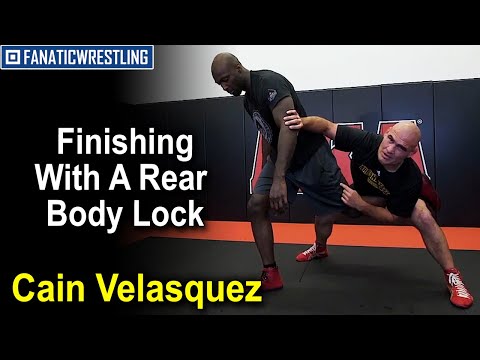
Finishing With A Rear Body Lock by Cain Velasquez https://fanaticwrestling.com/ In this wrestling training video, Cain …
The rear body lock is a clinch control applied from behind the opponent, typically used to secure a takedown, drive positioning, or establish back control in wrestling and grappling contexts. The family encompasses both offensive applications—where the aggressor uses body lock compression to break down and takedown a grounded or near-grounded opponent—and defensive escapes from the position. FANATIC WRESTLING emphasizes the rear body lock as part of a cascading attack chain, stressing that the practitioner must earn the position through pressure, weight distribution, and continuous adjustment; Cain Velasquez demonstrates how to establish the lock after clearing an opponent's defensive framing, then drive through their leg defenses while maintaining tight hip and elbow contact to prevent escape. SBG PDX & Vancouver BJJ frames the body lock primarily as a finish point from stand-up clinch exchanges, focusing on how to construct the position from an arm-drag entry and the critical mechanics of hip placement before establishing the grip. Both instructors highlight that controlling the opponent's hip or hip-bone area is essential to locking the body lock effectively, and that loose or mid-level applications create escape opportunities. The distinction between defensive and offensive framing—stepping back with base versus driving forward—determines whether the lock succeeds in progression or gets neutralized, making positional awareness and controlled pressure the unifying technical principles across variants.
Synthesized from 2 instructors
No instructional courses yet for this technique.
Sign in to suggest a course.
Risk of injury to the person this technique is applied to
Body clinch positions enable throws and takedowns; rib compression risk
Skill level needed to execute this technique reliably
Whether this technique is allowed under major competition rule sets
Freestyle Wrestling: A Complete Guide for Coaches and Wrestlers (Petrov, 1977)
Alias sources — [1] Wrestling Physical Conditioning Encyclopedia (Welker, 2010) [2] Clinch Fighting for MMA (Couture, 2011) [3] Kodokan Judo (Kano, 1986)
Effectiveness sources — [1] Wrestling Physical Conditioning Encyclopedia (Petrov, 1977)
Standard katakana transliteration of Western martial arts terminology (外来語) — used in Japanese MMA, boxing, and BJJ communities
Alias sources — [1] Wrestling Physical Conditioning Encyclopedia (Welker, 2010) [2] Clinch Fighting for MMA (Couture, 2011) [3] Kodokan Judo (Kano, 1986)
Effectiveness sources — [1] Wrestling Physical Conditioning Encyclopedia (Petrov, 1977)
arm length to wrap the torso, squeeze strength, hip drive
long arms and strong grip, powerful lower back
biceps, pectorals, forearms, erector spinae, glutes
Every move, in any martial art, shares a few universal traits. Mix and match below to pinpoint the right tool — or compare equivalents across styles.
The rear body lock (back clinch with double underhooks) is the dominant position for suplexes in Greco-Roman wrestling and for slam takedowns in MMA. (FILA/UWW wrestling manuals)
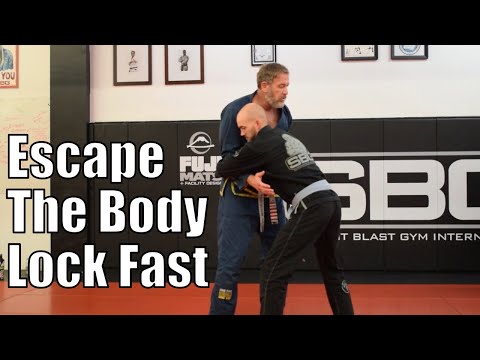
According to SBG PDX & Vancouver BJJ, stepping back with your leg on the side of the attacker's head is the most important initial step to prevent them from driving in with the body lock. Once you break their grip, you can then arch your back to create separation.
SBG PDX & Vancouver BJJ emphasizes bracing against the attacker's shoulder that is connected to you—the shoulder that would execute the takedown—rather than pushing randomly against their arms.
SBG PDX & Vancouver BJJ advises you want to be positioned either all the way high or all the way low—avoid being in the middle. If you're high, you can use a shrug motion to create an escape.
Cain Velasquez teaches that if your opponent pushes for separation, you can maintain the lock and transition back to a double-leg style attack, keeping the grip tight around their body to force them to work harder for the escape.
The Rear Body Lock subfamily covers positions where the attacker locks the grip around the opponent's torso from behind, with the attacker's chest against the opponent's back. The rear body lock is one of the most dominant standing clinch positions because the opponent faces away from the attacker and cannot effectively counter-attack — their primary options are grip fighting and hip defence.
The rear body lock is a fundamental control position in all wrestling styles, with particular emphasis in Greco-Roman wrestling where the rear standing position is one of the most scoring-productive positions in competition. In MMA, the standing rear body lock is a highly valued position for initiating takedowns to back control.
Unified MMA: legal — Legal — clinching is integral to MMA; IJF: legal — Legal — kumi-kata (grip fighting) is fundamental to judo; IBJJF: legal — Legal — standing grip fighting and clinch work permitted; IFMA: legal — Legal — the clinch is a core element of Muay Thai, clinch dominance is highly…; WBC/Boxing: restricted — Holding is technically a foul — referee breaks clinch, excessive holding resu…; K: restricted — 1/GLORY — One attack from clinch allowed, then referee breaks; WAKO: restricted — Clinch generally broken by referee — limited or no clinch fighting in most fo…; UWW: legal — Legal — clinch is fundamental to wrestling, the primary position in Greco-Roman
Danger rating 4/10. Moderate — body clinch positions enable throws and takedowns; rib compression risk
The standard setup chain: Close Distance → Secure Both Arms → Clasp Hands → Hip Drive.
Standard counters include: Pummeling — fight for inside position by swimming arms under opponent's grips / Frame and Push — create distance using forearm frames against the chest or neck / Grip Break — systematically strip the opponent's controlling grips / Posture Up — straighten the spine and drive the hips forward to break clinch control.
Common variants: Front body lock (locked hands around the torso face-to-face); Rear body lock (hands locked around the torso from behind); Side body lock (angled body lock for trips and throws); Over-arms body lock (locking over both arms to pin the opponent's arms to thei…).
Rear body lock throws are high-scoring techniques in Greco-Roman wrestling at Olympic level.
Top errors to watch for: Locking hands around the chest instead of the waist — high locks from behind allow the opponent to drop their weight … / Not pressing your chest into the opponent's back — space allows them to turn and face you / Standing upright behind the opponent — bend your knees and drive your hips into their lower back / Holding the lock without attacking — the opponent will fight the hands and eventually break free.
The Rear Body Lock is also known as Ria Bodi Rokku, Rear Bear Hug Lock, Back Body Lock, Ushiro-Goshi Grip.