Japanese Sword Fighting
0
Japanese Sword — Kenjutsu-Kendo·Jed Cossonay
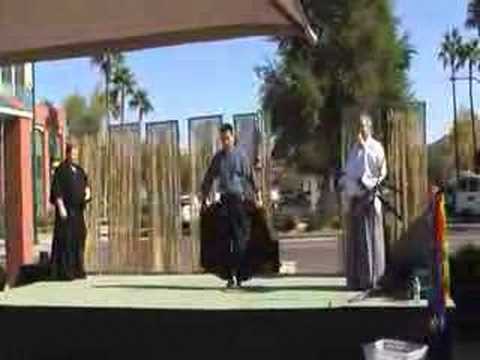
Japanese sword fighting performance took place at The Raku Art Festival in Chandler AZ. This made for any exciting afte…
Перевод: Art of the Sword / Way of the Sword
The Japanese Sword family encompasses the interrelated disciplines of kenjutsu (classical sword combat), kendō (modern bamboo-sword fencing), and iaidō/iaijutsu (the art of drawing and cutting), all practised with the Japanese katana or its training equivalents. [1] The Japanese sword tradition is among the most technically refined and culturally significant weapon arts in world history, with an unbroken lineage stretching from battlefield kenjutsu of the Kamakura period (1185–1333) through the Edo-period refinement of iaidō to the modern competitive sport of kendō. [1],[2] Kenjutsu preserves the combat techniques of the samurai through kata with bokutō or shinken, kendō tests striking skill in full-contact sparring with shinai and bōgu, and iaidō develops the art of the draw-cut through solo kata with iaito or shinken. [2],[3] The great koryū schools — Tenshin Shōden Katori Shintō-ryū (c. 1447), Ittō-ryū, and Yagyū Shinkage-ryū — codified comprehensive sword curricula, while the All Japan Kendo Federation standardised modern kendō and Seitei Iai for international practice. [3],[4]
Japanese swordsmanship traces its origins to the curved tachi swords of the Heian period (794–1185), which evolved into the iconic katana during the Muromachi period (1336–1573). [1] The great kenjutsu ryūha were founded from the fifteenth through seventeenth centuries, with Iizasa Ienao's Tenshin Shōden Katori Shintō-ryū (c. 1447) among the oldest. [2],[3] Iaidō emerged as a distinct discipline in the Edo period, while kendō developed from shinai training methods popularised in the eighteenth century. [3] The All Japan Kendo Federation (AJKF), founded in 1952, standardised modern competition rules, and the International Kendo Federation now governs practice in over sixty nations. [3],[4]
The Japanese sword (katana) and its associated combat systems represent one of the most refined weapon traditions in history. [1] Kenjutsu's effectiveness derives from the katana's unique combination of cutting geometry (curved single-edged blade), two-handed grip (enabling precise control and powerful cuts), and the emphasis on decisive single-strike victories (ikken hissatsu). [2] The Japanese tradition places exceptional emphasis on mental preparedness (zanshin — remaining awareness), distancing (maai), and seizing initiative (sen), which together create a comprehensive combat methodology. [3]
Japanese swordsmanship traces its origins to the koryu (classical martial schools) established from the Kamakura period (1185–1333) onward. [1] The oldest extant school, Tenshin Shoden Katori Shinto-ryu (c. 1450, founder Iizasa Ienao), teaches comprehensive weapon arts including kenjutsu, iaijutsu, and sojutsu. [2] Yagyu Shinkage-ryu (1565, Yagyu Munetoshi from Kamiizumi Nobutsuna's Shinkage-ryu) served as the official sword school of the Tokugawa shoguns. [3] Itto-ryu (c. 1560, Ito Ittosai) is the most influential single-cut school and the primary ancestor of modern kendo through its Ono-ha branch. [4] Modern kendo was standardised by the All Japan Kendo Federation (AJKF, est. 1952) and is governed internationally by the International Kendo Federation (IKF). [5]
The World Kendo Championships (WKC), organised by the IKF, have been held triennially since 1970. [1] Japan has won the men's individual and team competitions at nearly every WKC, with South Korea being the most consistent challenger. [2] The All Japan Kendo Championship (Zen Nippon Kendo Senshuken Taikai) is the most prestigious individual kendo event, held annually since 1953. [3]
Изображений для этой техники пока нет.
Войдите, чтобы предложить изображение.
Japanese sword fighting performance took place at The Raku Art Festival in Chandler AZ. This made for any exciting afte…
Учебных курсов по этой технике пока нет.
Войдите, чтобы предложить курс.
Риск травмы для человека, к которому применяется техника
Edged weapons cause fatal lacerations; historical battlefield mortality rates >30% (Amberger 1999)
Уровень мастерства, необходимый для надёжного выполнения техники
Разрешена ли техника по основным соревновательным правилам
The Book of Five Rings (Miyamoto Musashi, 1645)
Alias sources — [1] Kodokan Judo (Kano, 1986) [2] Kodokan Judo (Kano, 1986) [3] Kodokan Judo (Kano, 1986)
Effectiveness sources — [1] Draeger, D., Classical Bujutsu (Weatherhill, 1973) [2] Warner, G. & Draeger, D., Japanese Swordsmanship: Technique and Practice (Weatherhill, 1982) [3] Yagyu Munenori, Heiho Kadensho: The Life-Giving Sword (Kodansha, trans. Wilson, 2003)
Established Japanese martial arts naming convention — native Japanese term (和語/漢語)
Alias sources — [1] Kodokan Judo (Kano, 1986) [2] Kodokan Judo (Kano, 1986) [3] Kodokan Judo (Kano, 1986)
Effectiveness sources — [1] Draeger, D., Classical Bujutsu (Weatherhill, 1973) [2] Warner, G. & Draeger, D., Japanese Swordsmanship: Technique and Practice (Weatherhill, 1982) [3] Yagyu Munenori, Heiho Kadensho: The Life-Giving Sword (Kodansha, trans. Wilson, 2003)
wrist control for edge alignment, grip endurance, footwork precision
quick wrists, strong forearms, good posture
forearm extensors/flexors, deltoids, core, calves
Каждое движение в любом боевом искусстве обладает рядом универсальных свойств. Комбинируйте параметры ниже, чтобы найти нужный инструмент или сравнить аналоги из разных стилей.
The Iaidō Draw Cut subfamily covers the techniques of drawing the Japanese sword from its scabbard and delivering an immediate cutting strike in a single fluid motion — the defining action of iaidō and iaijutsu. [1] Iaidō kata follow a four-phase structure: nukitsuke (initial draw-cut), kiritsuke (main cutting action), chiburi (blood removal), and noto (resheathing). [1,2] The Musō Shinden-ryū and Musō Jikiden Eishin-ryū are the two most widely practised iaidō lineages, and the AJKF's Zen Nippon Kendō Renmei Iai (Seitei Iai) set of twelve standardised kata is the most commonly tested curriculum worldwide. [2,3]
The Kamae subfamily encompasses the five standard sword guards (go-gyō-no-kamae) used across Japanese sword arts — chūdan, jōdan, gedan, hassō, and waki-gamae. [1] Each kamae positions the sword to defend specific lines while threatening others, creating a matrix of tactical options for attack, defence, and counter-attack. [1,2] Kamae are not static postures but dynamic states from which techniques flow; the choice of kamae communicates intent and invites or denies specific opponent actions. [2,3]
The Kendō Waza subfamily covers the competitive techniques of kendō — the four valid target strikes (men, kote, dō, tsuki), the footwork that delivers them, and the tactical categories of shikake-waza (initiating techniques) and ōji-waza (counter techniques). [1] Each strike must satisfy the criteria of ki-ken-tai-ichi — the simultaneous expression of fighting spirit (kiai), correct blade contact (datotsu-bu), and body commitment (fumikomi) — to be awarded ippon by the referees. [1,2] Kendō waza are trained through kihon drills, kata with bokutō, and applied in ji-geiko (free sparring), developing both technical skill and mental discipline. [2,3]
The Kenjutsu Cut subfamily encompasses the primary cutting techniques of classical Japanese swordsmanship, classified by their trajectory and target. [1] The major cuts include shōmen-uchi (straight downward to the centreline), kesagiri (diagonal cut following the line of a monk's kesa sash), yokogiri (horizontal cut), and gyaku-kesagiri (reverse diagonal). [1,2] Proper kenjutsu cutting mechanics require coordination of the hips, shoulders, and hasuji (blade alignment) to deliver cuts that would cleanly bisect a target with a live blade. [2,3]
Japanese swordsmanship (kenjutsu/kendo/iaido) is documented extensively across our book corpus. Kenjutsu is the battlefield sword art; kendo is the modern sport form using bamboo swords (shinai) and armor (bogu); iaido is the art of drawing and cutting in a single motion. (Draeger, Classical Budo; multiple books in corpus)
Noto is the technique of returning the sword back to the scabbard. According to Jed Cossonay, it is performed entirely by feel without looking at the mouth of the scabbard, and the Japanese were the only country to invent this kind of technique.
Kyshaku translates to a dueling match equivalent to pistol dueling. Historically, it was used to mercifully cut off the head of someone committing harakiri to save them from pain, according to Jed Cossonay.
Jed Cossonay emphasizes that while speed is important in iaido practice, technique is more important, and practitioners should concentrate more on correct technique than on quickness.
According to Jed Cossonay, iaido does not have tournaments as that is not the purpose of the art, whereas karate, judo, and kendo require tournaments to function.
The Japanese Sword family encompasses the interrelated disciplines of kenjutsu (classical sword combat), kendō (modern bamboo-sword fencing), and iaidō/iaijutsu (the art of drawing and cutting), all practised with the Japanese katana or its training equivalents. The Japanese sword tradition is among the most technically refined and culturally significant weapon arts in world history, with an unbroken lineage stretching from battlefield kenjutsu of the Kamakura period (1185–1333) through the Edo-period refinement of iaidō to the modern competitive sport of kendō.
Japanese swordsmanship traces its origins to the curved tachi swords of the Heian period (794–1185), which evolved into the iconic katana during the Muromachi period (1336–1573). The great kenjutsu ryūha were founded from the fifteenth through seventeenth centuries, with Iizasa Ienao's Tenshin Shōden Katori Shintō-ryū (c.
FIE: разрешён — Legal fencing technique — governed by FIE rules for foil, épée, and sabre; HEMA: разрешён — Legal in historical fencing competition
Оценка опасности 9/10. Extreme — edged weapons cause fatal lacerations; historical battlefield mortality rates >30% (Amberger 1999)
Стандартная цепочка подготовки: Assume Guard (Kamae/Hut) → Measure Distance (Ma-ai) → Initiate Cut/Thrust → Follow Through (Zanshin).
Стандартные контрприёмы: Parry (Absetzen) — deflect the incoming blade with a counter-displacement / Void (Step Back) — withdraw from measure to avoid the cutting arc / Counter-Cut (Nachreisen) — strike into the opponent's opening during their attack.
Распространённые варианты: Standard cut (primary cutting angle from the ready stance); Thrust (tsuki) (straight thrust targeting the throat, chest, or face); Rising cut (kiri-age) (upward diagonal cut from low to high); Diagonal cut (kesa-giri) (downward diagonal cut following the kimono line).
The World Kendo Championships (WKC), organised by the IKF, have been held triennially since 1970. Japan has won the men's individual and team competitions at nearly every WKC, with South Korea being the most consistent challenger.
Основные ошибки, на которые стоит обратить внимание: Treating kendo and kenjutsu as the same art — kendo is sport; kenjutsu is martial technique; the goals and methods di… / Using arm strength for cutting — Japanese sword cuts use whole-body mechanics: hips, core, and tenouchi (grip squeeze… / Ignoring proper etiquette (reigi) — Japanese sword arts place enormous importance on respect and proper conduct / Not studying kamae (stances) — the five fundamental stances are the foundation of all Japanese sword techniques.
Japanese Sword — Kenjutsu-Kendo также известен как Japanese Swordsmanship, Ken-jutsu, Ken-do.