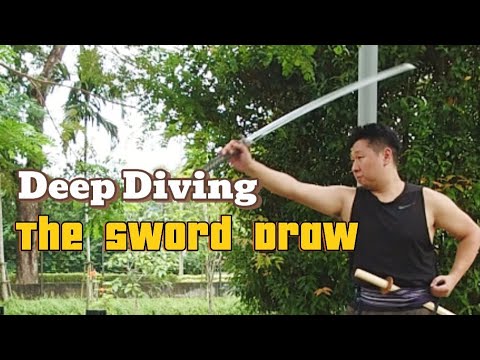
Iaido Training Analysis : The Draw Cut Technique
0
Iaido Draw Cut·Namazu Ryu Saiken
Extension from my last video, this is also a video deep diving into the draw cut technique
Перевод: Drawing-Sword Cutting Art
The Iaidō Draw Cut subfamily covers the techniques of drawing the Japanese sword from its scabbard and delivering an immediate cutting strike in a single fluid motion — the defining action of iaidō and iaijutsu. [1] Iaidō kata follow a four-phase structure: nukitsuke (initial draw-cut), kiritsuke (main cutting action), chiburi (blood removal), and noto (resheathing). [1],[2] The Musō Shinden-ryū and Musō Jikiden Eishin-ryū are the two most widely practised iaidō lineages, and the AJKF's Zen Nippon Kendō Renmei Iai (Seitei Iai) set of twelve standardised kata is the most commonly tested curriculum worldwide. [2],[3]
Iaijutsu is traditionally attributed to Hayashizaki Jinsuke Shigenobu (c. 1546–1621), who is revered as the founder of the art of sword-drawing. [1] His teachings branched into numerous ryūha, the two most prominent being Musō Shinden-ryū (via Nakayama Hakudō) and Musō Jikiden Eishin-ryū (via Ōe Masamichi). [2],[3] The AJKF established the Seitei Iai kata set in 1969, originally seven forms expanded to twelve by 2000. [3]
Iaido's draw cut (nukitsuke) is the art of cutting an opponent in a single motion as the sword is drawn from the scabbard (saya). [1] Its martial effectiveness rests on the element of surprise — drawing and cutting as a single action eliminates the time an opponent would have to react to a visible sword. [2] The technical difficulty of generating cutting power during the draw requires precise body mechanics, hip rotation, and saya-biki (pulling the scabbard backward) coordination. [2]
Iaido descends from iaijutsu as practised in koryu schools, particularly Muso Shinden-ryu (founded by Hayashizaki Jinsuke Shigenobu, c. 1560s) and Muso Jikiden Eishin-ryu. [1] Modern iaido practice was standardised by the AJKF through the Seitei Iai (now Zen Nippon Kendo Renmei Iai) kata set, established in 1968 and periodically revised. [2]
Iaidō draw-cutting is competed in AJKF and ZNKR iaidō competitions, judged on form, precision, and spirit. The All Japan Iaidō Championship has been held annually since 1966. [1]
Изображений для этой техники пока нет.
Войдите, чтобы предложить изображение.
Extension from my last video, this is also a video deep diving into the draw cut technique
Учебных курсов по этой технике пока нет.
Войдите, чтобы предложить курс.
Риск травмы для человека, к которому применяется техника
Edged weapons cause fatal lacerations; historical battlefield mortality rates >30% (Amberger 1999)
Уровень мастерства, необходимый для надёжного выполнения техники
Разрешена ли техника по основным соревновательным правилам
The Book of Five Rings (Miyamoto Musashi, 1645)
Alias sources — [1] Japanese Swordsmanship (Warner & Draeger, 1982) [2] Secrets of the Samurai (Ratti & Westbrook, 1973) [3] Secrets of the Samurai (Ratti & Westbrook, 1973)
Effectiveness sources — [1] Draeger, D., Classical Budo (Weatherhill, 1973) [2] Warner, G. & Draeger, D., Japanese Swordsmanship: Technique and Practice (Weatherhill, 1982)
Established Japanese martial arts naming convention — native Japanese term (和語/漢語)
Alias sources — [1] Japanese Swordsmanship (Warner & Draeger, 1982) [2] Secrets of the Samurai (Ratti & Westbrook, 1973) [3] Secrets of the Samurai (Ratti & Westbrook, 1973)
Effectiveness sources — [1] Draeger, D., Classical Budo (Weatherhill, 1973) [2] Warner, G. & Draeger, D., Japanese Swordsmanship: Technique and Practice (Weatherhill, 1982)
wrist control for edge alignment, grip endurance, footwork precision
quick wrists, strong forearms, good posture
forearm extensors/flexors, deltoids, core, calves
Каждое движение в любом боевом искусстве обладает рядом универсальных свойств. Комбинируйте параметры ниже, чтобы найти нужный инструмент или сравнить аналоги из разных стилей.
The Horizontal Draw Cut (nukitsuke) is the standard opening action of iaidō: from seiza or standing, the right hand draws the blade while the left hand pulls the saya rearward (sayabiki), and the blade is delivered in a horizontal cut to the opponent's temple or eyes at the moment of full extraction. [1] The cutting action is powered by hip rotation and the expansion of the arms, not by arm strength alone, and the blade must leave the saya with the kissaki tracing a straight horizontal line. [1,2] This draw-cut is the defining technique of iaidō, embodying the principle that the first strike from a seemingly passive state can be decisive. [2,3]
The Rising Draw Cut is an iaidō nukitsuke variant in which the blade is drawn upward in a rising arc rather than horizontally, cutting from the opponent's lower body toward the upper body or face. [1] This draw-cut is used in specific iaidō kata that address threats from a low or seated position, where the upward trajectory exploits the attacker's proximity. [1,2] The rising draw-cut requires precise coordination of sayabiki and blade extraction, as the upward motion demands different timing than the standard horizontal nukitsuke. [2,3]
The draw cut combines elbow leverage to create a large cutting arch with tenuchi (wrist acceleration) applied at the moment of target contact to maximize cutting power. Namazu Ryu Saiken emphasizes that timing the tenuchi acceleration properly—not too early—is critical for generating effective cutting speed through the target.
The Iaidō Draw Cut subfamily covers the techniques of drawing the Japanese sword from its scabbard and delivering an immediate cutting strike in a single fluid motion — the defining action of iaidō and iaijutsu. Iaidō kata follow a four-phase structure: nukitsuke (initial draw-cut), kiritsuke (main cutting action), chiburi (blood removal), and noto (resheathing).
Iaijutsu is traditionally attributed to Hayashizaki Jinsuke Shigenobu (c. 1546–1621), who is revered as the founder of the art of sword-drawing.
FIE Sabre: разрешён — Legal cutting technique to upper body target area; FIK Kendo: разрешён — Legal if targeting valid area with correct form; WEKAF: разрешён — Legal striking technique; HEMA: разрешён — Legal in applicable weapon categories
Оценка опасности 9/10. Extreme — edged weapons cause fatal lacerations; historical battlefield mortality rates >30% (Amberger 1999)
Стандартная цепочка подготовки: Assume Guard (Kamae/Hut) → Measure Distance (Ma-ai) → Initiate Cut/Thrust → Follow Through (Zanshin).
Стандартные контрприёмы: Parry (Absetzen) — deflect the incoming blade with a counter-displacement / Void (Step Back) — withdraw from measure to avoid the cutting arc / Counter-Cut (Nachreisen) — strike into the opponent's opening during their attack.
Распространённые варианты: Standard cut (primary cutting angle from the ready stance); Thrust (tsuki) (straight thrust targeting the throat, chest, or face); Rising cut (kiri-age) (upward diagonal cut from low to high); Diagonal cut (kesa-giri) (downward diagonal cut following the kimono line).
Iaidō draw-cutting is competed in AJKF and ZNKR iaidō competitions, judged on form, precision, and spirit. The All Japan Iaidō Championship has been held annually since 1966.
Основные ошибки, на которые стоит обратить внимание: Drawing the sword with arm strength alone — the draw uses hip rotation and saya-biki (pulling the scabbard back) for … / Not coordinating the drawing hand with the scabbard hand — both hands must work together for a fast, clean draw / Rushing through the draw cut without precision — speed must not sacrifice cutting accuracy / Not maintaining zanshin after the cut — the awareness and readiness after the technique are integral to iaido.
Iaido Draw Cut также известен как Battojutsu, Iaijutsu Draw, Sword Drawing Art.