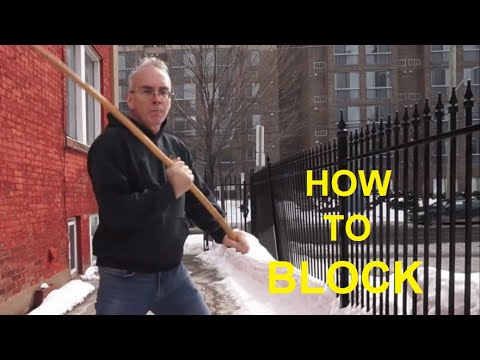
How To Block With A Bo Staff
0
Bo Block·Badger Jones
Nobody wants to get hit with a staff, but keeping that from happening isn't so simple. Here's how to do it, the techniq…
Перевод: Staff Blocks
Defensive techniques using the long staff to intercept, redirect, or absorb incoming strikes.
Blocking techniques with the bo (uke-waza) are documented in the oldest surviving Okinawan kobudo kata, including Shushi no Kon and Sakugawa no Kon, which oral tradition dates to the 18th century. [1] These defensive methods use the full length of the staff to intercept incoming strikes, employing the principle of receiving force along the weapon's axis rather than perpendicular to it. [2] Bo blocking was refined in the kata-based transmission system of Okinawan masters, with Taira Shinken's systematisation in the early 20th century establishing standardised blocking forms still practised today. [1]
Bō blocks use the staff's length to intercept attacks at a safe distance, with the ability to redirect force and counter-attack immediately. [1]
Bō blocking techniques were developed in both Okinawan kobudō and Japanese koryū bōjutsu traditions. [1]
Bō blocking is demonstrated in kobudō kata competition and koryū embu events. [1]
Изображений для этой техники пока нет.
Войдите, чтобы предложить изображение.
Nobody wants to get hit with a staff, but keeping that from happening isn't so simple. Here's how to do it, the techniq…
This video looks at some close range applications for the outside block with bo.
Учебных курсов по этой технике пока нет.
Войдите, чтобы предложить курс.
Риск травмы для человека, к которому применяется техника
Staff/bo/jo weapons generate significant blunt force; fracture risk
Уровень мастерства, необходимый для надёжного выполнения техники
Разрешена ли техника по основным соревновательным правилам
The Essence of Okinawan Karate-Do (Shoshin Nagamine, 1976)
Alias sources — [1] Kobudo: Okinawan Weapons (Demura, 1976) [2] Comprehensive Asian Fighting Arts (Draeger & Smith, 1969) [3] Comprehensive Asian Fighting Arts (Draeger & Smith, 1969)
History sources — [1] Bishop, M., Okinawan Kobudo (Tuttle, 1999) [2] Draeger, D. & Smith, R., Comprehensive Asian Fighting Arts (Kodansha, 1969)
Established Japanese martial arts naming convention — native Japanese term (和語/漢語)
Alias sources — [1] Kobudo: Okinawan Weapons (Demura, 1976) [2] Comprehensive Asian Fighting Arts (Draeger & Smith, 1969) [3] Comprehensive Asian Fighting Arts (Draeger & Smith, 1969)
History sources — [1] Bishop, M., Okinawan Kobudo (Tuttle, 1999) [2] Draeger, D. & Smith, R., Comprehensive Asian Fighting Arts (Kodansha, 1969)
wrist snap speed, sliding grip coordination, hip rotation
long reach and strong wrists for staff manipulation
forearms, wrist rotators, core rotators, shoulders
Каждое движение в любом боевом искусстве обладает рядом универсальных свойств. Комбинируйте параметры ниже, чтобы найти нужный инструмент или сравнить аналоги из разных стилей.
Steel Mace Karate recommends gripping the bo with your hand positioned close to the neck (the center area) rather than high on the staff, as this gives you better control and effectiveness for the technique.
According to Badger Jones, many students have difficulty learning this block because it requires real coordination and timing to execute the eight-motion defense effectively on either side.
Defensive techniques using the long staff to intercept, redirect, or absorb incoming strikes.
Blocking techniques with the bo (uke-waza) are documented in the oldest surviving Okinawan kobudo kata, including Shushi no Kon and Sakugawa no Kon, which oral tradition dates to the 18th century. These defensive methods use the full length of the staff to intercept incoming strikes, employing the principle of receiving force along the weapon's axis rather than perpendicular to it.
Traditional martial arts: разрешён — Practiced in traditional kata/forms and weapon-specific competition under var…; IWUF: разрешён — Legal in wushu taolu if applicable; HEMA: разрешён — Legal in applicable historical weapon categories
Оценка опасности 7/10. Very High — staff/bo/jo weapons generate significant blunt force; fracture risk
Стандартная цепочка подготовки: Grip and Stance → Chamber → Strike → Recovery.
Стандартные контрприёмы: Guard Position — return to a defensive ready stance / Distance Management — control the measure to avoid being in range / Counter-Attack — strike during the opponent's recovery or between movements.
Распространённые варианты: Overhead strike (bringing the staff down from above in a vertical arc); Lateral strike (horizontal sweep targeting the ribs or head); Thrust (straight thrust with the end of the staff); Butt-end strike (striking with the rear end of the staff at close range).
Bō blocking is demonstrated in kobudō kata competition and koryū embu events.
Основные ошибки, на которые стоит обратить внимание: Blocking with the tip of the staff — the middle section between the hands is the strongest blocking zone / Using only one hand to block — both hands must engage to control the staff and absorb impact / Meeting force directly — angle the block to deflect rather than stop the incoming weapon / Holding the staff too close to one end — the hands should be spaced to allow leverage and control.
Bo Block также известен как Bo Uke, Staff Block, Bojutsu Uke.