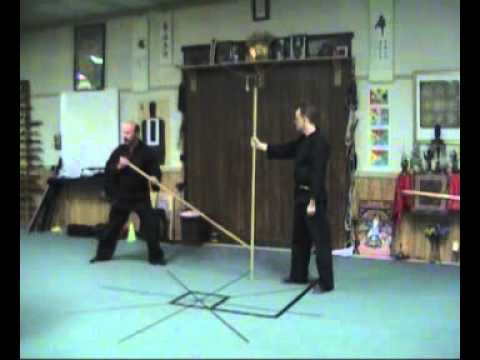
Ninja Bojutsu - Long Staff Lesson
0
Bojutsu — Long Staff·Jeffrey Miller
This is a sample lesson from the online weapons training course, featuring the rokushaku-bo 6' staff weapon of the Ninja…
Перевод: Staff Art
Japanese long staff (rokushakubo, approximately 6 feet) techniques including strikes, blocks, and sweeps from Okinawan kobudo and mainland traditions.
Bojutsu (long staff art) developed independently in both Okinawa and mainland Japan. In Okinawa, bo techniques evolved within the kobudo tradition alongside sai, tonfa, and nunchaku, with oral histories tracing organised bo training to the 15th–16th centuries during the Ryukyu Kingdom's weapons prohibition periods. [1] On mainland Japan, the rokushakubo (six-foot staff) was incorporated into the curricula of numerous koryu schools, including Tenshin Shoden Katori Shinto-ryu (founded c. 1447) and Kukishin-ryu. [2] The modern preservation of bojutsu owes much to Taira Shinken (1897–1970), who systematised Okinawan kobudo kata and founded the Ryukyu Kobudo Hozon Shinko Kai, and to Matayoshi Shinpo (1921–1997), who continued the Matayoshi Kobudo lineage. [1],[3]
The bo (six-foot staff) is one of the most versatile traditional weapons, capable of striking, thrusting, sweeping, and blocking from multiple angles, with the ability to use either end for attacks. [1] Its length provides superior reach over sword-length weapons, and its non-lethal nature (compared to bladed weapons) made it a preferred weapon for monks and travellers in feudal Japan. [2]
Bo-jutsu is included in the curriculum of many Okinawan and Japanese koryu traditions. [1] In Okinawa, bo-jutsu developed as part of the kobudo (old martial way) weapons tradition alongside sai, tonfa, and nunchaku. [2] Major bo-jutsu lineages include Matayoshi Kobudo and Taira Shinken's Ryukyu Kobudo Hozon Shinko Kai. [2]
Bōjutsu is competed in kobudō kata divisions at karate tournaments and demonstrated at Okinawan kobudō events and Japanese koryū embu. [1]
Изображений для этой техники пока нет.
Войдите, чтобы предложить изображение.
This is a sample lesson from the online weapons training course, featuring the rokushaku-bo 6' staff weapon of the Ninja…
Учебных курсов по этой технике пока нет.
Войдите, чтобы предложить курс.
Риск травмы для человека, к которому применяется техника
Staff/bo/jo weapons generate significant blunt force; fracture risk
Уровень мастерства, необходимый для надёжного выполнения техники
Разрешена ли техника по основным соревновательным правилам
The Essence of Okinawan Karate-Do (Shoshin Nagamine, 1976)
Alias sources — [1] Kodokan Judo (Kano, 1986) [2] Kodokan Judo (Kano, 1986) [3] Kodokan Judo (Kano, 1986)
Effectiveness sources — [1] Draeger, D. & Smith, R., Comprehensive Asian Fighting Arts (Kodansha, 1969) [2] Draeger, D., Classical Bujutsu (Weatherhill, 1973)
Established Japanese martial arts naming convention — native Japanese term (和語/漢語)
Alias sources — [1] Kodokan Judo (Kano, 1986) [2] Kodokan Judo (Kano, 1986) [3] Kodokan Judo (Kano, 1986)
Effectiveness sources — [1] Draeger, D. & Smith, R., Comprehensive Asian Fighting Arts (Kodansha, 1969) [2] Draeger, D., Classical Bujutsu (Weatherhill, 1973)
wrist snap speed, sliding grip coordination, hip rotation
long reach and strong wrists for staff manipulation
forearms, wrist rotators, core rotators, shoulders
Каждое движение в любом боевом искусстве обладает рядом универсальных свойств. Комбинируйте параметры ниже, чтобы найти нужный инструмент или сравнить аналоги из разных стилей.
Defensive techniques using the long staff to intercept, redirect, or absorb incoming strikes.
Offensive striking techniques with the long staff, using both ends of the weapon in rotational and direct attacks.
Low sweeping techniques using the bo to unbalance or trip the opponent by targeting the legs or feet.
Bo staff techniques appear in 19 passages across 11 books. The bo (6-foot staff) is the foundation weapon of Okinawan kobudo. Staff fighting appears in virtually every martial culture worldwide — from the Chinese gun to the European quarterstaff. (11 books; Okinawan kobudo texts)
Jeffrey Miller warns that any grip change in the middle of a fight causes you to lose fine motor skills and risks losing control of the weapon entirely.
Jeffrey Miller teaches fundamental sweeping motions as foundational techniques before advancing to more complex applications like ashibarai (leg sweeps) from different positions.
Japanese long staff (rokushakubo, approximately 6 feet) techniques including strikes, blocks, and sweeps from Okinawan kobudo and mainland traditions.
Bojutsu (long staff art) developed independently in both Okinawa and mainland Japan. In Okinawa, bo techniques evolved within the kobudo tradition alongside sai, tonfa, and nunchaku, with oral histories tracing organised bo training to the 15th–16th centuries during the Ryukyu Kingdom's weapons prohibition periods.
Traditional martial arts: разрешён — Practiced in traditional kata/forms and weapon-specific competition under var…; IWUF: разрешён — Legal in wushu taolu if applicable; HEMA: разрешён — Legal in applicable historical weapon categories
Оценка опасности 7/10. Very High — staff/bo/jo weapons generate significant blunt force; fracture risk
Стандартная цепочка подготовки: Grip and Stance → Chamber → Strike → Recovery.
Стандартные контрприёмы: Guard Position — return to a defensive ready stance / Distance Management — control the measure to avoid being in range / Counter-Attack — strike during the opponent's recovery or between movements.
Распространённые варианты: Overhead strike (bringing the staff down from above in a vertical arc); Lateral strike (horizontal sweep targeting the ribs or head); Thrust (straight thrust with the end of the staff); Butt-end strike (striking with the rear end of the staff at close range).
Bōjutsu is competed in kobudō kata divisions at karate tournaments and demonstrated at Okinawan kobudō events and Japanese koryū embu.
Основные ошибки, на которые стоит обратить внимание: Gripping with fixed hand positions — the hands must slide along the staff to adjust technique, reach, and power / Using only one end of the staff — the bo's advantage is two-ended capability; neglecting one end wastes half the weapon / Standing too close to the opponent — the bo's reach is its primary advantage; maintain long range / Swinging the bo like a baseball bat — bo strikes use circular mechanics and both ends, not linear swinging.
Bojutsu — Long Staff также известен как Bo Staff, Rokushakubo-jutsu, Long Staff Art.