Spear Fighting Basic Techniques - Kali Escrima Arnis
0
Standard Spear Thrust·Kali Center
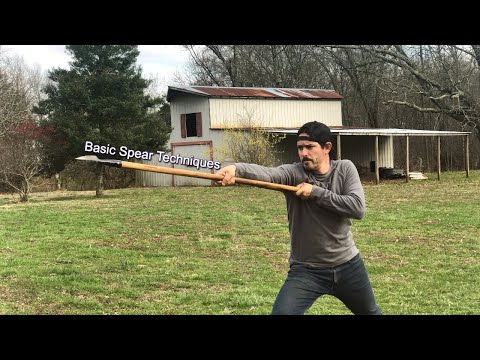
Join my Online Kali School and buy training gear here: https://www.kalicenter.com/ Subscribe to My NEW Kali Center Vlog…
Перевод: Basic Spear Thrust
The Standard Spear Thrust executes the fundamental yari thrust by driving the spear forward along its centreline with explosive hip-and-arm extension, directing the blade point at the opponent's throat, chest, or face. [1] The thrust is delivered with a sharp, snapping action — the rear hand drives the shaft forward while the front hand guides direction, and the spear retracts immediately after contact to prevent the opponent from grasping the shaft. [1],[2] Proper execution generates thrusting speed from the hips and core rather than the arms alone, and the rapid retraction distinguishes sojutsu thrusting from the committed lunge of European spear technique. [2],[3]
The standard spear thrust is the fundamental forward thrusting technique common to all spear traditions. [1]
The basic spear thrust is universal across all spear-fighting traditions worldwide. [1]
Standard spear thrusts are performed in wushu gun-shu competition and naginata/sōjutsu events. [1]
Изображений для этой техники пока нет.
Войдите, чтобы предложить изображение.
Join my Online Kali School and buy training gear here: https://www.kalicenter.com/ Subscribe to My NEW Kali Center Vlog…
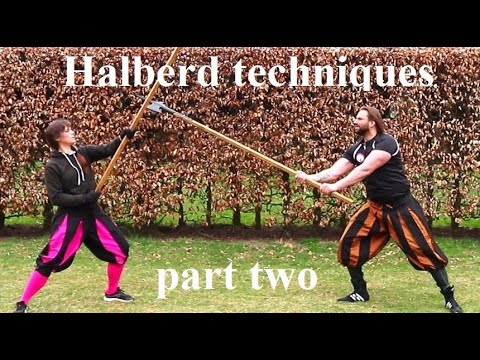
Four Halberd plays from Joachim Meyers book about the knightly art of swordsmanship - 1570 A.D. The plays can be found o…
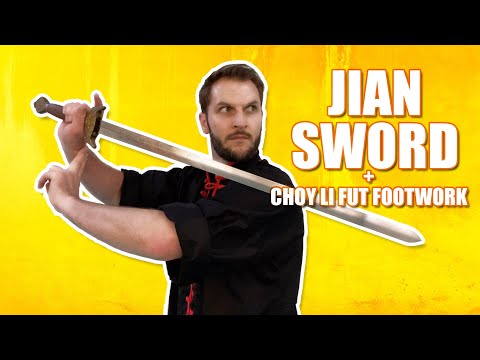
In this video we focus on techniques for the Gim (Jian sword) with the Choy Li Fut footwork pattern. I consider the Gim …
The standard spear thrust is the primary offensive tactic of spear fighting across multiple martial traditions. Kali Center emphasizes that the thrust, not the slash, is the spear's main technique—similar to knife fighting—because it leverages the weapon's length for both offense and defense while maintaining a protected head position. Two thrust variations are foundational: the short thrust, executed with the left hand stopping at the plexus and the weapon tip remaining at eye level to protect the face, and the long-range thrust, where the left hand extends under the armpit to increase reach while maintaining the same defensive principle. Both instructors stress that the spear tip must never drop below eye level after thrusting, as this exposes the face to counterattack. Sifu Kuttel reinforces this principle with the jian sword, emphasizing that the blade tip must remain in front of the center line to prevent creating openings for opponent counterattacks. Björn Rüther's halberd instruction confirms that powerful thrusts generate momentum through proper stance transitions and hand positioning along the shaft. All three instructors agree that precise hand placement, controlled weapon positioning, and maintenance of the center line are critical to executing an effective thrust while preserving defensive integrity.
Сформировано на основе 3 инструкторов
Учебных курсов по этой технике пока нет.
Войдите, чтобы предложить курс.
Риск травмы для человека, к которому применяется техника
Spears, halberds, and naginata; maximum reach with lethal cutting/thrusting capability
Уровень мастерства, необходимый для надёжного выполнения техники
Разрешена ли техника по основным соревновательным правилам
Chinese Martial Arts Training Manuals (Brian Kennedy & Elizabeth Guo, 2005)
Alias sources — [1] Japanese Swordsmanship (Warner & Draeger, 1982) [2] Secrets of the Samurai (Ratti & Westbrook, 1973) [3] Secrets of the Samurai (Ratti & Westbrook, 1973)
Effectiveness sources — [1] Comprehensive Asian Fighting Arts (Draeger & Smith, 1969)
Established Japanese martial arts naming convention — native Japanese term (和語/漢語)
Alias sources — [1] Japanese Swordsmanship (Warner & Draeger, 1982) [2] Secrets of the Samurai (Ratti & Westbrook, 1973) [3] Secrets of the Samurai (Ratti & Westbrook, 1973)
Effectiveness sources — [1] Comprehensive Asian Fighting Arts (Draeger & Smith, 1969)
two-handed coordination, hip rotation for power, distance management
tall reach, strong shoulders for extended weapon handling
shoulders, core rotators, forearms, quadriceps
Keep the tip of the spear high, menacing your opponent between their eyes while protecting your own head. A low tip exposes your face and makes it too hard to defend in time. When positioned high, you can protect your head and still reach low to defend your legs if needed.
After you thrust, don't drop the tip of your spear when bringing it back—keep it up to avoid opening up your face. Return your left hand back down to your hip while maintaining tip height at eye level.
Yes, you can use either a short spear or a long spear with all the basic drills and exercises—it's perfectly fine to practice with either length.
The spear is excellent for developing body mechanics and emphasizing proper technique, which will make your stick fighting, bolo, knife, and empty-hand work much faster and more powerful.
The Standard Spear Thrust executes the fundamental yari thrust by driving the spear forward along its centreline with explosive hip-and-arm extension, directing the blade point at the opponent's throat, chest, or face. The thrust is delivered with a sharp, snapping action — the rear hand drives the shaft forward while the front hand guides direction, and the spear retracts immediately after contact to prevent the opponent from grasping the shaft.
The standard spear thrust is the foundational technique of sojutsu, the action upon which the entire art is built. The snap-thrust-and-retract methodology was refined through centuries of Japanese spear fighting and remains the defining characteristic of sojutsu technique.
FIE: разрешён — Legal thrusting technique — primary scoring method in foil and épée; FIK Kendo: разрешён — Tsuki (throat thrust) is a valid target; HEMA: разрешён — Legal in applicable weapon categories
Оценка опасности 9/10. Extreme — spears, halberds, and naginata; maximum reach with lethal cutting/thrusting capability
Стандартная цепочка подготовки: Ready Position → Distance Control → Execute Technique → Return to Guard.
Стандартные контрприёмы: Parry (Absetzen) — deflect the incoming blade with a counter-displacement / Void (Step Back) — withdraw from measure to avoid the cutting arc / Counter-Cut (Nachreisen) — strike into the opponent's opening during their attack.
Распространённые варианты: Standard technique (primary execution from the most common grip and stance); Competition variation (adapted for sport-specific rules and scoring); Traditional variation (classical execution as taught in the traditional art); Combination variation (chained with preceding or following techniques in a flow).
Standard spear thrusts are performed in wushu gun-shu competition and naginata/sōjutsu events.
Основные ошибки, на которые стоит обратить внимание: Not extending fully — the standard thrust must use the hands' sliding motion to reach maximum range / Using a pushing motion instead of a snapping thrust — the thrust is explosive and fast, not a slow extension / Not aligning the point with the target — the straight-line path requires the point to be aimed precisely at the throa… / Stepping too large — the step should be measured to maintain balance; over-stepping creates vulnerability.
Standard Spear Thrust также известен как Choku Tsuki, Direct Yari Thrust, Basic Spear Thrust.