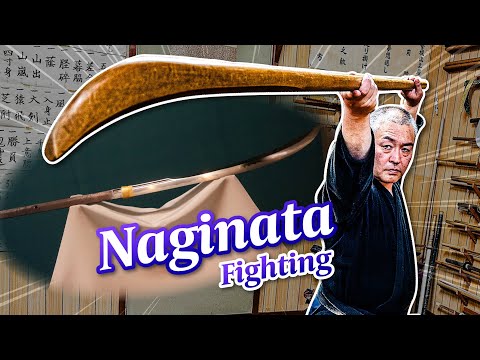
How a Katana Swordmaster Fights with a Naginata
0
Naginata Thrust·Let's ask Seki Sensei | Online Katana Lessons
🎫Purchase Your Ticket to the Annual Asayama Ichiden Ryu Training Camp in Japan: https://asayamaichidenryu.shop/products…
Перевод: Naginata Thrust
The Naginata Thrust subfamily covers straight thrusting techniques with the naginata, where the practitioner drives the point of the curved blade directly into the opponent's body. [1] While cutting is the naginata's primary attack mode, the thrust adds a linear dimension to the weapon's offensive repertoire, allowing the practitioner to attack opponents at maximum range and to exploit openings that are too narrow for a sweeping cut. [1],[2] Naginata thrusts target the throat (tsuki) in competitive naginata, and the technique requires precise point control despite the weapon's length and the offset angle of the curved blade. [2],[3]
Naginata thrusts use the weapon's reach advantage to strike from a distance where most opponents cannot counter, targeting the throat and chest. [1]
Naginata thrusting technique was developed in classical naginatajutsu schools and retained in modern atarashii naginata practice. [1]
Naginata thrusts are valid scoring techniques in competition, targeting the throat protector area. [1]
Изображений для этой техники пока нет.
Войдите, чтобы предложить изображение.
🎫Purchase Your Ticket to the Annual Asayama Ichiden Ryu Training Camp in Japan: https://asayamaichidenryu.shop/products…
Учебных курсов по этой технике пока нет.
Войдите, чтобы предложить курс.
Риск травмы для человека, к которому применяется техника
Spears, halberds, and naginata; maximum reach with lethal cutting/thrusting capability
Уровень мастерства, необходимый для надёжного выполнения техники
Разрешена ли техника по основным соревновательным правилам
Kodokan Judo (Jigoro Kano, 1986)
Alias sources — [1] Japanese Swordsmanship (Warner & Draeger, 1982) [2] Comprehensive Asian Fighting Arts (Draeger & Smith, 1969) [3] Comprehensive Asian Fighting Arts (Draeger & Smith, 1969)
Effectiveness sources — [1] Classical Bujutsu (Draeger, 1973)
Established Japanese martial arts naming convention — native Japanese term (和語/漢語)
Alias sources — [1] Japanese Swordsmanship (Warner & Draeger, 1982) [2] Comprehensive Asian Fighting Arts (Draeger & Smith, 1969) [3] Comprehensive Asian Fighting Arts (Draeger & Smith, 1969)
Effectiveness sources — [1] Classical Bujutsu (Draeger, 1973)
two-handed coordination, hip rotation for power, distance management
tall reach, strong shoulders for extended weapon handling
shoulders, core rotators, forearms, quadriceps
Каждое движение в любом боевом искусстве обладает рядом универсальных свойств. Комбинируйте параметры ниже, чтобы найти нужный инструмент или сравнить аналоги из разных стилей.
Yes, according to Seki Sensei, you can thrust after stopping an attack with the naginata, and you don't necessarily need to use a winding technique to set up the thrust.
Getting too close is considered a weakness of the naginata, so managing distance and using the other end of the weapon to stop attacks and counter-attack quickly becomes important in close-range situations.
The Naginata Thrust subfamily covers straight thrusting techniques with the naginata, where the practitioner drives the point of the curved blade directly into the opponent's body. While cutting is the naginata's primary attack mode, the thrust adds a linear dimension to the weapon's offensive repertoire, allowing the practitioner to attack opponents at maximum range and to exploit openings that are too narrow for a sweeping cut.
Naginata thrusting technique was part of the weapon's battlefield application, where thrusts could penetrate armour gaps at the throat, armpits, and groin. Modern competitive naginata restricts thrusting to the throat protector (tsuki-dare) for safety.
FIE: разрешён — Legal thrusting technique — primary scoring method in foil and épée; FIK Kendo: разрешён — Tsuki (throat thrust) is a valid target; HEMA: разрешён — Legal in applicable weapon categories
Оценка опасности 9/10. Extreme — spears, halberds, and naginata; maximum reach with lethal cutting/thrusting capability
Стандартная цепочка подготовки: Ready Position → Distance Control → Execute Technique → Return to Guard.
Стандартные контрприёмы: Parry (Absetzen) — deflect the incoming blade with a counter-displacement / Void (Step Back) — withdraw from measure to avoid the cutting arc / Counter-Cut (Nachreisen) — strike into the opponent's opening during their attack.
Распространённые варианты: Standard technique (primary execution from the most common grip and stance); Competition variation (adapted for sport-specific rules and scoring); Traditional variation (classical execution as taught in the traditional art); Combination variation (chained with preceding or following techniques in a flow).
Naginata thrusts are valid scoring techniques in competition, targeting the throat protector area.
Основные ошибки, на которые стоит обратить внимание: Over-extending on the thrust — the naginata's length makes over-extension tempting, but it creates balance problems / Not retracting immediately — the extended naginata is vulnerable to being pushed aside; snap the thrust back / Using a pushing motion rather than a sharp thrust — the thrust must be explosive for speed and accuracy / Thrusting without footwork — the step adds reach and power; a stationary thrust is less effective.
Naginata Thrust также известен как Naginata Tsuki, Glaive Thrust, Naginata-do Thrust.