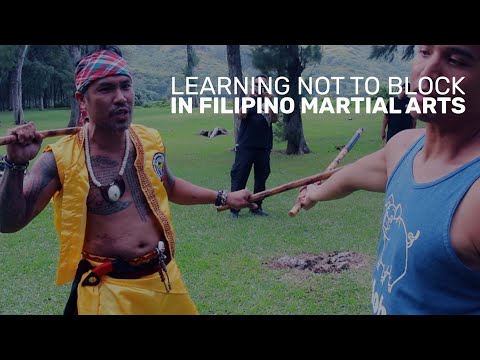
Learning Not To Block In Filipino Martial Arts
0
Defensa — Block·Budo Brothers
GM Oliver "Pintados" Garduce discusses how as a beginner in filipino martial arts your block should be able to be transl…
Перевод: defensa — block
The Defensa (Block) subfamily covers the defensive stick techniques used to intercept, redirect, or stop incoming attacks in single-stick fighting. [1] Filipino martial arts defensive technique differs fundamentally from the passive blocking found in many martial arts — defensa techniques are designed to be damaging to the attacker, using the stick to meet the attacking limb or weapon with force, often targeting the opponent's hand, wrist, or forearm with the block itself. [1],[2] The defensa system includes roof blocks (umbrella blocks over the head), wing blocks (lateral blocks to the side), cross blocks, and reinforced blocks using both hands on the stick. [2],[3]
Defensive stick techniques have been part of Filipino martial arts since their origin, developed through the practical necessity of surviving weapon combat where a missed block meant severe injury or death. [1] The aggressive blocking philosophy — where blocks are themselves attacks on the opponent's weapon hand — reflects the combat-proven wisdom of Filipino martial arts. [2],[3]
FMA blocking (defensa) uses the weapon to intercept and deflect incoming strikes, often incorporating destructions that damage the opponent's weapon hand. [1]
Defensive techniques in FMA were developed to counter the numbered angles of attack, with each angle having specific defensive responses. [1]
Defensive technique is essential in WEKAF competition, where effective blocking prevents scoring and creates counter-attack opportunities. [1]
Изображений для этой техники пока нет.
Войдите, чтобы предложить изображение.
GM Oliver "Pintados" Garduce discusses how as a beginner in filipino martial arts your block should be able to be transl…
Учебных курсов по этой технике пока нет.
Войдите, чтобы предложить курс.
Риск травмы для человека, к которому применяется техника
Arnis/Escrima/Kali stick and blade techniques; designed for close-range lethality
Уровень мастерства, необходимый для надёжного выполнения техники
Разрешена ли техника по основным соревновательным правилам
The Filipino Martial Arts (Dan Inosanto, 1980)
Alias sources — [1] Filipino Martial Arts (Wiley, 1994) [2] The Filipino Martial Arts (Inosanto, 1980)
Effectiveness sources — [1] Filipino Martial Arts (Wiley, 1997)
Mixed Japanese-Western terminology — combines traditional Japanese terms with katakana loanwords
Alias sources — [1] Filipino Martial Arts (Wiley, 1994) [2] The Filipino Martial Arts (Inosanto, 1980)
Effectiveness sources — [1] Filipino Martial Arts (Wiley, 1997)
wrist speed, hand coordination (especially double stick), cardiovascular endurance
quick hands, conditioned forearms, coordination
forearms, wrists, shoulders, core rotators
Каждое движение в любом боевом искусстве обладает рядом универсальных свойств. Комбинируйте параметры ниже, чтобы найти нужный инструмент или сравнить аналоги из разных стилей.
In Filipino martial arts like pentados, there's no traditional block—instead, you position yourself so that when your opponent strikes, you're already out of the way or in a safe position. The moment they attack, you're already moved, making a formal block unnecessary.
No. Budo Brothers instructors emphasize that trying to block a weapon strike with empty hands is dangerous—you use your weapon to strike the incoming attack or weapon, not your bare hands.
Practice striking patterns with consistent footwork and hand positioning so there's no mistake in your movement—whether you're striking inside, outside, or using backhands, the same principles apply across all angles and positions.
The Defensa (Block) subfamily covers the defensive stick techniques used to intercept, redirect, or stop incoming attacks in single-stick fighting. Filipino martial arts defensive technique differs fundamentally from the passive blocking found in many martial arts — defensa techniques are designed to be damaging to the attacker, using the stick to meet the attacking limb or weapon with force, often targeting the opponent's hand, wrist, or forearm with the block itself.
Defensive stick techniques have been part of Filipino martial arts since their origin, developed through the practical necessity of surviving weapon combat where a missed block meant severe injury or death. The aggressive blocking philosophy — where blocks are themselves attacks on the opponent's weapon hand — reflects the combat-proven wisdom of Filipino martial arts.
WEKAF: разрешён — Legal in padded stick competition; HEMA: разрешён — Legal in applicable weapon categories
Оценка опасности 8/10. Very High — Arnis/Escrima/Kali stick and blade techniques; designed for close-range lethality
Стандартная цепочка подготовки: Grip and Stance → Chamber → Strike → Recovery.
Стандартные контрприёмы: Umbrella Block — raise the stick overhead to intercept a downward strike / Cross Block — meet the incoming strike with a perpendicular block / Disarm — strip the opponent's weapon through leverage on the hand or wrist.
Распространённые варианты: Angle 1 (forehand diagonal) (downward diagonal strike from the dominant side); Angle 2 (backhand diagonal) (downward diagonal strike from the off side); Angle 5 (thrust) (straight thrust with the tip of the stick); Redonda (continuous) (flowing circular strikes chaining multiple angles).
Defensive technique is essential in WEKAF competition, where effective blocking prevents scoring and creates counter-attack opportunities.
Основные ошибки, на которые стоит обратить внимание: Blocking with the tip of the stick — use the strong end near the grip to absorb force without losing the weapon / Meeting power with power — use angled deflections to redirect force rather than opposing it directly / Not checking after the block — the block without a live-hand check allows the opponent to recover and attack again / Blocking without a counter — a block alone is defensive; every block must lead to an immediate counter-strike.
Defensa — Block также известен как Defensa / Uke, Defensa, Blokeo, Eskrima Block, Arnis Block.