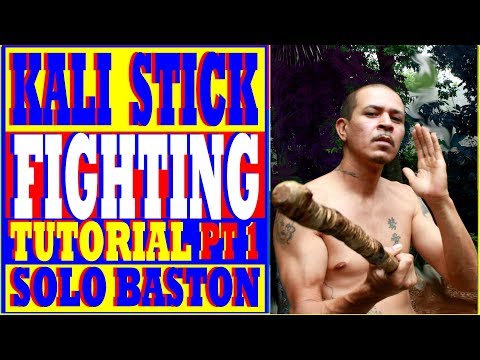
KALI SINGLE STICK Fighting "tutorial" (pt 1) solo baston
0
Single Stick — Solo Baston·Kali Kombat
An introduction to KALI Solo Stick Fighting by Solo Minati visit - https://www.solominati.com/ this video tutorial is j…
Перевод: single stick — solo baston
The Single Stick (Solo Baston) family covers all techniques using a single rattan stick, which is the core weapon and primary training tool of Filipino martial arts. [1] Solo baston is the foundation of Filipino martial arts training — the single stick teaches the angles of attack, defensive responses, footwork, and body mechanics that transfer to every other weapon and to empty-hand fighting. [1],[2] The single stick is typically 26-28 inches long and made from rattan, and techniques include the numbered angle strikes (typically 5-12 fundamental angles of attack), blocks (defensa), disarms (disarma), and counter-for-counter drills. [2],[3] Solo baston competition (full-contact stick fighting) is also the primary competitive format in Arnis, governed by the World Eskrima Kali Arnis Federation (WEKAF) and the Philippine Eskrima Kali Arnis Federation. [3]
Single stick fighting is the oldest and most fundamental training method in Filipino martial arts, used for centuries by Filipino warriors as both a combat weapon and a training tool for bladed weapons. [1] The rattan stick became the standard training weapon because it is durable, lightweight, and can deliver powerful strikes without the lethality of a blade, allowing full-contact training. [2],[3] Arnis was declared the national martial art and sport of the Philippines in 2009 through Republic Act No. 9850. [3]
Solo baston (single stick) is the foundational FMA weapon, teaching footwork, angles of attack, and defensive patterns that transfer to all other FMA weapons and empty-hand combat. [1]
Single stick is the primary competition format in WEKAF (World Eskrima Kali Arnis Federation) tournaments, which have been held since 1989. Arnis was designated the national sport of the Philippines in 2009. [1]
Изображений для этой техники пока нет.
Войдите, чтобы предложить изображение.
An introduction to KALI Solo Stick Fighting by Solo Minati visit - https://www.solominati.com/ this video tutorial is j…
Учебных курсов по этой технике пока нет.
Войдите, чтобы предложить курс.
Риск травмы для человека, к которому применяется техника
Arnis/Escrima/Kali stick and blade techniques; designed for close-range lethality
Уровень мастерства, необходимый для надёжного выполнения техники
Разрешена ли техника по основным соревновательным правилам
The Filipino Martial Arts (Dan Inosanto, 1980)
Alias sources — [1] Filipino Martial Arts (Wiley, 1994) [2] Filipino Martial Arts (Wiley, 1994) [3] Filipino Martial Arts (Wiley, 1994)
Effectiveness sources — [1] Filipino Martial Arts (Wiley, 1997)
Standard katakana transliteration of Western martial arts terminology (外来語) — used in Japanese MMA, boxing, and BJJ communities
Alias sources — [1] Filipino Martial Arts (Wiley, 1994) [2] Filipino Martial Arts (Wiley, 1994) [3] Filipino Martial Arts (Wiley, 1994)
Effectiveness sources — [1] Filipino Martial Arts (Wiley, 1997)
wrist speed, hand coordination (especially double stick), cardiovascular endurance
quick hands, conditioned forearms, coordination
forearms, wrists, shoulders, core rotators
Каждое движение в любом боевом искусстве обладает рядом универсальных свойств. Комбинируйте параметры ниже, чтобы найти нужный инструмент или сравнить аналоги из разных стилей.
The Angle Strike subfamily covers the numbered angles of attack that form the fundamental offensive framework of Filipino martial arts, with each angle representing a specific trajectory and target. [1] The angle system is the organising principle of Filipino martial arts — rather than naming individual techniques, the arts classify all strikes by their angle of delivery, creating a universal framework that applies regardless of whether the practitioner holds a stick, a blade, or an empty hand. [1,2] While different systems use varying numbers of angles (5, 6, 9, or 12 are common), the first five angles are nearly universal across all Filipino martial arts: Angle 1 (forehand diagonal downward to the temple), Angle 2 (backhand diagonal downward to the temple), Angle 3 (forehand horizontal to the body), Angle 4 (backhand horizontal to the body), and Angle 5 (thrust to the centre). [2,3]
The Defensa (Block) subfamily covers the defensive stick techniques used to intercept, redirect, or stop incoming attacks in single-stick fighting. [1] Filipino martial arts defensive technique differs fundamentally from the passive blocking found in many martial arts — defensa techniques are designed to be damaging to the attacker, using the stick to meet the attacking limb or weapon with force, often targeting the opponent's hand, wrist, or forearm with the block itself. [1,2] The defensa system includes roof blocks (umbrella blocks over the head), wing blocks (lateral blocks to the side), cross blocks, and reinforced blocks using both hands on the stick. [2,3]
The Disarma (Disarm) subfamily covers techniques designed to strip the weapon from the opponent's hand through leverage, joint manipulation, trapping, or impact to the weapon hand. [1] Disarming is a highly developed speciality of Filipino martial arts — the arts contain dozens of disarming techniques for each angle of attack, reflecting centuries of development in an environment where taking an opponent's weapon provided decisive tactical advantage. [1,2] Disarming techniques include vine disarms (snaking the stick around the opponent's weapon hand), strip disarms (levering the weapon free), and impact disarms (striking the hand or wrist to force release). [2,3]
Single stick (solo baston) is the foundation of Filipino martial arts — Arnis, Eskrima, and Kali all begin with single stick training. The principle is that stick techniques transfer directly to bladed weapons and empty hands. Rattan sticks of 28 inches are standard. (Wiley, Filipino Martial Arts; FMA manuals)
According to Kali Kombat, you don't grip it from the end—instead, give a little slack in your grip and hold it in the middle section. This grip allows you to spin the stick for 360-degree rotation and enables jabbing, stabbing, locking, and other techniques.
Kali Kombat emphasizes that the stick is not just for striking; you can use it for jabbing, stabbing, locking, chokes, joint manipulations, breaks, locks, and trips. The stick can even create effective chokes by forming a triangle with your bone and the stick.
Kali Kombat recommends practicing rotation on both sides and emphasizes hitting like a whip by letting the stick slide through rather than using only straight shots. Focus on not telegraphing your strikes—use just a flick of the wrist to generate power without revealing where you're coming from.
Kali Kombat demonstrates using a plunger as a training tool, emphasizing that you can find a weapon anywhere and don't need to buy expensive equipment—the principle is to master something practical and accessible.
The Single Stick (Solo Baston) family covers all techniques using a single rattan stick, which is the core weapon and primary training tool of Filipino martial arts. Solo baston is the foundation of Filipino martial arts training — the single stick teaches the angles of attack, defensive responses, footwork, and body mechanics that transfer to every other weapon and to empty-hand fighting.
Single stick fighting is the oldest and most fundamental training method in Filipino martial arts, used for centuries by Filipino warriors as both a combat weapon and a training tool for bladed weapons. The rattan stick became the standard training weapon because it is durable, lightweight, and can deliver powerful strikes without the lethality of a blade, allowing full-contact training.
WEKAF: разрешён — Legal in padded stick competition; HEMA: разрешён — Legal in applicable weapon categories
Оценка опасности 8/10. Very High — Arnis/Escrima/Kali stick and blade techniques; designed for close-range lethality
Стандартная цепочка подготовки: Grip and Stance → Chamber → Strike → Recovery.
Стандартные контрприёмы: Umbrella Block — raise the stick overhead to intercept a downward strike / Cross Block — meet the incoming strike with a perpendicular block / Disarm — strip the opponent's weapon through leverage on the hand or wrist.
Распространённые варианты: Angle 1 (forehand diagonal) (downward diagonal strike from the dominant side); Angle 2 (backhand diagonal) (downward diagonal strike from the off side); Angle 5 (thrust) (straight thrust with the tip of the stick); Redonda (continuous) (flowing circular strikes chaining multiple angles).
Single stick is the primary competition format in WEKAF (World Eskrima Kali Arnis Federation) tournaments, which have been held since 1989. Arnis was designated the national sport of the Philippines in 2009.
Основные ошибки, на которые стоит обратить внимание: Gripping the stick too tightly — a relaxed grip allows faster manipulation and prevents the stick from being stripped / Ignoring the live hand — the non-weapon hand is not a passive spectator; it actively participates in every exchange / Winding up for strikes — telegraphed strikes are easily blocked; power comes from mechanics, not wind-up / Striking with the arm alone — the body generates power; arm-only strikes are weak and tire the fighter quickly.
Single Stick — Solo Baston также известен как Soro Basuton, Solo Baston, Single Baston, One Stick.