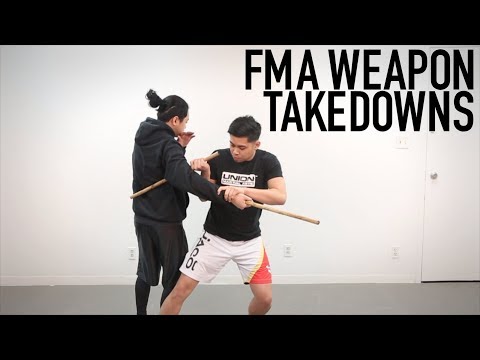
FILIPINO MARTIAL ARTS WEAPON TAKEDOWNS | TECHNIQUE TUESDAY
0
Angle Strike·Mark Anastacio
Takedowns are a huge section integrated into Filipino Martial Arts. Normally, a lot of these techniques in other arts ar…
Перевод: angle strike
The Angle Strike subfamily covers the numbered angles of attack that form the fundamental offensive framework of Filipino martial arts, with each angle representing a specific trajectory and target. [1] The angle system is the organising principle of Filipino martial arts — rather than naming individual techniques, the arts classify all strikes by their angle of delivery, creating a universal framework that applies regardless of whether the practitioner holds a stick, a blade, or an empty hand. [1],[2] While different systems use varying numbers of angles (5, 6, 9, or 12 are common), the first five angles are nearly universal across all Filipino martial arts: Angle 1 (forehand diagonal downward to the temple), Angle 2 (backhand diagonal downward to the temple), Angle 3 (forehand horizontal to the body), Angle 4 (backhand horizontal to the body), and Angle 5 (thrust to the centre). [2],[3]
The angle-based attack system is one of the defining innovations of Filipino martial arts, providing a geometric framework for understanding and organising all offensive actions. [1] The system developed through centuries of combat experience and was transmitted orally through family and regional lineages before being codified by modern masters. [2],[3]
The angle strike system (typically 12 angles) provides a structured framework for attacking from every direction, ensuring comprehensive offensive coverage. [1]
Angle-of-attack systems are universal in Filipino martial arts, with each major system (Doce Pares, Modern Arnis, Pekiti-Tirsia) defining its own set of numbered angles. [1]
Angle strikes form the basis of WEKAF single-stick competition, with fighters using combinations of numbered angles. [1]
Изображений для этой техники пока нет.
Войдите, чтобы предложить изображение.
Takedowns are a huge section integrated into Filipino Martial Arts. Normally, a lot of these techniques in other arts ar…
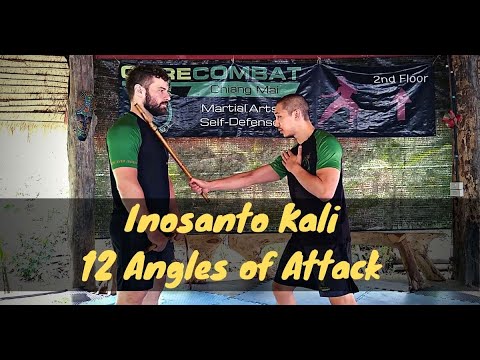
Inosanto / Lacoste Kali 12 Angles of Attack 1. Diagonal Down 2. Diagonal Down 3. Horizontal Across 4. Horizontal Across …
Учебных курсов по этой технике пока нет.
Войдите, чтобы предложить курс.
Риск травмы для человека, к которому применяется техника
Arnis/Escrima/Kali stick and blade techniques; designed for close-range lethality
Уровень мастерства, необходимый для надёжного выполнения техники
Разрешена ли техника по основным соревновательным правилам
The Filipino Martial Arts (Dan Inosanto, 1980)
Alias sources — [1] Filipino Martial Arts (Wiley, 1994) [2] Comprehensive Asian Fighting Arts (Draeger & Smith, 1969) [3] Comprehensive Asian Fighting Arts (Draeger & Smith, 1969)
Effectiveness sources — [1] Filipino Martial Arts (Wiley, 1997)
Standard katakana transliteration of Western martial arts terminology (外来語) — used in Japanese MMA, boxing, and BJJ communities
Alias sources — [1] Filipino Martial Arts (Wiley, 1994) [2] Comprehensive Asian Fighting Arts (Draeger & Smith, 1969) [3] Comprehensive Asian Fighting Arts (Draeger & Smith, 1969)
Effectiveness sources — [1] Filipino Martial Arts (Wiley, 1997)
wrist speed, hand coordination (especially double stick), cardiovascular endurance
quick hands, conditioned forearms, coordination
forearms, wrists, shoulders, core rotators
Каждое движение в любом боевом искусстве обладает рядом универсальных свойств. Комбинируйте параметры ниже, чтобы найти нужный инструмент или сравнить аналоги из разных стилей.
The Angle Five Strike is a straight thrust (estocada) directed at the opponent's centreline — typically the solar plexus, throat, or face — delivered by driving the tip of the stick or blade straight forward. [1] Angle Five is fundamentally different from Angles One through Four because it is a linear thrust rather than an angular cut, targeting the centreline with a piercing rather than striking motion. [1,2] In blade application, the Angle Five thrust is the most lethal single attack, as a direct thrust to the torso penetrates deeper and causes more damage than a cut. [2,3]
The Angle Four Strike is a backhand horizontal strike targeting the opponent's right elbow, ribs, or hip (from the attacker's perspective), travelling horizontally from the attacker's left to right. [1] Angle Four mirrors Angle Three on the backhand side, completing the horizontal mid-section attack pair just as Angles One and Two form the diagonal pair. [1,2] The backhand horizontal is particularly effective in combination with Angle Three, creating a rapid left-right mid-section attack sequence that is difficult to defend against. [2,3]
The Angle One Strike is a forehand diagonal downward strike targeting the opponent's left temple (from the attacker's perspective), travelling from the attacker's right shoulder to the opponent's left temple or collarbone area. [1] Angle One is universally recognised as the primary strike in Filipino martial arts — it is the most natural and powerful single-stick attack because it follows the dominant hand's strongest biomechanical path, combining gravity and rotational force. [1,2] In blade application, Angle One corresponds to a diagonal downward cut to the neck or collarbone, one of the most devastating cutting trajectories in edged weapon combat. [2,3]
The Angle Three Strike is a forehand horizontal strike targeting the opponent's left elbow, ribs, or hip (from the attacker's perspective), travelling horizontally from the attacker's right to left. [1] Angle Three targets the mid-section with a horizontal trajectory, attacking the body rather than the head and exploiting openings below the opponent's guard. [1,2] In blade application, Angle Three corresponds to a horizontal slash across the midsection or a cut to the weapon arm's elbow — both high-value targets in edged weapon combat. [2,3]
The Angle Two Strike is a backhand diagonal downward strike targeting the opponent's right temple (from the attacker's perspective), travelling from the attacker's left shoulder to the opponent's right temple or collarbone area. [1] Angle Two is the mirror image of Angle One, using the backhand trajectory, and together they form the fundamental X-pattern that defines the basic offensive framework of Filipino martial arts. [1,2] The backhand diagonal requires more training than the forehand because it travels against the dominant hand's natural mechanics, but it is equally important for developing the bilateral striking ability that Filipino martial arts demand. [2,3]
Speed is not important when doing these drills—instead, take your time and focus on getting the angles correct, as emphasized by Sakan Lam in instruction on the 12 Angles of Attack.
Make sure the strike is slightly angled upward rather than a straight thrust, and consume the space between you and your opponent by controlling the weapon transition and positioning your body to create distance for the technique.
The Angle Strike subfamily covers the numbered angles of attack that form the fundamental offensive framework of Filipino martial arts, with each angle representing a specific trajectory and target. The angle system is the organising principle of Filipino martial arts — rather than naming individual techniques, the arts classify all strikes by their angle of delivery, creating a universal framework that applies regardless of whether the practitioner holds a stick, a blade, or an empty hand.
The angle-based attack system is one of the defining innovations of Filipino martial arts, providing a geometric framework for understanding and organising all offensive actions. The system developed through centuries of combat experience and was transmitted orally through family and regional lineages before being codified by modern masters.
WEKAF: разрешён — Legal in padded stick competition; HEMA: разрешён — Legal in applicable weapon categories
Оценка опасности 8/10. Very High — Arnis/Escrima/Kali stick and blade techniques; designed for close-range lethality
Стандартная цепочка подготовки: Grip and Stance → Chamber → Strike → Recovery.
Стандартные контрприёмы: Beat Parry — deflect the blade with a sharp lateral beat before it reaches target / Displacement — move the body off the line while threatening with the point / Counter-Thrust — extend into the attacker's line during their advance.
Распространённые варианты: Angle 1 (forehand diagonal) (downward diagonal strike from the dominant side); Angle 2 (backhand diagonal) (downward diagonal strike from the off side); Angle 5 (thrust) (straight thrust with the tip of the stick); Redonda (continuous) (flowing circular strikes chaining multiple angles).
Angle strikes form the basis of WEKAF single-stick competition, with fighters using combinations of numbered angles.
Основные ошибки, на которые стоит обратить внимание: Memorising angles by number only without understanding the body mechanics of each — each angle has specific biomechanics / Not training all angles equally — practitioners often favour certain angles; this creates defensive gaps / Striking at angles that don't match the numbered system — consistency in angles allows partner training to work properly / Neglecting the return path — every strike must return to a guard position or flow into the next angle.
Angle Strike также известен как Anguru Sutoraiku, Angulo, Numbered Strike, Striking Angles.