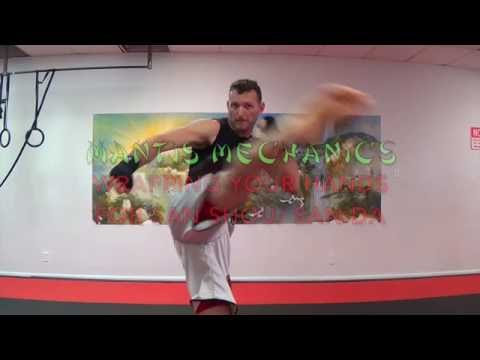
How to wrap your hands for san shou/sanda
0
Standard Clinch Sanda Throw·Mantis Mechanics·Added by Admin
How to wrap your hands for san shou/sanda. Over the years, I have learned many techniques for wrapping your hands. The…
Перевод: standard Sanda clinch throw
Standard Clinch Sanda Throw is the fundamental clinch-based throw in sanda in which the fighter secures a collar tie, underhook, or body lock, disrupts the opponent's balance through pushing and pulling, and executes a hip throw, body-lock trip, or lateral drop while maintaining their own standing base to maximise scoring. [1],[2] The emphasis on remaining upright after the throw distinguishes sanda clinch throws from judo sacrifice techniques. [2],[3]
Clinch sanda throws are effective in sanda competition because the ruleset awards points for clean throws while the fighter remains standing, incentivising controlled clinch-to-throw sequences. [1] The integration of throwing with striking gives sanda fighters the ability to chain punches and kicks into clinch throws, creating multi-threat attacks. [2]
Sanda throwing techniques were formalised as part of the Chinese Wushu Association's competitive sanda curriculum in the 1980s, drawing on traditional Chinese wrestling (shuai jiao) and modern wrestling methods. [1] The clinch throws in sanda are distinctly Chinese in character, emphasising remaining upright after the throw rather than following to the ground. [2]
Throwing techniques are a major scoring element in IWuF (International Wushu Federation) Sanda World Championships and Chinese national sanda competitions. [1]
Изображений для этой техники пока нет.
Войдите, чтобы предложить изображение.
How to wrap your hands for san shou/sanda. Over the years, I have learned many techniques for wrapping your hands. The…
Учебных курсов по этой технике пока нет.
Войдите, чтобы предложить курс.
Риск травмы для человека, к которому применяется техника
Sanda/Sanshou throws emphasize speed and catching strikes into throws
Уровень мастерства, необходимый для надёжного выполнения техники
Разрешена ли техника по основным соревновательным правилам
Japanese Sanda/Sanshou terminology
Japanese Sanda/Sanshou terminology
Original Chinese martial arts term used in Japanese context
Katakana transliteration used in Japanese Sanda (散打)
hip rotation speed, core strength, lower back stability
strong hips and core, good flexibility for turning entry
hip rotators, core, quadriceps, latissimus dorsi
According to Mantis Mechanics, you want enough pressure to be supportive and protective, but not so tight that you feel tingling or numbness. Too loose and they won't protect you; too tight and you risk cutting off circulation and injuring your hand.
Mantis Mechanics recommends folding the wrap long enough to cover all your knuckles without overlapping. If the fold is too short, your knuckles won't be fully protected; if too long, it will overlap unnecessarily.
Mantis Mechanics emphasizes keeping your fingers splayed apart during the wrapping process, not together, as this creates a tighter and more effective wrap when you pull the material through.
Standard Clinch Sanda Throw is the fundamental clinch-based throw in sanda in which the fighter secures a collar tie, underhook, or body lock, disrupts the opponent's balance through pushing and pulling, and executes a hip throw, body-lock trip, or lateral drop while maintaining their own standing base to maximise scoring. The emphasis on remaining upright after the throw distinguishes sanda clinch throws from judo sacrifice techniques.
The standard clinch sanda throw was formalised as part of the competitive sanda curriculum developed by the Chinese Wushu Association in the 1980s, drawing on both traditional Chinese wrestling and modern wrestling methodology.
IJF: разрешён — Legal throwing technique; IBJJF: разрешён — Legal at all belt levels; UWW: разрешён — Legal in both freestyle and Greco-Roman; Unified MMA: разрешён — Legal throwing technique; ADCC: разрешён — Legal; FIAS Sport Sambo: разрешён — Legal; FIAS Combat Sambo: разрешён — Legal
Оценка опасности 6/10. High — Sanda/Sanshou throws emphasize speed and catching strikes into throws
Стандартная цепочка подготовки: Grip Setup (Kumi-kata) → Off-Balance (Kuzushi) → Entry (Tsukuri) → Execution (Kake) → Fall (Sutemi).
Стандартные контрприёмы: Lower Centre of Gravity — bend knees and drop hips to make the throw harder to execute / Block the Hip — post hand on the thrower's hip to prevent loading / Step Around — circle away from the throw direction to avoid being loaded / Grip Break — deny the thrower their preferred gripping configuration.
Распространённые варианты: Standard hip throw (full turn-in with hip below the opponent's centre of gravity); No-gi hip throw (adapted without gi grips, using overhook and collar tie); Drop hip throw (dropping to one knee to lower the fulcrum point); Combination hip throw (chaining from a failed foot technique or hand technique).
Throwing techniques are a major scoring element in IWuF (International Wushu Federation) Sanda World Championships and Chinese national sanda competitions.
Основные ошибки, на которые стоит обратить внимание: Clinching without a striking setup — the opponent sees you coming and defends / Using finger grips inside the gloves — the referee will separate you and may penalise / Holding the clinch without throwing — you'll be broken up and lose the tactical moment / Executing the trip too slowly — the opponent adjusts their base and blocks.
Standard Clinch Sanda Throw также известен как Sanda Kurinchi Nage, Classical Sanda Clinch Throw, Standard Sanshou Clinch Throw.