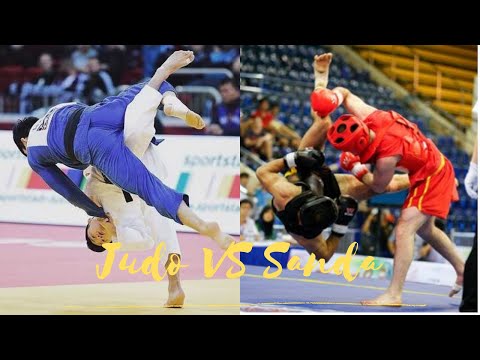
Judo VS Wushu Sanda 散打
0
Sanda Throw·Chadi
Support me on Patreon: https://www.patreon.com/chadijudo Josh Simon's shop/articles: https://simonbjj.com/ #Judo #Wush…
Перевод: Sanda throwing technique
Sanda Throw is the family of throwing techniques used in sanda (also called sanshou), the full-contact Chinese kickboxing format that permits striking and throwing but not sustained ground fighting. [1],[2] Sanda throws are uniquely adapted to a ruleset where fighters must throw from striking range or the clinch, often in combination with punches and kicks, and where throws are scored based on amplitude and control. [2],[3] The sanda throwing repertoire includes clinch-based throws similar to Greco-Roman and judo techniques, as well as the distinctive kick-catch throws in which a fighter intercepts the opponent's kick and uses the caught limb as a lever to execute the throw. [3],[4] Sanda competitors must develop the timing to transition rapidly from striking to throwing, making these techniques distinct in their application context. [4]
Sanda throwing techniques evolved from traditional Chinese martial arts — particularly shuai jiao and Shaolin-derived combat methods — and were codified into a modern competitive format by the Chinese Wushu Association beginning in the late 1970s. [1],[2] The sport was designed to test practical fighting ability, and throws were included as a central scoring element to distinguish sanda from pure striking arts. [2],[3]
Throws are a primary scoring action in International Wushu Federation (IWuF) sanda competition, alongside strikes and kicks. [1]
Изображений для этой техники пока нет.
Войдите, чтобы предложить изображение.
Support me on Patreon: https://www.patreon.com/chadijudo Josh Simon's shop/articles: https://simonbjj.com/ #Judo #Wush…
Учебных курсов по этой технике пока нет.
Войдите, чтобы предложить курс.
Риск травмы для человека, к которому применяется техника
Sanda/Sanshou throws emphasize speed and catching strikes into throws
Уровень мастерства, необходимый для надёжного выполнения техники
Разрешена ли техника по основным соревновательным правилам
Japanese Sanda/Sanshou terminology
Japanese Sanda/Sanshou terminology
Original Chinese martial arts term used in Japanese context
Katakana transliteration used in Japanese Sanda (散打)
coordination, grip strength, hip and core power, balance
athletic build with strong hips and good proprioception
core, hips, legs, grip/forearms
Каждое движение в любом боевом искусстве обладает рядом универсальных свойств. Комбинируйте параметры ниже, чтобы найти нужный инструмент или сравнить аналоги из разных стилей.
Clinch Sanda Throw encompasses the throwing techniques executed from the clinch position in sanda competition, where fighters close distance from striking range and use body locks, collar ties, underhooks, and overhooks to execute throws. [1,2] These throws resemble Greco-Roman wrestling and judo clinch techniques but are adapted to the sanda scoring system, which awards points based on throwing amplitude and the thrower remaining standing. [2,3] Common clinch sanda throws include hip throws, body-lock lifts, and trip-and-sweep combinations executed while both fighters are locked in close-range grappling. [3]
Kick Catch Throw is a distinctive subfamily of sanda throws in which the fighter intercepts an incoming kick — typically a roundhouse, side kick, or front kick — catches the kicking leg, and uses the trapped limb as a lever to throw the opponent off balance and to the ground. [1,2] This technique category is uniquely prominent in sanda, where the combination of full-contact kicking and throwing rules creates frequent opportunities for kick-catching. [2,3] The thrower may execute a variety of finishes from the caught-kick position, including sweeping the standing leg, lifting and dumping, or rotating the opponent. [3]
Sanda (Chinese kickboxing) throwing techniques appear in 248 passages across 79 books. Sanda throws use the clinch to lift and slam opponents — scored separately from strikes. The lei tai (platform) fighting format penalizes falling off the edge, making throws that push opponents outward especially valuable. (79 books; Sanda competition rules)
Sanda Throw is the family of throwing techniques used in sanda (also called sanshou), the full-contact Chinese kickboxing format that permits striking and throwing but not sustained ground fighting. Sanda throws are uniquely adapted to a ruleset where fighters must throw from striking range or the clinch, often in combination with punches and kicks, and where throws are scored based on amplitude and control.
Sanda throwing techniques evolved from traditional Chinese martial arts — particularly shuai jiao and Shaolin-derived combat methods — and were codified into a modern competitive format by the Chinese Wushu Association beginning in the late 1970s. The sport was designed to test practical fighting ability, and throws were included as a central scoring element to distinguish sanda from pure striking arts.
IJF: разрешён — Legal throwing technique; IBJJF: разрешён — Legal at all belt levels; UWW: разрешён — Legal in both freestyle and Greco-Roman; Unified MMA: разрешён — Legal throwing technique; ADCC: разрешён — Legal; FIAS Sport Sambo: разрешён — Legal; FIAS Combat Sambo: разрешён — Legal
Оценка опасности 6/10. High — Sanda/Sanshou throws emphasize speed and catching strikes into throws
Стандартная цепочка подготовки: Grip Setup (Kumi-kata) → Off-Balance (Kuzushi) → Entry (Tsukuri) → Execution (Kake).
Стандартные контрприёмы: Lower Centre of Gravity — bend knees and drop hips to make the throw harder to execute / Grip Break — deny the thrower their preferred gripping configuration / Stiff-Arm — maintain distance with straight arms to prevent the entry.
Распространённые варианты: Standard technique (primary execution from standard grip and positioning); No-gi adaptation (modified without gi grips for submission grappling or MMA); Combination entry (entering from a failed attack or chain of techniques); Counter throw (applied as a direct counter to the opponent's throw or at…).
Throws are a primary scoring action in International Wushu Federation (IWuF) sanda competition, alongside strikes and kicks.
Основные ошибки, на которые стоит обратить внимание: Trying to grip like judo or wrestling — sanda uses gloved hands, so you clinch, hook, and underhook, not grip fabric / Spending too long in the clinch — sanda referees break clinches quickly; throw immediately or disengage / Attempting complex throws that require sustained grip control — sanda throws must be fast and direct / Not combining throws with strikes — isolated throws in sanda are easy to defend.
Sanda Throw также известен как Sanda Nage-waza, Sanda throws, San Shou throws, Chinese kickboxing throws.