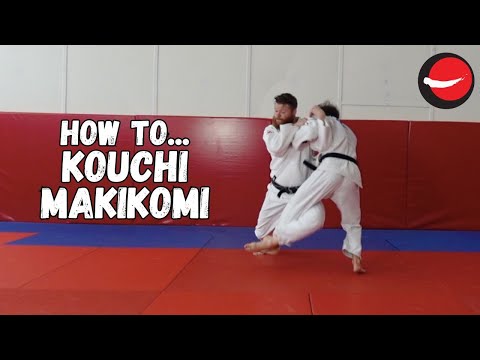
How To Kouchi Makikomi
0
Standard Uchi Makikomi·The Judo Way of Life·Added by Admin
Based on the style of Judo I have developed, mainly due to being right handed but left footed, a lot of my throws come f…
Перевод: inner wraparound
Standard Uchi Makikomi is the textbook inner winding throw in which tori threads their arm under uke's armpit, secures a tight grip around uke's torso, and drops into a lateral roll that carries uke to the mat pinned against tori's body. [1],[2] The inner wrapping position makes this throw difficult to counter once tori has committed to the roll. [2],[3]
Uchi makikomi (inner winding throw) is effective as a sacrifice variation of uchi mata, adding the thrower's body weight to the sweeping action for increased power. [1]
Uchi makikomi is classified in the Kodokan system as a yoko-sutemi-waza technique. [1]
The standard uchi makikomi is a regular technique in IJF competition. [1]
Изображений для этой техники пока нет.
Войдите, чтобы предложить изображение.
Based on the style of Judo I have developed, mainly due to being right handed but left footed, a lot of my throws come f…
Учебных курсов по этой технике пока нет.
Войдите, чтобы предложить курс.
Риск травмы для человека, к которому применяется техника
Rolling sacrifice adds rotational momentum; uncontrolled landing risk
Уровень мастерства, необходимый для надёжного выполнения техники
Разрешена ли техника по основным соревновательным правилам
Kodokan Judo — Official Nage-waza Classification
Traditional Judo throwing technique terminology (Kodokan Institute)
Official Kodokan ground technique classification system
Standard Japanese martial arts terminology (kanji/hiragana)
Established Japanese martial arts naming convention — native Japanese term (和語/漢語)
Traditional Judo throwing technique terminology (Kodokan Institute)
commitment, timing, body weight manipulation, falling skill
heavier build (body weight drives the throw), good ukemi
core rotators, hip flexors, abdominals
You don't want to turn too much—just give enough rotation to get a reaction from your opponent before bringing your arm underneath to lock the position. The Judo Way of Life emphasizes that this controlled turn is key to setting up the throw effectively.
Bring your arm underneath and squeeze your opponent's arm tightly between your bicep and forearm, locking it in firmly. The Judo Way of Life stresses the importance of this compression to maintain control throughout the technique.
Your toes should stay grounded and dig into the mat as you drive forward, like a sprinter setting off on a starting block. The Judo Way of Life warns that if your foot is turned the wrong way, you won't have the power to push your opponent down and risk getting countered.
If you attack without fully loading your leg and generating power from your weight, you'll get turned and countered. The Judo Way of Life emphasizes that loading up the leg is essential for a successful attack.
Standard Uchi Makikomi is the textbook inner winding throw in which tori threads their arm under uke's armpit, secures a tight grip around uke's torso, and drops into a lateral roll that carries uke to the mat pinned against tori's body. The inner wrapping position makes this throw difficult to counter once tori has committed to the roll.
The standard uchi makikomi follows the traditional Kodokan makikomi pattern and has been used extensively in competitive judo since its formal recognition as a distinct throwing technique.
IJF: разрешён — Legal throwing technique; IBJJF: разрешён — Legal at all belt levels; UWW: разрешён — Legal in both freestyle and Greco-Roman; Unified MMA: разрешён — Legal throwing technique; ADCC: разрешён — Legal; FIAS Sport Sambo: разрешён — Legal; FIAS Combat Sambo: разрешён — Legal
Оценка опасности 6/10. High — rolling sacrifice adds rotational momentum; uncontrolled landing risk
Стандартная цепочка подготовки: Grip Setup (Kumi-kata) → Off-Balance (Kuzushi) → Entry (Tsukuri) → Execution (Kake).
Стандартные контрприёмы: Lower Centre of Gravity — bend knees and drop hips to make the throw harder to execute / Grip Break — deny the thrower their preferred gripping configuration / Stiff-Arm — maintain distance with straight arms to prevent the entry.
Распространённые варианты: Rear sacrifice (falling backward while pulling the opponent over); Side sacrifice (falling to the side to project the opponent laterally); Rolling sacrifice (combining a roll with the sacrifice throw for rotation); Counter sacrifice (using the opponent's forward pressure as the driving force).
The standard uchi makikomi is a regular technique in IJF competition.
Основные ошибки, на которые стоит обратить внимание: Not establishing proper inside position first — the underhook is fundamental / Rolling without committing — half-rolls leave you in a bad position with no throw / Wrapping too loosely so uke separates during the roll / Not pulling the sleeve hand across — the cross-pull is what rotates uke into the throw.
Standard Uchi Makikomi также известен как Uchi Makikomi, Classical Inner Winding Throw, Standard Inside Wrap-Around.