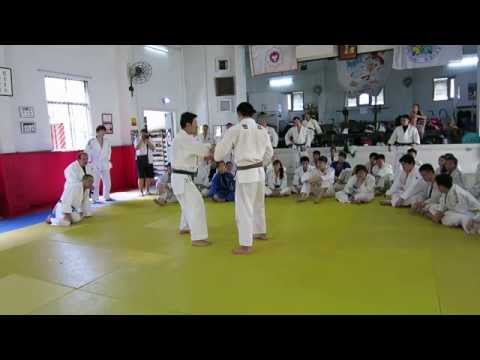
Judo Legend Jeon Ki Young: Seoi-otoshi Variation (HD)
0
Seoi Otoshi·Singapore Judo Club·Added by Admin
25th Aug 2013 @ Singapore Judo Club https://www.facebook.com/singaporejudoclub The Singapore Judo Club is proud to have…
Перевод: shoulder drop
Seoi Otoshi (back-carrying drop) is a variant of seoi-nage in which the thrower drops to both knees or a deep squat during the turn-in, using the dropping body weight to pull the opponent forward and over the lowered shoulder. [1] The 'otoshi' (drop) element creates a dramatic level change that loads the opponent heavily onto the thrower's back, and the falling action adds downward force that amplifies the arm pull. [1],[2] Seoi-otoshi is often used against taller opponents or when the thrower cannot achieve sufficient rotation for a standing seoi-nage, as the drop allows a lower, deeper entry beneath the opponent's centre of gravity. [2],[3]
Seoi otoshi was classified in the Kodokan system as a te-waza technique distinct from the standing seoi-nage variants, recognising the different mechanics introduced by the dropping action. [1] The dropping seoi has become increasingly popular in modern competition, where many judoka use the drop entry as their primary seoi-nage attack. [2],[3]
Seoi otoshi (shoulder drop) is effective because the thrower drops to both knees during the entry, lowering the centre of gravity dramatically and creating a fulcrum below the opponent's hip line that is very difficult to resist. [1] The dropping action makes it accessible to fighters who lack the flexibility for a standing seoi nage entry. [2]
Seoi otoshi is classified in the Kodokan system as a distinct technique from seoi nage, differentiated by the dropping (otoshi) entry where the thrower's knees contact the mat. [1]
Seoi otoshi (often called 'drop seoi nage' in competition context) is one of the most frequently scored techniques at World Championships and Olympics in the lighter weight categories. [1]
Изображений для этой техники пока нет.
Войдите, чтобы предложить изображение.
25th Aug 2013 @ Singapore Judo Club https://www.facebook.com/singaporejudoclub The Singapore Judo Club is proud to have…
Учебных курсов по этой технике пока нет.
Войдите, чтобы предложить курс.
Риск травмы для человека, к которому применяется техника
Seoi-Nage family; high amplitude with rotation over tori's shoulder (Kano 1986)
Уровень мастерства, необходимый для надёжного выполнения техники
Разрешена ли техника по основным соревновательным правилам
Kodokan Judo — Official Nage-waza Classification
Traditional Judo throwing technique terminology (Kodokan Institute)
Official Kodokan ground technique classification system
Standard Japanese martial arts terminology (kanji/hiragana)
Established Japanese martial arts naming convention — native Japanese term (和語/漢語)
Traditional Judo throwing technique terminology (Kodokan Institute)
explosive turning speed, arm pulling power, deep level change
shorter stature for getting under the opponent, strong back
deltoids, trapezius, quadriceps, core
Seoi Otoshi (back-carrying drop) is a variant of seoi-nage in which the thrower drops to both knees or a deep squat during the turn-in, using the dropping body weight to pull the opponent forward and over the lowered shoulder. The 'otoshi' (drop) element creates a dramatic level change that loads the opponent heavily onto the thrower's back, and the falling action adds downward force that amplifies the arm pull.
Seoi otoshi was classified in the Kodokan system as a te-waza technique distinct from the standing seoi-nage variants, recognising the different mechanics introduced by the dropping action. The dropping seoi has become increasingly popular in modern competition, where many judoka use the drop entry as their primary seoi-nage attack.
IJF: разрешён — Legal throwing technique; IBJJF: разрешён — Legal at all belt levels; UWW: разрешён — Legal in both freestyle and Greco-Roman; Unified MMA: разрешён — Legal throwing technique; ADCC: разрешён — Legal; FIAS Sport Sambo: разрешён — Legal; FIAS Combat Sambo: разрешён — Legal
Оценка опасности 6/10. High — Seoi-Nage family; high amplitude with rotation over tori's shoulder (Kano 1986)
Стандартная цепочка подготовки: Grip Setup (Kumi-kata) → Off-Balance (Kuzushi) → Entry (Tsukuri) → Execution (Kake).
Стандартные контрприёмы: Lower Centre of Gravity — bend knees and drop hips to make the throw harder to execute / Grip Break — deny the thrower their preferred gripping configuration / Stiff-Arm — maintain distance with straight arms to prevent the entry.
Распространённые варианты: Morote seoi nage (two-handed shoulder throw with both hands gripping); Ippon seoi nage (one-arm shoulder throw loading the arm over the shoulder); Drop seoi nage (dropping to the knees for a lower entry point); Korean-style shoulder throw (modified entry with deeper level change).
Seoi otoshi (often called 'drop seoi nage' in competition context) is one of the most frequently scored techniques at World Championships and Olympics in the lighter weight categories.
Основные ошибки, на которые стоит обратить внимание: Dropping to the knees without first pulling the opponent forward — the kuzushi must precede the drop / Landing on the knees too hard, which causes knee injuries over time — use knee pads in training / Not maintaining the upper body pull during the drop — the hands must drive the opponent over as you go down / Dropping too far from the opponent — your back must still contact their chest when you land on your knees.
Seoi Otoshi также известен как Shoulder Drop, Back Carry Drop, Seoi Otoshi, Shoulder Wheel Drop.