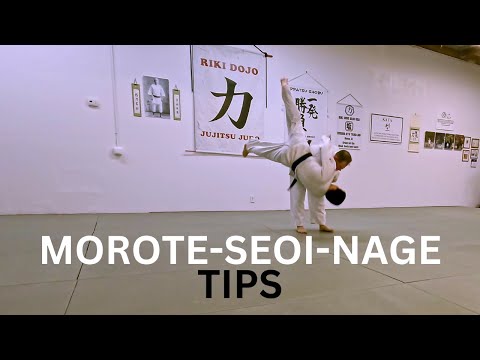
Morote-Seoi-Nage Tips | Riki Judo Dojo
0
Morote Seoi Nage·Riki Judo Dojo·Added by Admin
Riki sensei explained morote-seoi-nage (背負投 - two handed shoulder throw) during judo class on 12-29-2022. 0:00 definiti…
Перевод: two-hand shoulder throw
Morote Seoi Nage (two-handed back-carrying throw) is a seoi-nage variant in which the thrower maintains both lapel grips throughout the throw, turning in and loading the opponent across the upper back while pulling with both hands on the lapels or collar. [1] The 'morote' (two-handed) designation distinguishes this from ippon seoi-nage — both hands remain on the gi rather than one arm reaching under the opponent's arm. [1],[2] The two-handed grip provides strong control of the opponent's upper body throughout the throw, though it requires the thrower to generate lifting force through hip and leg drive rather than the arm-trapping mechanism of ippon seoi-nage. [2],[3]
Morote seoi nage has been recognised as a distinct variant of seoi-nage in the Kodokan classification, valued for its strong grip control and applicability to a wide range of body types. [1] The technique is popular among judoka who prefer to maintain their standard grip configuration throughout the throw rather than switching to the underhook position of ippon seoi-nage. [2],[3]
Morote seoi nage provides a more powerful grip configuration than ippon seoi nage because both hands maintain their standard judo grips (lapel and sleeve), giving the thrower greater pulling force during the throw. [1] Daigo notes that the two-handed version sacrifices some arm control in exchange for superior kuzushi power, making it effective against heavier opponents. [2]
Morote seoi nage is commonly scored across all weight categories at IJF events, particularly in the middle and heavier weight divisions where the stronger grip provides advantages over the single-arm variant. [1]
Изображений для этой техники пока нет.
Войдите, чтобы предложить изображение.
Riki sensei explained morote-seoi-nage (背負投 - two handed shoulder throw) during judo class on 12-29-2022. 0:00 definiti…
Учебных курсов по этой технике пока нет.
Войдите, чтобы предложить курс.
Риск травмы для человека, к которому применяется техника
Seoi-Nage family; high amplitude with rotation over tori's shoulder (Kano 1986)
Уровень мастерства, необходимый для надёжного выполнения техники
Разрешена ли техника по основным соревновательным правилам
Kodokan Judo — Official Nage-waza Classification
Traditional Judo throwing technique terminology (Kodokan Institute)
Official Kodokan ground technique classification system
Standard Japanese martial arts terminology (kanji/hiragana)
Established Japanese martial arts naming convention — native Japanese term (和語/漢語)
Traditional Judo throwing technique terminology (Kodokan Institute)
hip rotation speed, core strength, lower back stability
strong hips and core, good flexibility for turning entry
hip rotators, core, quadriceps, latissimus dorsi
Morote seoi nage (two-arm shoulder throw) is the most popular competition variant of seoi-nage — both hands grip the gi for maximum control during the throw. Kosei Inoue won Olympic gold in 2000 using morote seoi nage as his primary attack. (Kano, Kodokan Judo; IJF records)
Your hand should turn so you're holding the collar like an old-style telephone—this grip creates the proper kuzushi (off-balance) needed for the throw.
No—avoid trying to lift or force anything. Instead, float in lightly and bump your opponent out using proper positioning rather than muscular effort.
Morote Seoi Nage (two-handed back-carrying throw) is a seoi-nage variant in which the thrower maintains both lapel grips throughout the throw, turning in and loading the opponent across the upper back while pulling with both hands on the lapels or collar. The 'morote' (two-handed) designation distinguishes this from ippon seoi-nage — both hands remain on the gi rather than one arm reaching under the opponent's arm.
Morote seoi nage has been recognised as a distinct variant of seoi-nage in the Kodokan classification, valued for its strong grip control and applicability to a wide range of body types. The technique is popular among judoka who prefer to maintain their standard grip configuration throughout the throw rather than switching to the underhook position of ippon seoi-nage.
IJF: запрещён — Banned since 2010 leg grab prohibition — direct hansoku-make; IBJJF: разрешён — Legal at all belt levels; UWW: разрешён — Legal in both freestyle and Greco-Roman; Unified MMA: разрешён — Legal throwing technique; ADCC: разрешён — Legal; FIAS Sport Sambo: разрешён — Legal; FIAS Combat Sambo: разрешён — Legal
Оценка опасности 6/10. High — Seoi-Nage family; high amplitude with rotation over tori's shoulder (Kano 1986)
Стандартная цепочка подготовки: Grip Setup (Kumi-kata) → Off-Balance (Kuzushi) → Entry (Tsukuri) → Execution (Kake).
Стандартные контрприёмы: Lower Centre of Gravity — bend knees and drop hips to make the throw harder to execute / Block the Hip — post hand on the thrower's hip to prevent loading / Step Around — circle away from the throw direction to avoid being loaded / Grip Break — deny the thrower their preferred gripping configuration.
Распространённые варианты: Standard hip throw (full turn-in with hip below the opponent's centre of gravity); No-gi hip throw (adapted without gi grips, using overhook and collar tie); Drop hip throw (dropping to one knee to lower the fulcrum point); Combination hip throw (chaining from a failed foot technique or hand technique).
Morote seoi nage is commonly scored across all weight categories at IJF events, particularly in the middle and heavier weight divisions where the stronger grip provides advantages over the single-arm variant.
Основные ошибки, на которые стоит обратить внимание: Releasing one of the grips during the turn — the whole point of morote is maintaining both grips / Not turning the lapel grip hand inward to drive under the armpit / Entry too high — the hip drop is equally important in the morote version / Not pulling forward with the sleeve hand (hikite) — the pull drives the rotation.
Morote Seoi Nage также известен как Two-Handed Shoulder Throw, Double-Grip Back Carry, Morote Seoi Nage, Two-Arm Shoulder Throw.